
Pine bark beetle
Ips suturalis
Description
How to identify
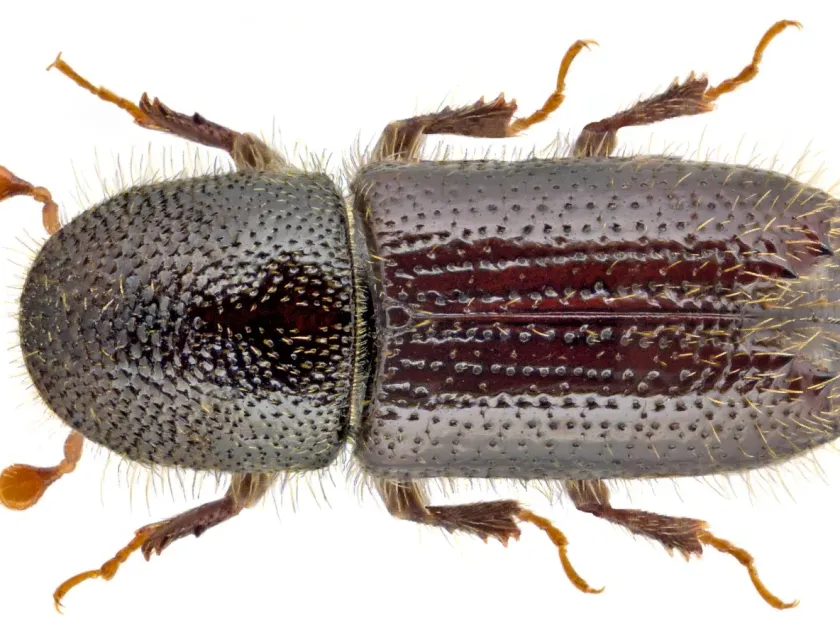
The pine bark beetle, Ips suturalis, is a small wood-boring insect belonging to the Curculionidae family. Adults typically reach a length of 2.5–3.5 mm and possess a cylindrical, dark brown body.
A distinctive feature of this species is the declivity on the elytra (wing covers), which has a specific pattern of teeth used for pushing out frass (boredust) from their tunnels during development.
Larvae are white, legless, and soft-bodied. They dwell exclusively beneath the bark of host trees, feeding on the nutrient-rich phloem and cambium layers throughout their development.
Identification is often performed by inspecting the gallery patterns left under the bark. Each bark beetle species creates a unique etching style that helps foresters verify the insect species.
Professional entomologists use pheromone traps to identify the presence of these beetles within a forest stand before the infestation becomes widespread and visible to the naked eye.
What it damages
The primary host for Ips suturalis is the Scots pine (Pinus sylvestris). They tend to select parts of the tree with thinner bark, making them particularly dangerous for younger trees or the upper canopy of mature stands.
Feeding damage prevents the circulation of nutrients and water throughout the tree's conductive tissues, essentially strangling the tree from within and leading to rapid wilting.
These beetles act as vectors for blue-stain fungi. The spores enter the tree through beetle entry points, colonizing the wood and causing significant structural and aesthetic damage to the timber.
The cumulative damage often results in the death of large forest sections. When trees are stressed by drought or fire, they become more susceptible to rapid mass attacks by this beetle species.
The economic impact of these infestations is severe, as killed trees lose their commercial value for lumber, and the dead wood increases the risk of forest fires.
When it appears
Adult beetles emerge in early spring, typically when daytime temperatures reach approximately 12–15 degrees Celsius. This marks the beginning of the initial flight phase.
After mating, females excavate egg galleries, laying eggs along the sides. The complete life cycle from egg to mature adult lasts between 40 to 60 days, depending on climatic conditions.
In warm, dry seasons, Ips suturalis can produce multiple generations per year, significantly accelerating the rate of forest damage and population growth within a single season.
As winter approaches, mature adults seek refuge within the bark of host trees or in the leaf litter at the base of the tree to survive the freezing temperatures.
Seasonal surveillance is essential for effective pest management, as intervention must occur during the flight and colonization phases to protect healthy trees from infestation.
Signs of infestation
Visible frass, resembling fine sawdust, on the bark surface or collected in bark crevices is often the first indicator that a tree has been successfully colonized.
Resin flow, known as pitch tubes, may be visible near the entrance holes as the tree attempts to push the invading beetles out using its natural resin production.
The foliage color changes from healthy green to yellow and finally reddish-brown as the tree loses its connection to its water source and begins to die.
Loose, peeling bark is a clear indicator of an advanced infestation. Under the bark, one can observe the intricate network of larval galleries that have destroyed the phloem.
Woodpecker activity is a classic secondary sign. The presence of these birds, which feed on bark beetle larvae, can alert foresters to the presence of pests on a specific tree.
Control measures
Sanitary logging is the most effective control method. Removing infested trees before the new generation of beetles emerges prevents the pest from spreading to neighboring healthy trees.
Trap trees are often used to manage populations. Freshly cut logs are placed strategically in the forest to attract beetles; once infested, these logs are debarked or destroyed.
Chemical treatments are generally restricted to urban or high-value forest areas due to environmental impact and high costs, usually involving trunk sprays with contact insecticides.
Biological control, encouraging natural predators like checkered beetles and parasitic wasps, can help keep bark beetle populations at equilibrium levels within stable forest ecosystems.
Silvicultural practices that promote tree vigor, such as thinning overcrowded stands and preventing physical damage during forest operations, are crucial for long-term pest resistance.
Taxonomy
- Latin name
- Ips suturalis
- Order
- Coleoptera (beetles)
- Family
- Curculionidae
- EPPO code
- IPSXSU
Discussion
No discussions yet — be the first.