
Six-toothed bark beetle
Ips sexdentatus
Description
How to identify
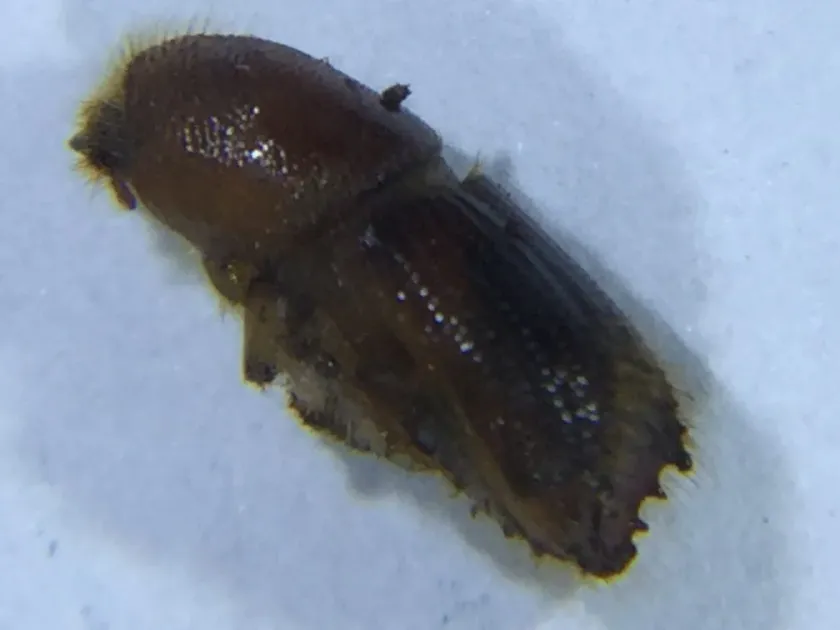
The six-toothed bark beetle (Ips sexdentatus) is a member of the Curculionidae family, subfamily Scolytinae. It is one of the largest bark beetle species, with adults measuring between 6 and 8 mm in length.
The beetle is characterized by its elongated, dark brown to black body. The most distinctive feature is the depression on the elytra, which features six prominent teeth on each side, serving as a reliable diagnostic trait for identification.
The larvae are legless, white grubs with a well-developed head capsule. They live beneath the bark, feeding on the inner bark layers and cambium, creating intricate galleries that can eventually girdle the tree.
The lifecycle is highly temperature-dependent, with developmental speed increasing significantly during warm, dry summers. Beetles communicate through pheromones, which allows for coordinated mass attacks on host trees.
Despite being primarily a secondary pest, it poses a major threat to coniferous forests worldwide, especially when the trees are already stressed by drought, windthrow, or pollution.
What it damages
The preferred host for the six-toothed bark beetle is pine (Pinus species). In some cases, it can also infest spruce, fir, and larch trees when populations are high or preferred hosts are scarce.
The beetles typically target the lower and middle trunk sections of trees with thick bark. By feeding on the cambium, they disrupt the flow of nutrients and water, which eventually leads to the death of the host tree.
Infestations result in significant timber degradation, reducing the economic value of the wood. Furthermore, mass outbreaks can transform vast forest areas into dry wood, significantly increasing the risk of forest fires.
The beetle acts as a vector for various wood-decay fungi, which further weaken the tree's defense systems and accelerate the decline of the host.
Large-scale outbreaks can cause rapid canopy dieback, altering the structure of the forest ecosystem and affecting biodiversity in the long term.
When it appears
The flight period typically begins in early spring, once temperatures consistently reach +12°C or higher. Overwintering adults emerge from their hibernation sites to search for suitable host trees.
Depending on local climate conditions, the species can produce one to three generations per year. The duration of the life cycle is significantly affected by the thermal sum of the region.
Peak activity generally occurs in June and July. During these months, beetles are highly active, searching for mates and establishing new gallery systems under the bark.
Overwintering occurs primarily in the adult stage, either in the bark of the trees where they developed or in the forest litter near the base of the tree.
The beetle's ability to remain dormant during harsh winter months ensures the survival of the population, leading to rapid recovery once favorable conditions return.
Signs of infestation
One of the most visible indicators of infestation is the presence of reddish-brown boring dust (frass) accumulating in bark crevices or at the base of the trunk.
Small circular entrance holes are visible on the bark surface. In healthy trees, the appearance of resin drops around these holes indicates a defensive response aimed at pushing the invader out.
As the infestation progresses, the tree's foliage begins to change color, shifting from healthy green to yellow, and eventually to a characteristic reddish-brown, marking the terminal stage of decline.
Beneath the bark, one can find complex gallery patterns, consisting of a central maternal tunnel and lateral larval galleries that radiate outwards.
Increased woodpecker activity on a specific tree is often a sign that a beetle outbreak is occurring, as the birds strip away pieces of bark to feed on the larvae and pupae.
Control measures
Sanitation felling is the primary control method. Affected trees must be removed and the wood processed or debarked before the next generation of beetles emerges and spreads to healthy trees.
Trap trees (freshly felled logs) can be utilized to concentrate beetle populations, which are then destroyed, preventing further spread into the surrounding forest stands.
Pheromone traps are extensively used for monitoring population levels and timing control operations effectively, ensuring that management efforts are proactive rather than reactive.
Maintaining forest health through proper silvicultural practices, such as thinning and promoting mixed-species stands, reduces the susceptibility of the forest to beetle attacks.
- Regular forest monitoring and inspection.
- Timely removal of storm-damaged or stressed trees.
- Proper disposal of slash and wood residues after harvesting.
- Encouraging natural predators and parasitoids.
Taxonomy
- Latin name
- Ips sexdentatus
- Order
- Coleoptera (beetles)
- Family
- Curculionidae
- EPPO code
- IPSXSE
Discussion
No discussions yet — be the first.