
California five-spined engraver
Ips plastographus
Description
How to identify
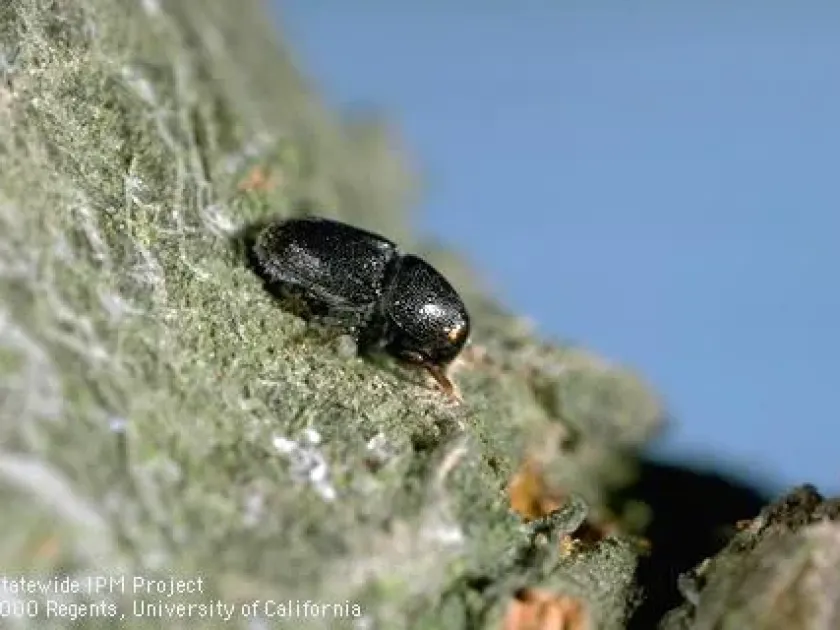
The California five-spined engraver (Ips plastographus) belongs to the order Coleoptera and the family Curculionidae (subfamily Scolytinae). Adults are small, cylindrical beetles typically measuring 4 to 5 millimeters in length.
The coloration ranges from dark brown to black, providing excellent camouflage against the bark of coniferous trees. A key diagnostic feature is the specific arrangement of spines on the declivity of the elytra, which aids the beetle in clearing boring dust from its galleries.
The larvae are legless, white-colored, with a yellowish head and a characteristic curved body shape. They develop directly beneath the bark, feeding on the cambium layer, which makes this developmental stage hidden from casual observation.
The pupae are pale cream in color and resemble the adult form but with softer cuticles. Pupation occurs within specialized chambers or niches that the larvae excavate at the end of their gallery systems before transforming into mature beetles.
Adult males and females show distinct differences in the structure of the frons and the number of spines on the elytral declivity, which serves as a crucial taxonomic marker for field experts and laboratory identification.
What it damages
The primary hosts for this species are various conifer species, particularly pine. In natural environments, the pest prefers weakened trees, but during mass outbreaks, it is capable of attacking and successfully colonizing relatively healthy trees.
Damage is caused by both adult beetles and their larvae, which bore intricate gallery systems under the bark. This action severs the conductive tissues responsible for transporting nutrients and water, ultimately causing the rapid death of the tree.
Mass infestation of a tree by these bark beetles often results in total mortality within one or two seasons if management actions are not taken promptly to contain the outbreak.
The damage is further compounded by the fact that bark beetles often act as vectors for fungal pathogens, which invade the tree's vascular system and accelerate its decline beyond the structural damage caused by the beetles themselves.
In forestry, this species is considered a significant threat capable of causing the decline and death of large coniferous tracts, especially under drought conditions or following disturbances like windthrow or fire.
When it appears
The activity period of the California five-spined engraver is highly dependent on regional climatic conditions and ambient temperature. Usually, the emergence of overwintering beetles begins in the spring when bark temperatures reach optimal levels.
During the summer, multiple generations can develop if the climate is sufficiently warm and the season is long enough. The development of a single generation can take from several weeks to several months depending on weather patterns.
Peak activity occurs in mid-summer, when massive dispersal of beetles to new host trees is observed. This period is the most effective window for using pheromone traps to monitor and manage population levels.
As autumn approaches and temperatures decrease, the insects enter a state of diapause. Overwintering typically occurs within the inner bark or in the forest litter at the base of host trees.
Spring awakening is regulated not only by temperature but also by day length, ensuring a synchronized emergence of the population to seek new feeding sites once the harsh winter conditions have subsided.
Signs of infestation
The first obvious sign of beetle presence is the appearance of boring dust — fine sawdust that the beetles eject while constructing their galleries. This dust typically accumulates in bark crevices or at the base of the tree.
Resin droplets may appear on the trunk as a defensive response from the conifer. However, during mass attacks, the tree is often unable to "pitch out" the beetles, and the infestation proceeds successfully.
Visual inspection of the canopy may reveal yellowing or browning needles. This indicates that the tree is severely compromised and that the interruption of nutrient flow has led to tissue death.
Bark sloughing is a late-stage sign, indicating that an extensive network of galleries has already formed underneath. Removing a section of bark will reveal the characteristic maternal and larval gallery patterns.
- Entrance holes in the bark, approximately 2 mm in diameter.
- Increased bird activity (woodpeckers) stripping bark in search of larvae.
- Progressive needle drop and canopy thinning on the affected sections.
Control measures
The key management strategy is the sanitation harvesting of infested trees before the next generation of beetles emerges. Removing infested wood from the area is essential for drastically reducing the population density.
The use of pheromone traps allows for the monitoring of beetle populations and serves as a tool to attract adults to specific locations for containment and destruction. This method is highly selective and does not harm beneficial insects.
Chemical control involves spraying tree trunks with systemic or contact insecticides. However, this method is effective only during the early stages of infestation and is often impractical for use in large forest landscapes.
Silvicultural measures include maintaining forest health, promptly clearing downed logs and slash, which serve as ideal breeding grounds for beetle accumulation.
The application of biological control agents, such as entomopathogenic fungi, is currently under research, showing promising results for inclusion in integrated forest protection systems.
Taxonomy
- Latin name
- Ips plastographus
- Order
- Coleoptera (beetles)
- Family
- Curculionidae
- EPPO code
- IPSXPL
Discussion
No discussions yet — be the first.