
Northern spruce engraver
Ips perturbatus
Description
How to identify
The Northern spruce engraver (Ips perturbatus) is a member of the Curculionidae family, specifically the Scolytinae subfamily. These beetles are small, cylindrical insects, typically measuring 4 to 5.5 mm in length, and vary in color from reddish-brown to almost black.
The most distinct feature of this species is the declivity at the end of the elytra, which is concave and equipped with four pairs of teeth. The third pair of teeth is significantly enlarged, possessing a characteristic club-like shape that helps experts distinguish it from other engraver beetles.
Larvae of the Northern spruce engraver are legless, white to cream-colored, with a curved, wrinkled body and a dark brown head capsule. They spend their entire development phase beneath the bark of the host tree.
Pupae generally resemble the adults but are lighter in color and have softer cuticles. They are found at the end of the larval galleries in specially constructed pupal chambers.
The adults are strong fliers and exhibit mass aggregation behavior. They release pheromones that attract other members of the same species to mass-attack a host tree, overcoming its defensive mechanisms.
What it damages
The primary hosts of this beetle are spruce trees, though it also infests larch, pine, and fir. It thrives in boreal forests, targeting trees that are stressed, diseased, or fallen due to storm damage.
The beetles bore through the outer bark to reach the phloem and cambium layers. By excavating complex galleries, they disrupt the vascular system of the tree, effectively cutting off the supply of water and nutrients to the crown.
During outbreaks, this pest can successfully attack healthy trees. The sheer number of beetles invading a single tree depletes its ability to produce resin, eventually leading to the rapid decline and death of the tree.
The damage caused by the Northern spruce engraver makes timber susceptible to blue-stain fungi and other secondary wood-boring insects, which significantly reduces the economic value of the forest stand.
Beyond individual tree mortality, infestations create large gaps in the forest canopy, altering the local environment and increasing the risk of secondary wildfires due to dry wood accumulation.
When it appears
The life cycle is dictated by the thermal regime of the boreal environment. Spring emergence usually occurs when temperatures consistently exceed 10-12 degrees Celsius, typically around late May or June.
Once mated, females initiate gallery construction. The larval development phase usually lasts for several weeks, depending on the ambient temperature. In typical years, the species completes one generation per season.
In regions experiencing unusually warm and long summers, the beetle may complete a second, partial generation, which leads to a dramatic spike in the local population for the following year.
Overwintering occurs at the adult stage. The beetles retreat into the bark of previously infested trees or move down to the litter layer near the base of the trunk for insulation against extreme cold.
Diapause is essential for their survival during the harsh winter months. Activity resumes in the spring once the bark temperature increases sufficiently to trigger the beetle's metabolic processes.
Signs of infestation
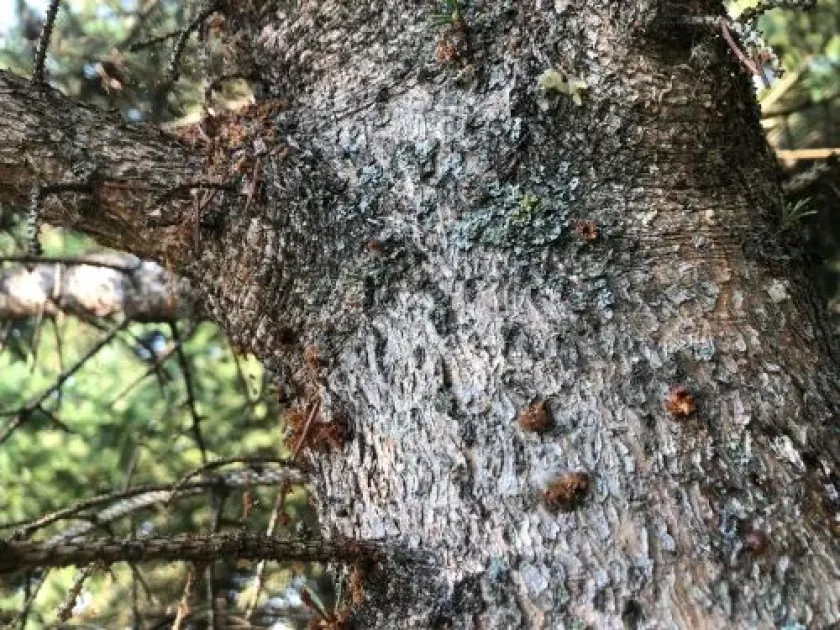
The presence of Ips perturbatus is often first revealed by the appearance of "frass" — fine wood dust ejected by the beetles during gallery construction. This dust often collects in bark crevices or near the base of the tree.
A change in foliage color is a classic late-stage sign of infestation. The needles start to fade from dark green to light green, eventually turning yellow and finally reddish-brown as the tree dies.
Close inspection of the trunk reveals numerous small, round entry holes. In some cases, resin flow (pitch tubes) may be visible around these holes as the tree makes a desperate attempt to push the beetles out.
The bark may start to loosen or slough off in patches, exposing the intricate maternal and larval galleries underneath. This often attracts woodpeckers, whose foraging activity leaves characteristic scarring on the bark.
- Accumulation of fine wood dust (frass).
- Gradual yellowing and browning of needles.
- Visible circular entry holes on the trunk.
- Increased woodpecker damage on bark surfaces.
Control measures
Management of the Northern spruce engraver relies heavily on integrated forest health practices. Regular surveys and aerial monitoring are critical for the early detection of infestation hotspots.
Sanitation harvesting is the most effective control measure. Infested trees should be removed and disposed of through burning, chipping, or debarking before the new generation of adults completes development and emerges.
Pheromone traps are widely used to monitor flight activity and population density. While they can help manage small populations, their effectiveness is limited in the face of large-scale outbreaks.
Maintaining healthy forest stands through proper thinning and removal of logging debris is essential. Clean forestry practices prevent the buildup of materials that attract the beetles.
Biological control, such as protecting woodpecker populations and promoting the presence of natural predatory insects like clerid beetles, provides a level of population regulation within a balanced ecosystem.
Taxonomy
- Latin name
- Ips perturbatus
- Order
- Coleoptera (beetles)
- Family
- Curculionidae
- EPPO code
- IPSXPE
Discussion
No discussions yet — be the first.