
California five-spined ips
Ips paraconfusus
Description
How to identify
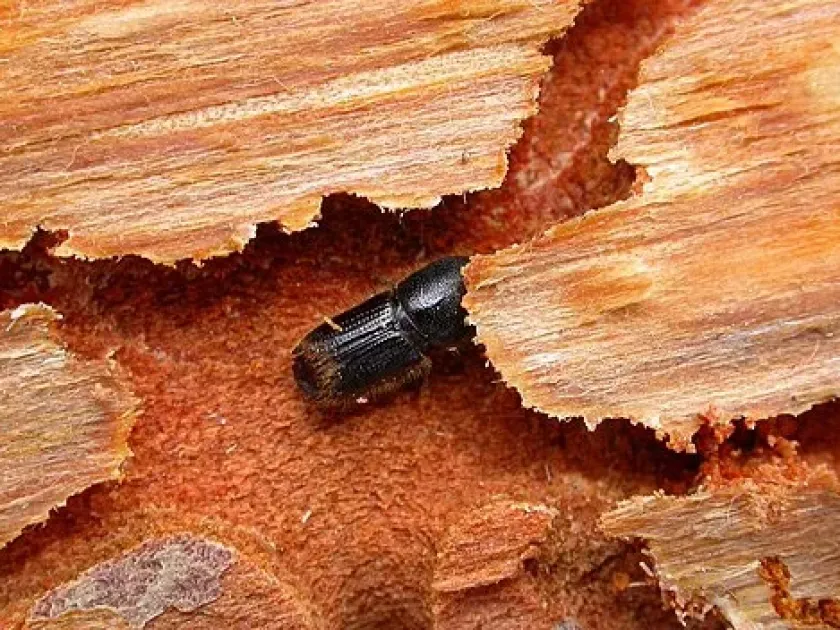
The Ips paraconfusus, or California five-spined ips, is a small bark beetle with a cylindrical body, typically measuring 3.5 to 5 mm in length.
Its diagnostic feature is the presence of five distinct spines located on the declivity of each elytron, used to clear frass from beetle galleries.
Adults are dark brown or black in color, blending well with the bark textures where they reside and reproduce.
Larvae are legless, white, and C-shaped, living strictly beneath the bark, feeding on the phloem of host trees.
The species relies on complex pheromone signaling to communicate and mass-attack host trees, which often leads to the death of the tree.
What it damages
This beetle primarily targets pine species throughout Western North America, representing a significant challenge for forest management.
While preferring stressed, lightning-struck, or wind-thrown trees, the beetle can kill healthy trees when population densities are high.
Damage is caused by the construction of egg galleries under the bark, which effectively girdles the tree and stops the transport of water and nutrients.
Blue-stain fungi are introduced into the tree by the beetles, further weakening the vascular system and accelerating the decay process.
Infested stands show rapid needle discolouration, shifting from green to yellow, and eventually to a reddish-brown as the tree dies.
When it appears
Beetle activity typically begins in early spring, as temperatures rise, signaling the emergence of adults searching for suitable host trees.
Depending on the climate, the insect can complete multiple generations per year, with activity peaking during the hot summer months.
Severe drought conditions often trigger increased beetle attacks, as the lack of moisture significantly weakens the natural resistance of pines.
As winter approaches, activity slows down, and beetles seek shelter to overwinter under the bark or in the soil near the host tree.
Successful colonization is highly dependent on temperature, which dictates the rate of larval development and the timing of beetle emergence.
Signs of infestation
Visible entry holes in the outer bark are the most prominent indicator of an active infestation in the forest stand.
Accumulation of red-brown boring dust at the base of the tree or caught in bark crevices is a reliable sign of ongoing beetle tunneling.
Pitch tubes, which are small masses of resin, are frequently observed on the trunk as trees attempt to push the invading beetles out.
Internal examination of the bark reveals a characteristic pattern of a main gallery with numerous side tunnels radiating from it.
Crown fade is a late symptom, indicating that the tree is already severely compromised and unlikely to recover from the infestation.
Control measures
Prompt sanitation cutting of infested trees is the primary method to prevent the spread of the beetle to healthy surrounding trees.
Removed material should be processed or disposed of quickly to break the beetle's life cycle before new adults can emerge.
Pheromone-baited traps are widely used for monitoring population levels and to reduce local beetle numbers in high-risk areas.
Maintaining vigorous forest stands through thinning and thinning-from-below helps improve tree resistance to bark beetle attacks.
- Sanitation harvest of infested trees.
- Monitoring using pheromone traps.
- Promotion of beneficial insect predators.
- Avoidance of logging damage to standing timber.
Taxonomy
- Latin name
- Ips paraconfusus
- Order
- Coleoptera (beetles)
- Family
- Curculionidae
- EPPO code
- IPSXPA
Discussion
No discussions yet — be the first.