
Mountain pine beetle
Ips montanus
Description
How to identify
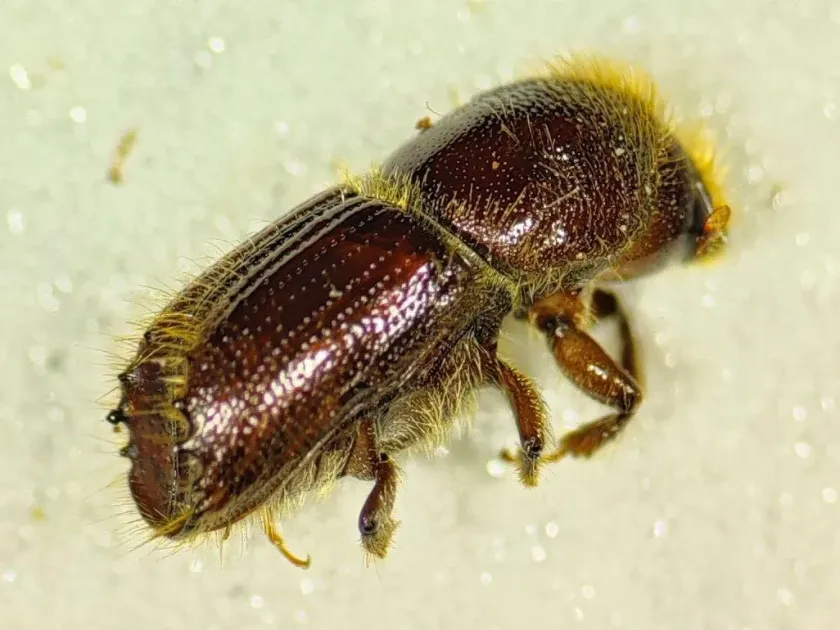
The mountain pine beetle (Ips montanus) is a member of the Curculionidae family, subfamily Scolytinae. These beetles are relatively small, typically measuring between 5 and 7 millimeters in length.
They possess a cylindrical, robust body, ranging in color from dark brown to black. A key identification feature is the presence of spines on the declivity of the elytra, which the beetle uses to push frass out of its galleries.
The larvae are white, legless, and have a distinct dark head capsule. They spend their entire developmental phase beneath the bark, where they feed on the phloem and cambium layers of the host tree.
Pupation occurs in small chambers created by the larvae at the end of their feeding tunnels. The transition from larva to adult is a critical period that determines the beetle's survival rate for the next generation.
Native to high-elevation forests in North America, this species is well-adapted to the harsh environmental conditions characteristic of mountain ecosystems.
What it damages
This beetle primarily targets pine species, although it can occasionally infest spruce or fir. It is a major disturbance agent in coniferous forests, significantly altering their structure.
While the beetle typically colonizes stressed or damaged trees, it can mass-attack and kill healthy trees when population densities reach high levels, overwhelming the tree's natural defenses.
Damage is caused by the disruption of nutrient transport. As adults and larvae tunnel through the inner bark, they effectively girdle the tree, cutting off the flow of water and photosynthates between roots and needles.
The tunnels created by the beetles also introduce blue-stain fungi into the tree, which further accelerates the decline of the host by clogging the water-conducting tissues.
The combined impact of the beetle's feeding and the associated fungal infection leads to rapid crown yellowing, followed by tree death and subsequent economic loss.
When it appears
The lifecycle of Ips montanus is heavily dictated by seasonal temperature patterns. Adult emergence usually begins in late spring or early summer as temperatures rise.
The peak activity period occurs throughout the summer months. Depending on elevation and climate, the species may produce one or more generations per year, leading to potential population surges.
Overwintering typically takes place as an adult inside the bark of infested trees or within the leaf litter at the base of the trunk. They remain in a state of diapause to survive winter temperatures.
Fall serves as the period for late-stage larvae to complete their development and pupate, ensuring that new adults are ready to emerge or survive the winter.
Prolonged hot and dry weather conditions are known to favor the development of the mountain pine beetle, allowing for rapid expansion within forest stands.
Signs of infestation
One of the earliest signs of an infestation is the presence of frass, or boring dust, which resembles sawdust and accumulates in bark crevices or at the base of the tree.
Small, circular entrance holes on the surface of the bark are indicative of beetle colonization. Often, resin flow or "pitch tubes" can be observed, representing the tree's attempt to repel the attackers.
As the tree's vascular system fails due to beetle activity, the crown begins to change color. Initially, the needles turn a light green, eventually progressing to yellow and then reddish-brown.
Peeling away a section of the bark reveals the intricate network of egg and larval galleries, which are diagnostic of a bark beetle infestation.
Severe infestations are marked by significant needle drop and sloughing of the bark, particularly in the later stages when the brood has already emerged from the tree.
Control measures
Sanitation cutting remains the most effective strategy for managing mountain pine beetle outbreaks. Removing and destroying infested trees helps to curb the spread of the beetle to healthy parts of the forest.
Pheromone-based trapping systems are useful for monitoring population trends and identifying emerging hotspots before they grow into major infestations.
Maintaining forest health through proper silvicultural practices is essential for long-term prevention, reducing the availability of suitable hosts for the beetle.
While insecticides may be used on high-value individual trees, they are generally impractical for large-scale forest management due to costs and potential ecological impacts.
- Regular forest surveys to detect early infestations.
- Immediate removal of susceptible and infested material.
- Encouragement of natural predator and parasite populations.
- Appropriate timing of logging operations to avoid beetle attraction.
Taxonomy
- Latin name
- Ips montanus
- Order
- Coleoptera (beetles)
- Family
- Curculionidae
- EPPO code
- IPSXVA
Discussion
No discussions yet — be the first.