
Ips integer
Ips integer
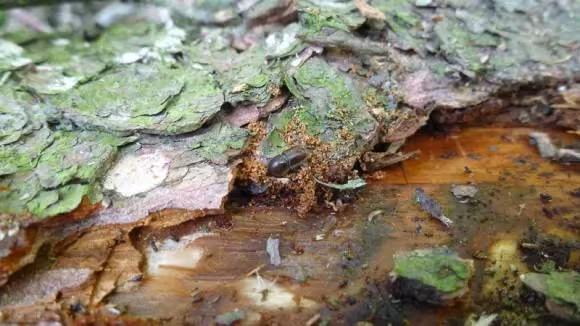
Description
How to identify
Ips integer is a species of bark beetle belonging to the order Coleoptera and the family Curculionidae, specifically the subfamily Scolytinae.
The adult beetle has a cylindrical body measuring 4 to 5 mm in length, with a dark brown or blackish color that provides camouflage on tree bark.
A distinctive morphological feature is the declivity on the elytra, which features sharp teeth used for clearing frass from their tunnels.
Larvae are legless, C-shaped, and creamy white with a brownish head capsule, developing in the cambial layer of host trees.
As part of the genus Ips, these beetles rely on complex pheromone systems to coordinate attacks on suitable host trees.
What it damages
The primary host range for Ips integer includes various species of the genus Pinus, often targeting stressed or weakened individual trees.
During outbreaks, populations can rise sharply, allowing them to overcome the defensive resin response of otherwise healthy coniferous trees.
Feeding damage occurs in the phloem and cambium layers, essentially girdling the tree and cutting off the vital flow of water and nutrients.
In addition to physical damage, these beetles serve as vectors for blue-stain fungi, which colonize the sapwood and degrade timber quality rapidly.
The cumulative effect of beetle infestation results in widespread tree mortality and significant economic losses in forest management programs.
When it appears
The flight period typically begins in early spring, triggered by rising ambient temperatures, often when daily maximums reach 15°C or higher.
The duration of the life cycle varies depending on local climate conditions, allowing for single or multiple generations per year in warmer regions.
Overwintering occurs primarily as adults in sheltered locations, such as the duff layer at the base of the tree or within the thick bark of stems.
Larval development is most intensive during the warm summer months, coinciding with the peak period of tree stress and beetle activity.
As temperatures decline in late autumn, the beetles transition to their overwintering phase, marking the end of the annual reproductive cycle.
Signs of infestation
The presence of fine, reddish-brown boring dust (frass) accumulating in bark crevices or at the tree base is a primary indicator of successful colonization.
Fading of the crown, where needles turn from green to yellow and finally to reddish-brown, indicates that the tree is already heavily compromised.
Visible entry holes, approximately 1-2 mm in diameter, can be observed on the bark surface where the adult beetles have initiated their galleries.
Peeling back the bark reveals a distinct gallery system consisting of a central egg gallery with lateral larval feeding tunnels branching off.
Extensive resin weeping can sometimes occur at the entry points, although this defense mechanism is often exhausted once the beetle population density is high.
Control measures
Sanitation harvesting, which involves the rapid removal and destruction of infested trees, is the most effective management strategy for Ips integer.
The use of trap trees, which are intentionally left or placed to attract beetles, can help consolidate populations for later removal and disposal.
Pheromone-baited traps are highly useful tools for monitoring population dynamics and reducing the number of adults during the flight season.
Promoting forest stand health through proper thinning and removal of logging slash ensures that there are fewer breeding grounds for these beetles.
Chemical control methods, though limited in large-scale forestry, may be implemented in high-value ornamental plantings using registered insecticide treatments.
Taxonomy
- Latin name
- Ips integer
- Order
- Coleoptera (beetles)
- Family
- Curculionidae
- EPPO code
- IPSXIG
Discussion
No discussions yet — be the first.