
Eastern five-spined engraver
Ips grandicollis
Description
How to identify
The Eastern five-spined engraver (Ips grandicollis) is a significant wood-boring beetle belonging to the Curculionidae family, subfamily Scolytinae.
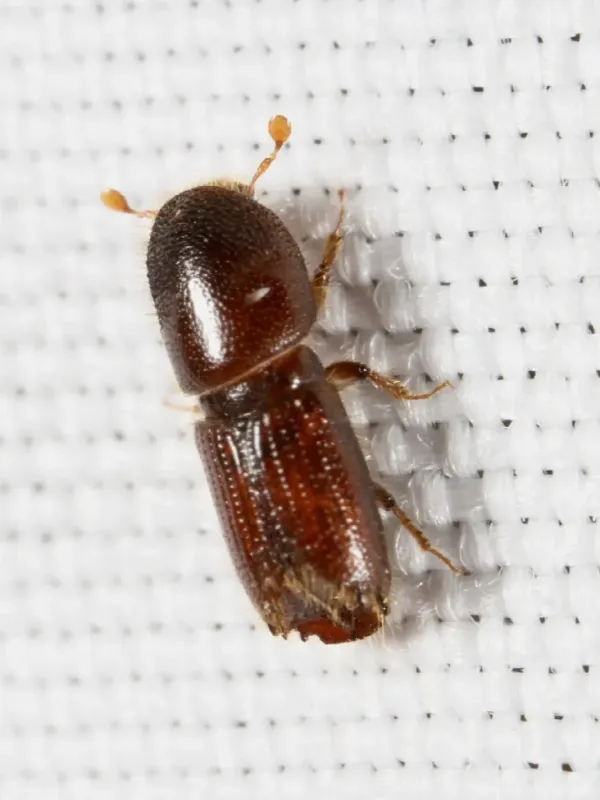
Adult beetles are relatively small, typically ranging from 3.0 to 4.5 mm in length, and are characterized by a dark brown, cylindrical body.
The most distinctive feature of this species is the declivity on the elytra, which features five pairs of teeth along its edges, facilitating identification.
Larvae are white, legless grubs with a brown head capsule, specialized for feeding within the phloem and cambium layers of host trees.
They usually reach maturity in the bark layers, after which they transform into pupae within small, excavated chambers known as pupal cells.
What it damages
This beetle primarily targets various pine species, especially when trees are weakened by drought, disease, or mechanical damage.
The beetles burrow through the outer bark to reach the nutrient-rich phloem, constructing galleries that disrupt the flow of sap throughout the tree.
This disruption causes the tree to slowly dehydrate and eventually die, as the vascular system becomes unable to transport essential water and nutrients.
Beyond the structural damage caused by the larvae, these beetles act as vectors for blue-stain fungi, which further degrade timber quality.
In high population densities, the Eastern five-spined engraver can successfully overwhelm even healthy trees, leading to extensive forest mortality.
When it appears
The adult beetles emerge in the spring once the ambient temperature reaches a threshold suitable for their flight and mating activities.
The species is multivoltine, meaning it can produce several generations per year depending on the length of the growing season in the region.
Peak activity generally occurs during the hottest months, as the beetles are highly attracted to stressed trees that are suffering from heat and moisture deficits.
During the fall, the beetles begin to prepare for winter hibernation, seeking shelter under the bark of infested trees or in the leaf litter near the soil.
Adults are the primary overwintering stage, which ensures their quick reactivation and ability to initiate a new cycle as soon as spring temperatures return.
Signs of infestation
The presence of fine, reddish-brown boring dust (frass) gathered in bark crevices or at the tree base is the most common early indicator of an infestation.
Entrance holes are visible on the tree bark, often surrounded by droplets of resin, indicating the tree's attempt to defend itself against the invaders.
As the infestation progresses, the tree's needles begin to fade from green to yellow, eventually turning brown as the canopy dies back.
Removing a section of the bark reveals a complex network of tunnels, typically featuring a central vertical gallery with numerous lateral larval branches.
Extensive bark sloughing indicates that the tree has been heavily infested for some time and that the beetle population has likely moved to adjacent trees.
Control measures
The most effective strategy for managing Ips grandicollis is the swift identification and removal of infested trees (sanitation logging) before new adults emerge.
Forest management should prioritize the removal of logging slash and freshly cut timber, as these provide ideal breeding grounds for the beetle populations.
Pheromone traps are widely used to monitor beetle activity and population trends, allowing forest managers to implement control measures in time.
Chemical control using systemic or contact insecticides may be applied to high-value individual trees or in ornamental landscapes to prevent infestation.
- Regular forest health monitoring.
- Use of trap trees to attract beetles.
- Maintenance of tree vigor through proper forest density.
- Promotion of natural predators and parasitoids.
Taxonomy
- Latin name
- Ips grandicollis
- Order
- Coleoptera (beetles)
- Family
- Curculionidae
- EPPO code
- IPSXGR
Discussion
No discussions yet — be the first.