
Double-spined bark beetle
Ips duplicatus
Description
How to identify
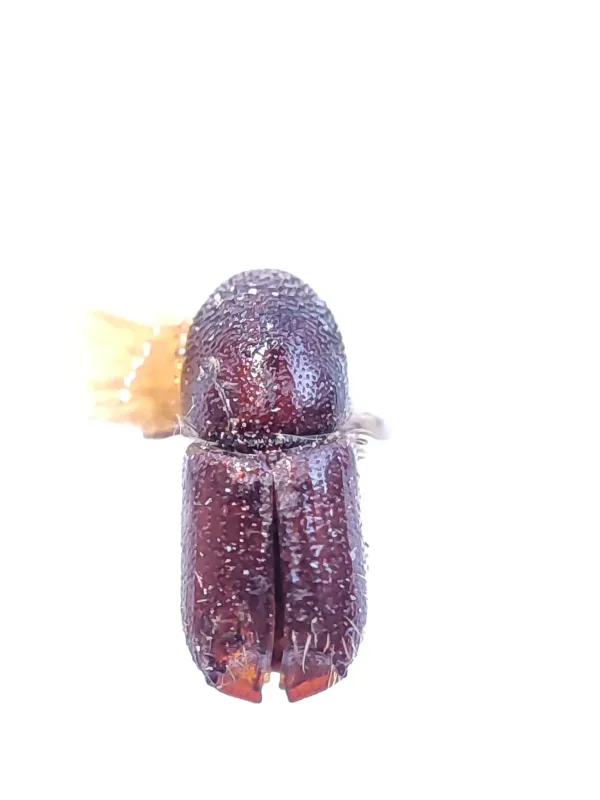
The double-spined bark beetle (Ips duplicatus) is a small insect belonging to the Curculionidae family. Adult beetles typically measure between 3 and 4.5 mm in length.
Their body is cylindrical and dark brown or black in color. A distinguishing feature is the structure of the elytral declivity, which bears specific teeth used to identify this species.
It is often mistaken for other bark beetles; however, the arrangement of its entrance holes and galleries beneath the bark are unique to this specific species.
The larvae are white, legless grubs with a yellowish head, living and feeding exclusively between the bark and the sapwood of host trees.
Pupation occurs in small chambers created by the larvae under the bark, where the insect completes its transformation before emerging as a new adult.
What it damages
The primary host for Ips duplicatus is the Norway spruce (Picea abies), though it can occasionally attack other coniferous tree species in its range.
The beetle prefers trees weakened by adverse conditions such as prolonged drought, wind damage, or environmental stressors that compromise the tree's health.
Both adults and larvae cause severe damage by creating galleries that destroy the phloem and cambium layers, essentially cutting off nutrient flow.
This activity prevents the transport of water and nutrients, leading to rapid yellowing, needle drop, and the eventual death of the infested tree.
In outbreaks, the beetle can kill healthy trees by sheer numbers, turning small pockets of infestation into large areas of dead forest.
When it appears
Adult flight typically begins in spring, depending on temperatures, usually starting in April or May when the weather becomes consistently warm.
In favorable conditions, the species may produce two generations per year, significantly increasing the potential for population outbreaks.
During the summer months, reproduction continues, with eggs being laid in galleries, followed by larval development and maturation of new adults.
The lifecycle is tightly coupled with temperature; warm summers accelerate development and increase the number of successful generations.
Adults overwinter primarily under the bark of infested trees or in the forest litter, emerging the following spring to resume the life cycle.
Signs of infestation
A primary indicator of infestation is the presence of brown boring dust (frass) visible in bark crevices or at the base of the infested spruce trees.
Entrance holes can be spotted on the trunk, often accompanied by resin flow, which is the tree's attempts to seal off the intruders.
As the infestation progresses, the tree needles begin to discolor, changing from green to yellow and eventually reddish-brown.
Peeling bark reveals the characteristic gallery patterns, which show how deeply the insects have penetrated the vital tissues of the trunk.
Severe infestations often attract woodpeckers, whose drilling for larvae is a visible sign of a heavily colonized tree.
Control measures
Sanitation is the most critical control measure, which involves the prompt detection and removal of infested trees before the beetles can emerge.
Removing wind-felled trees is essential, as these provide the perfect breeding grounds for the initial population to build up.
- Installing pheromone traps to monitor and reduce local beetle populations.
- Using trap trees to divert beetles away from healthy stands of spruce.
- Maintaining forest hygiene by clearing debris and monitoring health status regularly.
Encouraging natural predators such as parasitic wasps and predatory beetles helps keep population levels in check within managed forests.
Effective management requires a landscape-level approach, focusing on stand diversity and tree vigor to minimize the risk of massive outbreaks.
Taxonomy
- Latin name
- Ips duplicatus
- Order
- Coleoptera (beetles)
- Family
- Curculionidae
- EPPO code
- IPSXDU
Discussion
No discussions yet — be the first.