
California five-spined engraver
Ips confusus
Description
How to identify
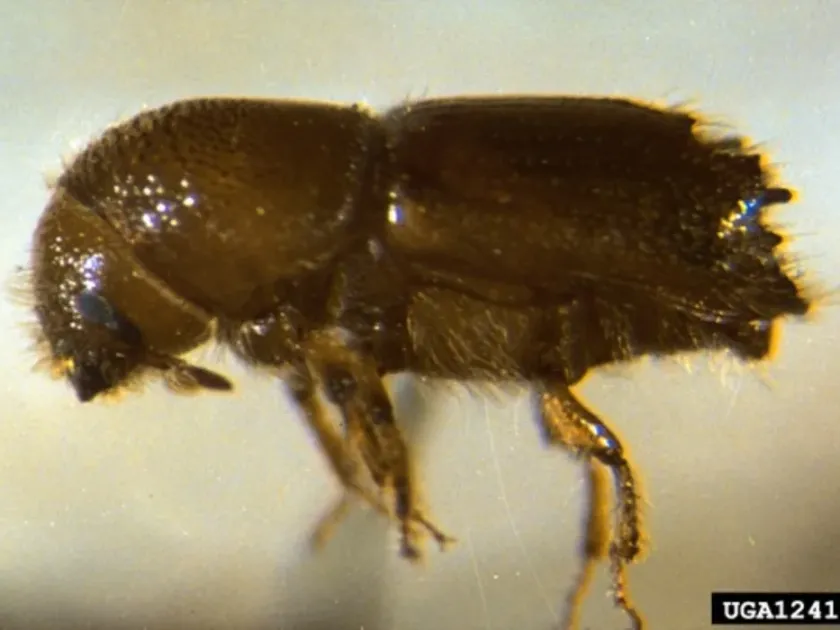
The California five-spined engraver (Ips confusus) is a significant forest pest belonging to the Curculionidae family and Scolytinae subfamily. These beetles are small, typically ranging from 3 to 4 millimeters in length, with a cylindrical, dark brown or black body.
The most distinctive feature for identification is the rear end of the elytra, known as the declivity. In this species, the declivity features five distinct spines on each side, which serves as a primary diagnostic trait for professionals to distinguish it from other bark beetle species.
Larvae are legless, cream-colored, and curved with a brown head capsule. They develop within the cambium layer of the host tree, where they create a network of tunnels that eventually girdle the tree, cutting off nutrient flow.
Pupation occurs in small, circular chambers created by the mature larvae. After the transformation process, the adult beetles emerge through tiny exit holes they chew into the bark, ready to seek new host trees to reproduce.
The species relies heavily on pheromone signals. Once a pioneering beetle finds a suitable host, it releases aggregation pheromones to attract others, which often leads to massive, simultaneous attacks that overwhelm the tree's natural defense mechanisms.
What it damages
The primary hosts of the California five-spined engraver are various pine species, most notably the pinyon pine (Pinus edulis) and the single-leaf pinyon (Pinus monophylla). These trees are highly susceptible when their health is compromised.
While the beetle typically targets weakened or stressed trees—often those suffering from drought, fire injury, or poor site conditions—it can also mount aggressive attacks on healthy stands when the population density reaches a threshold level.
Damage is caused by the adults and larvae feeding on the inner bark. This feeding activity disrupts the tree's vascular system, preventing the transport of water and nutrients, which ultimately leads to the rapid death of the tree.
These beetles also act as vectors for various blue-stain fungi. As the beetles burrow into the wood, they introduce these fungal pathogens into the tree, which further degrade the wood's structural integrity and accelerate the tree's decline.
The economic and ecological consequences include significant loss of pine timber, degradation of wildlife habitats, and high costs associated with removing dead trees in residential and forest areas to prevent fire hazards.
When it appears
The seasonal activity of the California five-spined engraver is largely driven by ambient temperatures. The primary flight season usually begins in early spring when temperatures consistently reach 15 to 18 degrees Celsius.
In warmer climates, this beetle is multivoltine, meaning it can complete multiple generations within a single growing season. Depending on the length of the warm period, anywhere from two to four generations can occur annually.
Peak activity is typically observed during the hottest months of summer. During this time, the beetles are most successful at colonizing new trees, as the high temperatures facilitate rapid development and high reproductive rates.
As autumn approaches and temperatures drop, the adult beetles enter a state of dormancy or diapause. They seek shelter under the bark of infested trees or within the forest duff layer to survive the winter months until the next season.
Extended warm spells in late autumn can sometimes result in delayed overwintering, potentially allowing late-stage larvae to mature. This adaptability makes the species highly resilient and capable of rapid population growth.
Signs of infestation
The presence of the California five-spined engraver is often indicated by the accumulation of boring dust, which appears as fine, reddish-brown sawdust caught in bark crevices or at the base of the tree.
- Pitch tubes (small hardened sap globules) on the trunk surface.
- Needle discoloration, shifting from green to yellow, and eventually reddish-brown.
- Small, circular exit holes on the bark surface.
- Crown thinning followed by top-kill, which often progresses downward.
- Removal of bark patches revealing characteristic galleries underneath.
Pitch tubes are a visible defense reaction where the tree attempts to flush out the invading beetles with resin. While this can be effective against solitary beetles, it usually fails during mass attacks.
The internal gallery pattern is highly specific. When the bark is peeled back, one can observe the mother tunnels and the larval galleries extending outward, which is the most reliable way to confirm the species during site inspections.
Control measures
Management strategies focus on maintaining tree vigor and reducing beetle breeding habitats. Providing adequate water during periods of drought is one of the most effective ways to help trees maintain their natural defenses.
Sanitation is a critical control method. Infested trees must be promptly removed and destroyed or treated before the next generation of beetles can emerge. This breaks the cycle and prevents the spread of the infestation to surrounding healthy trees.
Pheromone traps are used extensively for population monitoring and for "mass trapping" in high-value areas. These traps mimic the beetle’s own chemical signals to attract them, thereby reducing the number of adults available to attack trees.
Preventative insecticide applications on the trunks of healthy trees can provide a temporary barrier against attacking beetles. This is typically reserved for high-value ornamental pines in urban or landscape settings.
Proper forest hygiene, including the prompt removal of slash and logging residue, is essential. These materials provide the ideal environment for the beetles to breed in large numbers, often serving as the source of infestations for the nearby living stand.
Taxonomy
- Latin name
- Ips confusus
- Order
- Coleoptera (beetles)
- Family
- Curculionidae
- EPPO code
- IPSXCO
Discussion
No discussions yet — be the first.