
Northern spruce bark beetle
Ips borealis
Description
How to identify
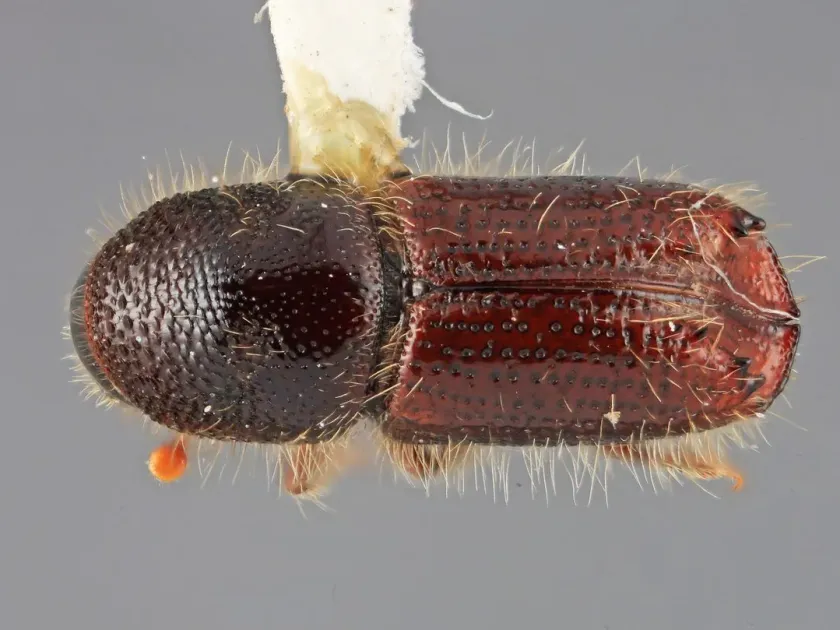
The Northern spruce bark beetle (Ips borealis) is a member of the Curculionidae family and the Scolytinae subfamily. It is a tiny, wood-boring insect that significantly impacts coniferous ecosystems, particularly in northern climates.
Adult beetles measure between 3.5 and 4.5 millimeters in length. Their bodies are cylindrical and dark brown or black, featuring thick bristles that assist them in navigating under the bark of host trees.
The elytra (wing covers) possess a distinct feature at the apex, known as a "beetle punch" or teeth arrangement, which is characteristic of the genus Ips and helps the insect clear debris from its galleries.
Larvae are legless, white, C-shaped grubs with brown head capsules. They feed within the phloem and cambium layers of the tree, creating intricate patterns of tunnels that often result in the tree's vascular system failure.
Pupae develop beneath the bark in specialized chambers. After the transformation, the young adults emerge to either stay within the same tree or fly to new host trees to begin the reproductive cycle.
What it damages
Spruce trees (Picea species) are the primary hosts for the Northern spruce bark beetle. While they naturally prefer weakened or fallen timber, they can become aggressive pests when population densities spike.
The insects feed on the inner bark, effectively girdling the tree. By disrupting the flow of water and nutrients, they cause the tree to dehydrate and lose its natural defenses against secondary pathogens.
High infestation levels lead to rapid tree death, often resulting in widespread patches of dead timber. This increases fire risk and leads to significant losses in timber quality and volume in managed forests.
Beyond direct feeding damage, these beetles serve as vectors for various blue-stain fungi. These fungi colonize the sapwood, which further degrades the structural integrity of the wood and accelerates the tree's demise.
The damage is cumulative and can alter the forest landscape, leading to the conversion of dense, healthy spruce stands into areas dominated by dead, standing timber and increasing forest vulnerability.
When it appears
The flight period for overwintered adults typically begins in spring, triggered by rising temperatures. Once air temperatures reach approximately 15-18 degrees Celsius, the beetles emerge to seek suitable host trees.
The peak reproductive phase occurs throughout late spring and early summer. During this time, males establish mating chambers and release pheromones to attract females for the next generation.
The larval stage occupies the middle of the summer, with individuals growing rapidly as they extend their galleries. This is the period when the most internal damage to the tree's tissue occurs.
As autumn approaches, the development of the new generation concludes. Depending on the latitude and weather conditions, some beetles may overwinter under the bark, while others move to the ground litter.
Overwintering is a critical survival phase for the species. They utilize the protection of the forest floor or the thicker bark at the base of trees to endure harsh winter temperatures before re-emerging.
Signs of infestation
One of the earliest signs of an infestation is the presence of "frass" (fine, reddish-brown sawdust) gathering in bark crevices or at the base of the tree, indicating boring activity.
Small, circular entrance holes are visible upon close inspection of the tree trunk. These indicate where individual beetles have entered to initiate gallery construction and colonization.
Foliage discoloration is a common symptom. The needles transition from their normal green to yellow, and eventually to a persistent reddish-brown, marking the tree's loss of physiological function.
Woodpecker activity is a major indicator of an infestation. These birds seek out the larvae under the bark, and their foraging leaves behind chipped-away bark sections and holes.
In cases of high-density attacks, the tree may exhibit resin flow in an attempt to "pitch out" the invading beetles, which manifests as resin drips or white tubes on the trunk surface.
Control measures
Sanitary logging remains the most effective management strategy. Removing and processing infested trees before the new brood emerges prevents the population from spreading to healthy surrounding stands.
Proper management of slash and logging residue is essential. Removing harvesting debris ensures that the beetle does not find suitable material to establish secondary breeding populations.
Pheromone traps are widely used for monitoring population levels. These traps allow foresters to track the flight activity of the beetles and make informed decisions regarding timing for control operations.
Promoting natural enemies such as parasitic wasps, predatory beetles, and woodpeckers is crucial for long-term control. A healthy, diverse forest ecosystem is more resilient against beetle outbreaks.
In highly sensitive areas, such as municipal parks or botanical gardens, systemic insecticides or protective trunk sprays can be applied to high-value trees to deter infestation during peak flight periods.
Taxonomy
- Latin name
- Ips borealis
- Order
- Coleoptera (beetles)
- Family
- Curculionidae
- EPPO code
- IPSXBO
Discussion
No discussions yet — be the first.