
Ips avulsus
Ips avulsus
Description
How to identify
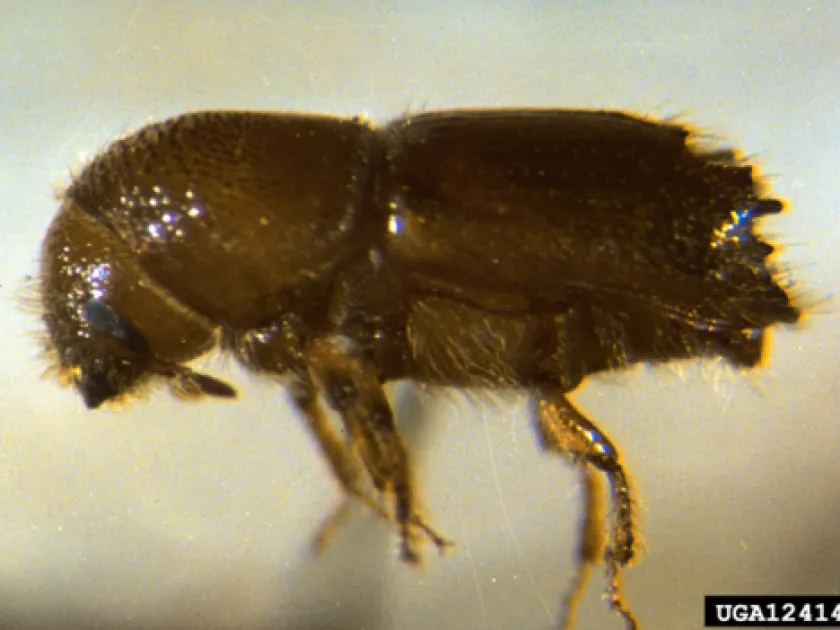
Ips avulsus, commonly known as the small southern pine engraver, is a beetle species belonging to the Curculionidae family. It is distinguished by its small size, usually ranging from 2 to 3 mm in length.
The body is cylindrical and reddish-brown to black. The most prominent identification feature is the presence of four spines on the declivity of the elytra, with the last spine being the most pronounced.
This species exhibits sexual dimorphism, which is common within the Ips genus. Adult beetles are highly dispersive and play a significant role in the initial colonization of stressed pine trees.
The life cycle is closely linked to the availability of suitable host material. Under favorable conditions, the beetle undergoes rapid development, leading to overlapping generations throughout the season.
Accurate identification is crucial for effective forest management, as this species often thrives in environments where larger bark beetles might not compete, specifically targeting thinner-barked areas.
What it damages
Ips avulsus primarily attacks various pine species. It favors trees that are stressed by environmental factors such as drought, fire, lightning strikes, or previous infestation by other pests.
Both adults and larvae bore beneath the bark, creating extensive gallery systems that sever the cambium and phloem layers. This process disrupts the tree's vascular system, leading to rapid mortality.
Unlike some of its larger relatives, this beetle frequently infests the branches and the upper trunk sections of trees. This behavior can lead to top-kill, which often precedes the complete death of the tree.
Large outbreaks can cause significant economic losses in silviculture. The presence of these beetles also increases the risk of wildfire by creating vast amounts of dry, dead fuel in the forest.
The damage is cumulative; as the infestation grows, the beetles exert more pressure on the remaining healthy trees, potentially leading to widespread forest dieback.
When it appears
Beetle activity typically begins in early spring when temperatures reach a threshold suitable for flight and reproduction. The first spring emergence often correlates with the onset of tree sap flow.
The insect is highly prolific, producing multiple generations per year depending on the climate. In warmer southern regions, reproduction can occur almost continuously throughout the growing season.
Mid-summer represents the peak of infestation activity, where high temperatures accelerate the life cycle. During this time, constant monitoring of forest health is essential for early detection.
As autumn approaches, adult beetles seek out overwintering sites. They typically hibernate under the bark of dying trees, in tree litter, or in the soil, protected from winter frosts.
Understanding the temporal patterns of emergence helps foresters time sanitation harvests effectively, ensuring that infested timber is removed before a new generation emerges.
Signs of infestation
The earliest sign of an Ips avulsus attack is the formation of small entrance holes in the bark. Often, the tree will produce pitch tubes, which are globes of resin used to try and trap the beetle.
Frass, a mixture of bark fragments and excrement that resembles sawdust, accumulates near the base of the tree or within bark crevices, indicating active boring activity underneath.
Fading of the tree canopy is a clear indicator of successful colonization. The needles first turn pale, then yellow, and eventually reddish-brown, marking the point of no return for the tree.
Removing a piece of bark reveals the characteristic gallery patterns. A central nuptial chamber with several radiating egg galleries provides definitive evidence of an active infestation.
Increased woodpecker activity on specific trees often serves as a natural bio-indicator, as birds frequently feed on the beetle larvae and adults residing within the wood.
Control measures
The primary control strategy involves the rapid removal and disposal of infested trees. Sanitation harvesting must be completed before the new generation of adults emerges and spreads.
Pheromone traps are widely used for monitoring population trends and managing beetle behavior. These tools can divert beetles away from high-value areas or healthy stands of timber.
- Regular forest health surveys and patrols;
- Prompt removal of storm-damaged or fallen timber;
- Promotion of natural predators and parasitoids;
- Application of prophylactic insecticides in extreme cases;
- Maintenance of proper tree density and forest thinning.
Improving overall stand vigor through sustainable forestry practices, such as proper thinning and nutrient management, helps trees produce enough resin to defend against initial beetle attacks.
If an outbreak becomes uncontrollable, large-scale salvage logging or containment cutting may be necessary to minimize the spread of the infestation to adjacent healthy forest areas.
Taxonomy
- Latin name
- Ips avulsus
- Order
- Coleoptera (beetles)
- Family
- Curculionidae
- EPPO code
- IPSXAV
Discussion
No discussions yet — be the first.