
Lesser spruce bark beetle
Ips amitinus
Description
How to identify
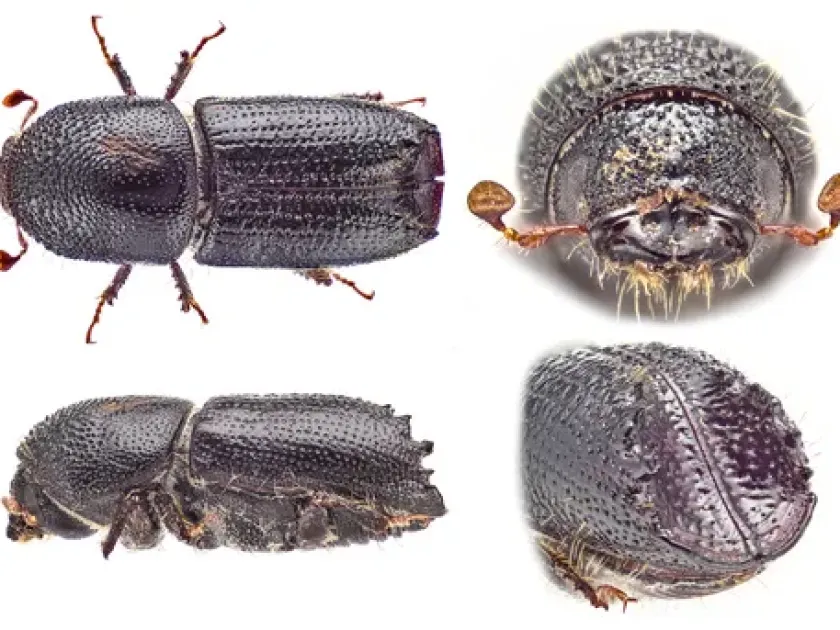
The Lesser spruce bark beetle (Ips amitinus) is a small beetle belonging to the Curculionidae family and the Scolytinae subfamily. Its body is cylindrical, measuring approximately 3.5 to 4.5 millimeters in length, with a coloration ranging from dark brown to black.
The species is identified by its characteristic declivity at the end of the elytra, featuring four teeth on each side. It is closely related to the common spruce bark beetle but is typically smaller in size and exhibits specific surface textures.
These beetles are highly mobile and capable of flying long distances to detect stressed or susceptible host trees. They rely on chemical signals emitted by weakened trees to locate breeding sites.
Larvae are legless, white-colored with a distinct brown head capsule. They spend their entire development phase beneath the bark, feeding on the inner layers of the tree, which makes them difficult to monitor.
Pupation occurs within small galleries constructed by the larvae in the phloem or the outer sapwood. After metamorphosis, the young adults emerge from the bark once their exoskeletons are fully hardened.
What it damages
The primary hosts for the Lesser spruce bark beetle are spruce trees, although it frequently attacks pines, firs, and larches. It is a significant pest in coniferous forests across Europe and Asia.
The beetle targets weakened trees, such as those suffering from drought, storm damage, or defoliation by other insects. In high-density populations, however, it can overwhelm healthy trees.
Adult beetles bore galleries through the bark to mate and lay eggs. The larvae then create winding tunnels that disrupt the transport of water and nutrients, effectively girdling and killing the tree.
The damage often facilitates the entry of wood-decaying fungi and blue-stain fungi. This significantly reduces the quality of the timber, making it unsuitable for construction or high-value industrial uses.
If left unmanaged, infestation patches can expand rapidly, leading to the large-scale death of forest stands, which creates massive economic and ecological impacts on the local environment.
When it appears
Adult activity begins in early spring as temperatures rise, typically when air temperatures exceed 15 degrees Celsius. This marks the emergence of overwintering beetles seeking new host trees.
Depending on the climatic zone and temperature, the beetle can complete multiple generations within a single growing season, leading to significant population increases during favorable weather conditions.
Peak flight and infestation periods generally occur during the mid-summer months. The beetles are most active on warm, dry days, which are optimal for their dispersal and colonization of new hosts.
By late autumn, the beetles prepare for winter. Overwintering occurs primarily at the adult stage, with the insects hiding in the forest litter, soil at the base of the tree, or under the bark in the lower trunk section.
Climate factors such as hot, dry summers drastically accelerate the developmental cycle. This environmental stress makes trees less resistant to attack, creating a perfect storm for outbreaks.
Signs of infestation
The presence of fine, sawdust-like bore dust (frass) at the base of the tree or tucked into bark crevices is one of the earliest signs that an infestation is occurring.
Resin tubes on the bark are a common defense mechanism. The tree tries to flush the beetles out with resin, resulting in noticeable hardened globules on the exterior of the trunk.
Crown symptoms are usually observed once the infestation is well-established. Needles begin to turn yellow, then fade to red-brown, eventually falling off as the vascular system fails.
Inspecting under the bark reveals intricate tunnel systems. The primary galleries are usually longitudinal, while the larval galleries radiate outward, forming a distinct, branching pattern.
- Entrance holes (1.5–2 mm) visible on the bark surface.
- Withered or discolored foliage throughout the crown.
- Increased woodpecker activity characterized by large strips of bark being removed.
- Peeling bark exposing dead cambium and characteristic gallery networks.
Control measures
Sanitation felling is the most effective management strategy. Infested trees must be identified and removed from the forest before the next generation of beetles emerges and spreads to healthy trees.
The use of trap trees, which are intentionally felled to attract beetles, is a common practice. Once the beetles colonize these logs, they can be debarked or destroyed to neutralize the population.
Pheromone traps are widely used for monitoring population trends. They can also be used for mass trapping or "lure and kill" strategies to reduce the density of adult beetles in high-risk areas.
Chemical control with insecticides is generally reserved for high-value trees in urban or ornamental settings. Treatment must be applied to the bark before beetles successfully bore inside.
Promoting forest health through diverse plantings and maintaining a clean forest floor by removing deadwood are essential preventative measures that keep beetle populations at endemic, non-destructive levels.
Taxonomy
- Latin name
- Ips amitinus
- Order
- Coleoptera (beetles)
- Family
- Curculionidae
- EPPO code
- IPSXAH
Discussion
No discussions yet — be the first.