
Pine engraver beetle
Ips acuminatus
Description
How to identify
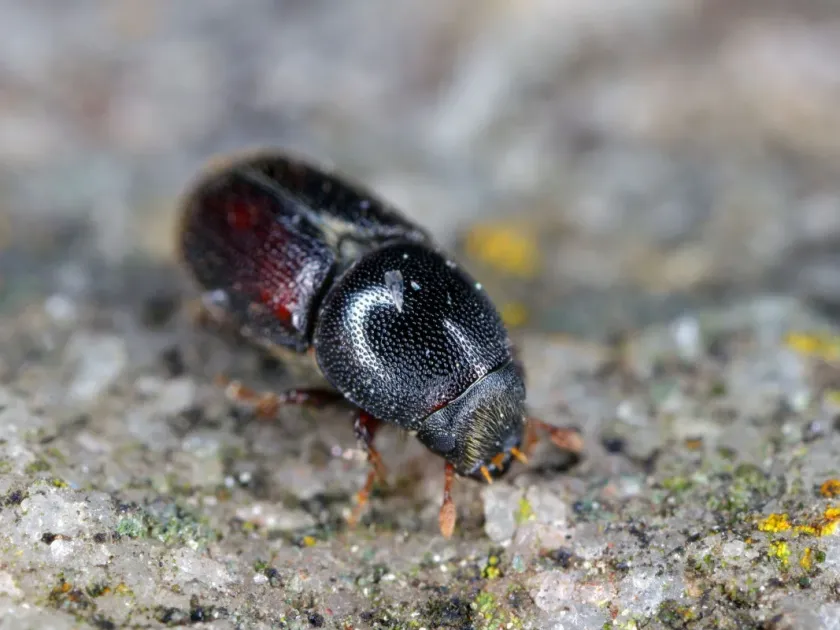
The pine engraver beetle (Ips acuminatus) belongs to the order Coleoptera and the family Curculionidae (subfamily Scolytinae). It is a small insect, with adults measuring between 2.2 and 3.9 mm in length, possessing a cylindrical, dark brown body.
A key identifying feature of this species is the shape of its elytra (wing covers), which end in a scooped depression lined with four distinct teeth on each side. These features are more pronounced in males, aiding them in clearing out wood dust.
The larvae are white, legless grubs with a light brown head. They live exclusively under the bark, where they feed on the phloem and cambium layers of host trees. The pupae are white and develop in small chambers called cradles.
Adult beetles are capable of sustained flight and utilize pheromones to signal other members of the species to colonize a host tree, which leads to mass attacks on weakened or vulnerable conifer stands.
This beetle is well-adapted to temperate climates, showing a high reproductive capacity with multiple generations per year, which makes it a significant threat to forest health.
What it damages
The pine engraver primarily infests Scots pine (Pinus sylvestris), although it can occasionally be found on spruce, larch, or cedar. It shows a strong preference for trees with thin to medium-thickness bark.
The beetle typically targets the upper sections of tree trunks and branches in mature trees, as well as young stands and saplings. It can kill healthy trees if the beetle population density is sufficiently high.
Larval feeding creates a complex web of galleries that girdle the tree, effectively disrupting the flow of water and nutrients between the roots and the needles. This leads to rapid desiccation of the tree.
Outbreaks are frequently triggered by environmental stress, such as severe droughts, windthrow, or large-scale logging operations, which weaken the trees' ability to produce defensive resin.
The economic impact involves the loss of timber value and the high costs associated with sanitation logging and replanting large forest areas devastated by the infestation.
When it appears
The active period usually begins in early spring as soon as air temperatures consistently reach +15°C to +18°C. This period marks the primary dispersal and colonization of host trees by overwintered adults.
Depending on the latitude and regional climate, the beetle can complete two or even three generations within a single growing season. Development from egg to adult takes approximately 40 to 60 days.
The second generation typically peaks in mid-summer, increasing the risk of mass attacks on new trees. This is a critical time for forest managers to conduct monitoring and preventive interventions.
As autumn approaches and temperatures drop, adult beetles cease feeding and prepare for winter dormancy. They typically overwinter under the bark of host trees or in forest litter near the base of the tree.
Winter survival is crucial for the species' population density; thus, cold weather helps regulate their numbers, though the ability of adults to hibernate successfully ensures a persistent threat for the following year.
Signs of infestation
The first indicator of an infestation is the presence of fine wood dust (frass) on the bark surface or accumulated at the base of the trunk. This indicates that beetles are actively boring into the tree.
Entrance holes (1–2 mm in diameter) are visible on the bark. In some cases, resin bleeds from these holes as the tree attempts to push the beetles out, which is a common defense mechanism.
If the bark is removed, a distinctive gallery pattern is revealed. A longitudinal central gallery is usually accompanied by multiple lateral larval galleries branching out in a dense, characteristic design.
Needle yellowing and subsequent browning are signs of advanced infestation. The process starts from the top of the crown and works its way down as the water supply to the branches is cut off.
Bark shedding is a late-stage sign, indicating that the tree is dead and that the beetles have likely completed their development and emerged, often leaving behind a ruined cambium layer.
Control measures
Sanitation logging is the primary and most effective method for controlling the pine engraver. Removing infested trees before the new generation of beetles emerges is essential to limit the spread of the population.
Pheromone-baited traps are widely used for monitoring population levels and can also serve as a tool to capture a significant number of beetles, thereby reducing the intensity of the attack on the stand.
Proper forest management, including the prompt removal of logging residue and felled timber, is critical to prevent the buildup of beetle populations in forest sites.
Chemical control is generally impractical for large-scale forest management but may be applied in nurseries or for the protection of high-value individual trees using registered systemic insecticides.
Maintaining vigorous and healthy forest stands through proper thinning and density management is the best long-term strategy to ensure trees remain resilient against bark beetle outbreaks.
Taxonomy
- Latin name
- Ips acuminatus
- Order
- Coleoptera (beetles)
- Family
- Curculionidae
- EPPO code
- IPSXAC
Discussion
No discussions yet — be the first.