
European spruce bark beetle
Ips
Description
How to identify
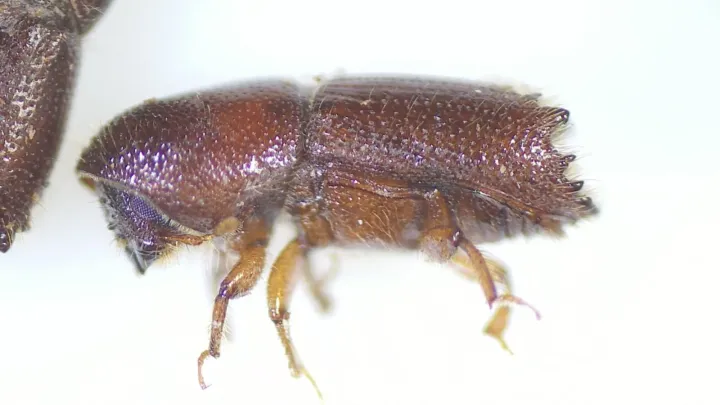
The European spruce bark beetle (Ips typographus) is a small, cylindrical insect, typically ranging from 4 to 5.5 millimeters in length, belonging to the weevil family.
Adult beetles have a dark brown, shiny appearance. Their most distinctive feature is a concave structure on the tip of the wing covers, lined with four distinct teeth.
Larvae are legless, white grubs with a brown head capsule, specialized for feeding on the inner bark layer of host trees throughout their growth phase.
Pupation occurs in the inner bark or surface of the sapwood, following which the young adults chew their way out of the tree to begin a new life cycle.
The life cycle is closely synchronized with the environmental temperature, allowing for multiple generations per year under warm and dry climatic conditions.
What it damages
The primary host for this beetle is the Norway spruce (Picea abies), though it can infest other coniferous species when the population density is high.
Beetles cause damage by creating elaborate networks of tunnels in the phloem, the layer responsible for transporting nutrients, effectively girdling the tree.
Mass infestations are deadly because the sheer number of beetles overwhelms the tree's defensive resin production, preventing it from sealing off the wounds.
The impact is catastrophic for spruce forests, as a successful attack leads to the rapid death of the tree within a single season of intense colonization.
Drought stress and high temperatures significantly reduce a tree's resistance, making it highly susceptible to these devastating bark beetle outbreaks.
When it appears
Beetle activity starts in the spring, typically when air temperatures rise consistently above 15 degrees Celsius, triggering the initial flight period.
The main flight usually occurs in late April or May, depending on the latitude, as beetles emerge from overwintering sites in the soil or tree bark.
During the summer, the beetle is capable of completing its lifecycle in as little as 6 to 8 weeks, allowing for two or even three distinct generations.
As daylight hours decrease and temperatures drop in autumn, the beetles prepare for hibernation by seeking protected sites in the lower tree bark.
Winter survival is crucial for the beetle, and they can withstand freezing conditions, remaining dormant until the cycle restarts with the first spring warmth.
Signs of infestation
The presence of fine, reddish-brown boring dust, similar to sawdust, at the base of the tree is the most reliable indicator of an active beetle infestation.
Small entry holes appear on the bark surface, sometimes accompanied by resin tubes or sap flows where the tree attempted to pitch out the invading insect.
The foliage of the infested tree will gradually change color, transitioning from a healthy dark green to a pale yellowish, and finally a dull reddish-brown.
Peeling away the bark reveals the signature "typographic" gallery patterns, consisting of a central mating chamber with radiating larval tunnels.
- reddish boring dust at the tree base;
- discolored yellow or brown needles;
- small exit holes in the outer bark;
- increased woodpecker activity on affected trees.
Control measures
Sanitation felling is the most effective management strategy, involving the rapid removal and processing of infested trees before the next beetle generation emerges.
Monitoring programs using pheromone-baited traps are essential for foresters to track population trends and detect new outbreak centers early.
Maintaining healthy and diverse forest stands through proper thinning helps improve the individual tree's resilience against initial bark beetle attacks.
The use of trap trees, intentionally felled to attract beetles, allows for the centralized collection and destruction of the pest population within an area.
Biological control, including the protection of woodpecker habitats and predatory insects, plays a vital role in balancing beetle populations in stable ecosystems.
Taxonomy
- Latin name
- Ips
- Order
- Coleoptera (beetles)
- Family
- Curculionidae
- EPPO code
- IPSXSP
Discussion
No discussions yet — be the first.