
Green iguana
Iguana iguana
Description
How to identify
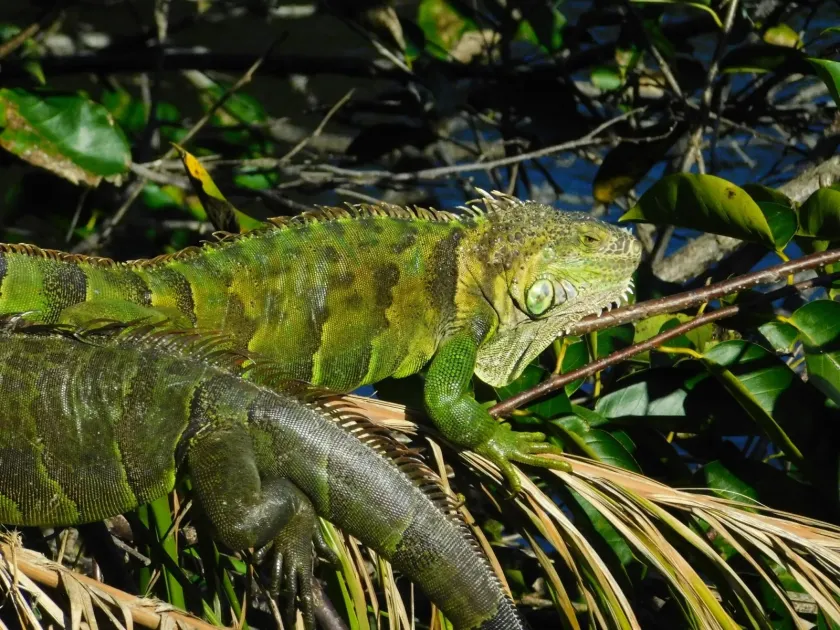
The green iguana (Iguana iguana) is a large, arboreal, herbivorous species of lizard in the family Iguanidae. It is native to Central and South America.
Adults can grow up to 2 meters in length, featuring a prominent crest of spines along their backs and a long, whip-like tail used for both balance and defense.
They are characterized by their distinct sub-tympanic shield and a large dewlap beneath the throat, which is more pronounced in males.
Their toes are equipped with sharp, strong claws, providing excellent gripping power for climbing trees and navigating vertical surfaces.
While often appearing docile, they are highly capable of thriving in urban environments, leading to significant ecological and agricultural imbalances.
What it damages
Green iguanas are primarily herbivorous, feeding on a wide variety of leaves, flowers, fruits, and buds, which makes them a major threat to agricultural plots.
They frequently target home gardens and commercial farms, causing severe damage to ornamental plants, vegetables like tomatoes, and fruit-bearing trees.
Feeding behavior often results in the stripping of foliage, which weakens trees and plants, potentially leading to their death if defoliation is severe.
Young plants are frequently crushed or broken by the sheer weight of the iguanas as they move across the canopy searching for the most tender shoots.
Their presence can lead to secondary issues such as soil and surface contamination from fecal matter, which may carry pathogens harmful to other crops.
When it appears
Iguanas are active throughout the year in tropical climates, but their foraging intensity fluctuates based on environmental conditions and seasonal food availability.
During dry seasons, when natural vegetation is sparse, iguanas are more likely to encroach upon human-tended gardens to satisfy their dietary requirements.
Breeding season occurs early in the year, during which time activity levels spike as they seek out appropriate nesting grounds near fertile soil.
Temperature plays a crucial role; being ectothermic, they are most active and damaging on sunny days when their metabolism is boosted by solar radiation.
Conversely, during cooler periods, their activity slows, yet they remain a persistent threat whenever temperatures permit movement and digestion.
Signs of infestation
The most evident sign of iguana presence is the skeletonization of leaves, where only the tough veins remain after the lizard has consumed the soft tissue.
Large, cylindrical, dark-colored fecal pellets scattered on the ground or on garden structures are a clear indicator of their presence.
Deep scratches on the trunks of trees and structural damage to fences indicate the frequent path of a heavy, clawed animal.
Observation of broken, mangled branches in the upper canopy, especially in fruit trees, often points to iguana foraging activity.
Frequent sightings of individuals basking in the sun on rooftops, branches, or walls bordering the agricultural area are reliable evidence of an infestation.
Control measures
Constructing physical barriers such as smooth, vertical metal sheets or specialized fencing is highly effective at preventing iguanas from entering gardens.
Wrapping the lower trunks of valued trees with sheet metal guards prevents the lizards from climbing up to reach the foliage and fruit.
Modifying the landscape by removing dense cover and brush piles minimizes safe harbor and reduces the attractiveness of the site to the lizards.
Planting non-preferred or repellent vegetation around the perimeter can create a passive barrier that discourages foraging entry.
Professional control strategies, including trapping and habitat management, are often necessary in areas where populations have reached high densities.
Taxonomy
- Latin name
- Iguana iguana
- Family
- Iguanidae
- EPPO code
- IGUAIG
Discussion
No discussions yet — be the first.