
Green iguana
Iguana
Description
How to identify
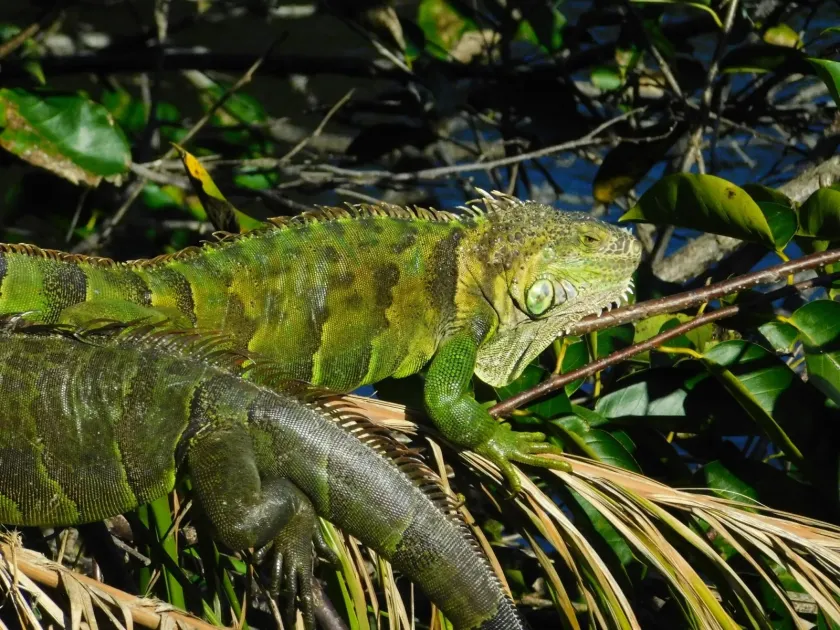
The green iguana Iguana iguana belongs to the order Squamata and the family Iguanidae. It is a large, arboreal lizard characterized by a long tail and a prominent dorsal crest.
The body is covered with scales that vary in color from bright green to brown or grey, providing effective camouflage among foliage and branches.
These lizards are primarily diurnal and exhibit remarkable climbing skills, allowing them to access the tops of fruit trees and garden plants easily.
As large herbivorous reptiles, they possess sharp teeth adapted for shearing plant material, enabling them to consume significant amounts of vegetation quickly.
They reproduce by laying eggs in burrows dug into the ground, which can occasionally disrupt the root zones of agricultural seedlings.
What it damages
Green iguanas are strictly herbivorous and consume a wide range of agricultural products, including leaves, flowers, fruits, and buds of various plants.
They cause substantial economic losses in citrus groves, mango orchards, and avocado plantations by stripping foliage and eating reproductive parts of trees.
In vegetable gardens, they are known to decimate lettuce, beans, cabbage, and other crops, often leaving only bare stalks behind after feeding.
Their weight and constant climbing activity can cause physical damage, such as broken branches, stunted growth, and distorted canopy development in young trees.
- Consumption of new leaf flushes and terminal buds.
- Destruction of flowers, leading to crop failure.
- Mechanical damage to plant stems and branches.
- Feeding on fruits during the development and ripening stages.
When it appears
Iguana activity is strongly influenced by temperature and sunlight, making them year-round pests in tropical and subtropical agricultural environments.
During the dry season, when natural forage becomes scarce in the wild, iguanas move toward irrigated agricultural plots, where succulent plants are abundant.
The breeding season involves specific behavioral shifts, where nesting females search for open, exposed ground to dig burrows, often in garden or orchard soil.
Mornings are typically peak feeding times, as iguanas use solar radiation to warm their bodies before searching for food sources in the fields.
The severity of the infestation usually correlates with the growth stages of the crops, with the most aggressive feeding occurring during the vegetative growth phase.
Signs of infestation
Evidence of iguana activity includes characteristic U-shaped bite marks on the edges of leaves, which are easily distinguishable from insect damage.
Large, elongated droppings containing fibrous plant matter found near the base of trees or along garden rows are clear indicators of their presence.
Scratch marks on the bark of fruit trees and claw tracks on soft soil are common indicators of iguana movement in the orchard area.
Wilted flowers and underdeveloped fruits littering the ground beneath trees often signify that iguanas have been feeding in the canopy.
Visual sightings of the lizards basking in sunny spots on garden fences or high up in tree branches confirm that the area is being utilized as a feeding site.
Control measures
Installing metal tree guards or smooth cylinders around the trunks of valuable trees prevents iguanas from climbing and accessing the fruit and foliage.
Applying topical repellents, such as hot pepper extract or garlic-based solutions, to the leaves can deter iguanas from consuming treated plants.
Good orchard sanitation practices, such as removing dense brush or overgrown vegetation, reduce potential hiding spots and nesting sites for the reptiles.
Motion-activated sound or light deterrents can be effective in startling iguanas and preventing them from settling comfortably in the garden area.
Where feasible, installing high-quality wire mesh fencing that is buried slightly underground serves as a physical barrier against encroaching populations.
Taxonomy
- Latin name
- Iguana
- Family
- Iguanidae
- EPPO code
- IGUASP
Discussion
No discussions yet — be the first.