
Coffee berry borer
Hypothenemus seriatus
Description
How to identify
The coffee berry borer Hypothenemus seriatus (syn. Hypothenemus hampei) is a member of the Curculionidae family. It is considered the most devastating pest of coffee plantations globally due to its cryptic lifestyle.
Adult females are approximately 1.5 mm long, while males are significantly smaller and wingless. They are dark brown or black in color and possess a compact, cylindrical body covered with stiff hairs.
The entire life cycle occurs within the coffee berry. A single female bores a hole into the fruit, where she lays eggs that hatch into larvae, which then feed on the coffee endosperm.
Because they spend most of their lives inside the fruit, these beetles are extremely difficult to target with traditional contact insecticides, making management highly challenging.
Rapid population growth is a hallmark of this species, with multiple generations emerging annually in optimal tropical conditions, leading to quick infestation of entire fields.
What it damages
The pest specifically targets the seeds of Coffea arabica and Coffea canephora. Larval feeding destroys the endosperm, significantly reducing the quality and weight of the coffee beans.
Damage results in direct financial losses for producers, as infested beans are downgraded or completely rejected by coffee buyers due to poor flavor and aroma profiles.
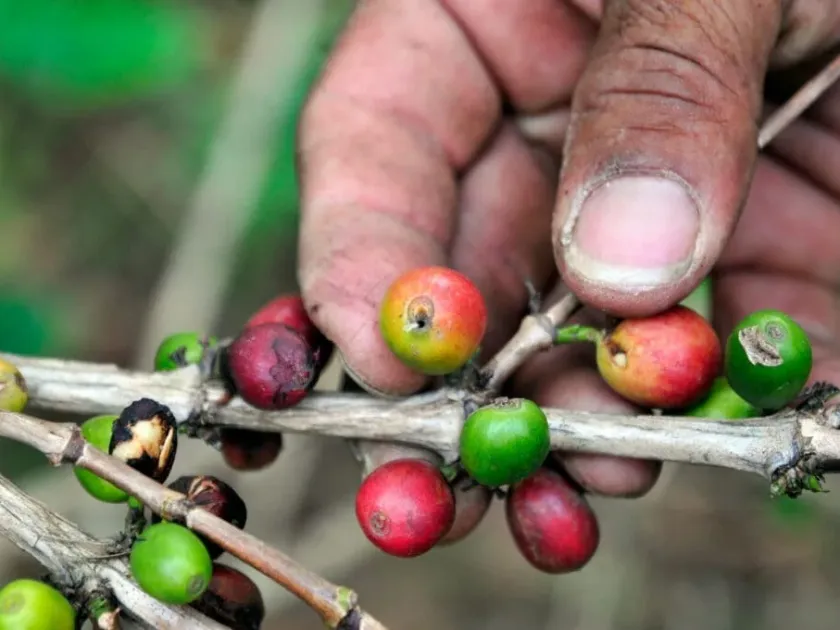
Boreholes made by the beetle serve as entry points for secondary pathogens, such as fungi, which cause the premature rotting and drop of coffee berries from the branches.
Severe infestations can lead to total crop loss, especially if berries remain on the trees or the ground for extended periods without timely harvesting.
The ability of the beetle to infest berries at various stages of maturity makes it a persistent threat throughout the entire fruiting cycle of the coffee tree.
When it appears
The beetle's activity is closely tied to the availability of suitable host fruit. In tropical environments with consistent rainfall, the insect can breed and reproduce throughout the year.
The infestation phase typically begins when the coffee endosperm hardens, as this provides the necessary nutrition for the developing larvae to complete their life cycle.
Periods of high humidity generally favor the migration of adult females from old, infested fruit to fresh, developing berries on the same or neighboring trees.
Although extreme heat and dryness may temporarily slow development, the presence of irrigation systems on modern plantations often maintains favorable conditions for the beetle.
Monitoring for beetle activity should be conducted regularly, particularly during the transition from green berry to mature fruit, to detect early signs of colonization.
Signs of infestation
The most reliable indicator of an infestation is the presence of small, circular entry holes typically located at the apex (the "disc") of the coffee berry.
- Premature yellowing or drop of coffee cherries.
- Accumulation of fine, powdery bore dust at the entry point.
- Visible tunneling inside the coffee bean during the processing stage.
- Stunted or damaged beans that result in lower yield during the drying process.
Ground-level accumulation of fallen cherries acts as a primary source of inoculum for the next generation of beetles, sustaining the population year after year.
Careful inspection of harvested fruit often reveals the presence of both adult females and larvae within the tunnels, confirming an active infestation within the shipment.
Control measures
Sanitary harvesting is the most critical management practice. Removing all berries, including those on the ground, prevents the borer from finding a host to reproduce during the off-season.
The use of the entomopathogenic fungus Beauveria bassiana provides a sustainable biological control, helping to suppress populations by infecting beetles as they move between berries.
Mass trapping using specialized lures containing a methanol and ethanol mixture is highly effective for monitoring and reducing the population of flying adult females.
Chemical control should be strictly limited to the brief window when females are actively migrating, as the beetles remain protected inside the fruit for the vast majority of their lives.
Integrated Pest Management (IPM) strategies, combining cultural, biological, and selective chemical methods, are essential for long-term control of this resilient insect.
Taxonomy
- Latin name
- Hypothenemus seriatus
- Order
- Coleoptera (beetles)
- Family
- Curculionidae
- EPPO code
- STEHSE
Discussion
No discussions yet — be the first.