
Coffee berry borer
Hypothenemus pusillus
Description
How to identify
The coffee berry borer (Hypothenemus pusillus) is a member of the Curculionidae family and the Scolytinae subfamily. It is recognized as one of the most significant pests affecting coffee production worldwide due to its specialized niche.
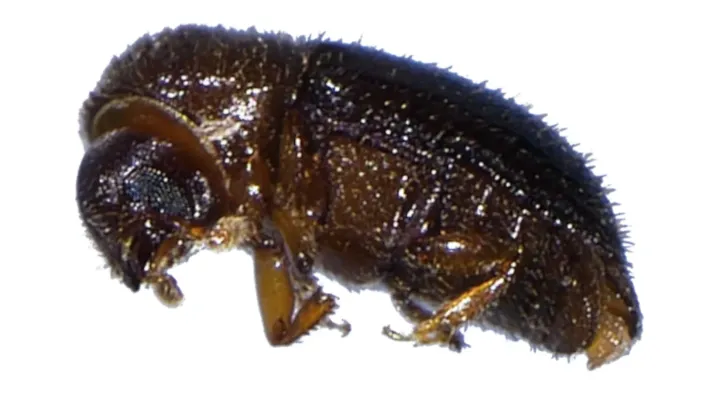
Adult beetles are extremely small, cylindrical in shape, and typically dark brown or black in color. Their bodies are covered in fine, short hairs, which help the insect remain secure within the narrow galleries it excavates inside the coffee berry.
Sexual dimorphism is quite prominent in this species. Females are larger and responsible for colonizing new berries and laying eggs, while males are significantly smaller, flightless, and spend their entire life cycle within the berry of their birth.
The life cycle is closely tied to the coffee berry's maturity. The insects prefer berries that are hardening, as they provide the necessary nutritional content for larval development, leading to rapid population growth under favorable environmental conditions.
Understanding their rapid reproductive cycle is essential for any agronomic program, as the pest can complete several generations within a single harvest season, depending on local climate and coffee variety.
What it damages
The primary damage is caused by the adult female boring a hole into the coffee berry, usually at the blossom end, to create a tunnel. Once inside, she lays eggs that hatch into larvae, which consume the seed's endosperm.
This feeding activity destroys the interior of the coffee bean, rendering it worthless or severely degrading its quality. As a result, the market value of the harvest drops, and producers face significant financial losses.
Beyond physical destruction, the tunneling process creates entry points for secondary pathogens, such as fungi, which can cause further rot and quality deterioration of the coffee cherries on the tree.
In high-infestation cases, the weight loss of the beans can be substantial. This forces farmers to invest in costly sorting and cleaning equipment to remove damaged beans, which would otherwise spoil the flavor of the final roasted product.
The presence of the beetle can also cause premature ripening and berry drop, which alters the harvest schedule and reduces the overall volume of healthy, sellable coffee produced from the plantation.
Signs of infestation
The most reliable sign of an infestation is the presence of small, round entry holes near the center of the coffee berry. These holes appear to be drilled with precision and are often surrounded by minor tissue darkening.
Inspecting the interior of the berry often reveals tunnels filled with "frass" (a powdery mixture of excrement and bean tissue). The presence of these tunnels is a clear indicator that the berry is actively occupied by the pest.
Berries that change color prematurely or appear shriveled on the branch are frequently infested. Growers should prioritize these berries during scouting to identify the level of pest pressure early in the season.
In humid conditions, white fungal growth might be visible around the entrance hole. This is a common secondary symptom resulting from the transport of fungal spores by the beetles as they move between plant parts.
Regular field monitoring, including examining fallen berries beneath the tree canopy, is the most effective way to catch the early signs of a population buildup before it spreads across the entire plantation.
Control measures
Sanitation is the cornerstone of integrated pest management. Removing all infested and fallen coffee cherries from the ground disrupts the life cycle of the beetle and prevents it from surviving until the next season.
Pheromone traps are highly effective for monitoring adult beetle flight activity. By using these traps, growers can determine the exact timing for necessary insecticide applications, ensuring the highest level of efficacy.
Biological control methods, particularly the use of Beauveria bassiana-based fungal sprays, have shown great promise in suppressing beetle populations without the excessive use of harsh chemical pesticides.
If chemical intervention is required, timing is critical. Sprays are only effective when beetles are actively moving on the berry surface. Once the beetle has successfully bored into the bean, it is protected from most contact-based treatments.
- Rigorous plantation sanitation
- Regular scouting and monitoring
- Use of pheromone lures
- Biological control with fungi
- Prompt harvesting of ripe berries
Taxonomy
- Latin name
- Hypothenemus pusillus
- Order
- Coleoptera (beetles)
- Family
- Curculionidae
- EPPO code
- HYOTPS
Discussion
No discussions yet — be the first.