
Coffee berry borer
Hypothenemus pubescens
Description
How to identify
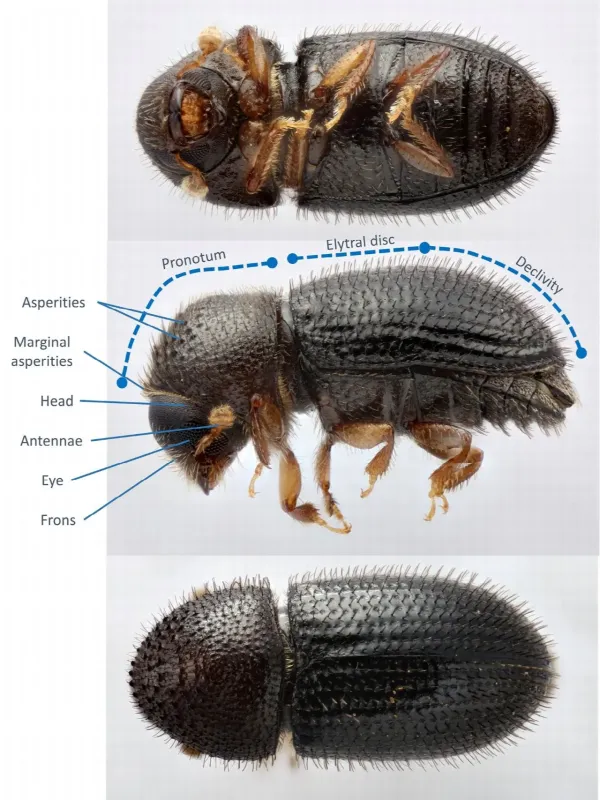
The coffee berry borer (Hypothenemus pubescens) is a destructive insect belonging to the family Curculionidae, subfamily Scolytinae. These beetles are tiny, typically measuring between 1.5 and 2 millimeters in length, with a cylindrical, dark brown or black body.
The life cycle of the berry borer is unique because it occurs almost entirely within the coffee berry. The female beetle bores a hole into the berry, creates galleries in the beans, and lays eggs. This protected environment makes the pest highly resistant to external environmental factors.
Reproduction follows an unusual pattern where mating occurs within the fruit, and the wingless males rarely leave the berry of their birth. Only mated females emerge to infest new fruit, facilitating the spread across the coffee plantation.
Biological development is highly dependent on humidity and temperature. In tropical climates, the species is capable of continuous breeding, leading to a rapid succession of generations throughout the year.
Due to the protective nature of the berry tissue, the borer can survive in varied environmental conditions, making it one of the most challenging pests to eradicate once it has established a population in a farm.
What it damages
The coffee berry borer primarily attacks the seeds (beans) of the coffee plant. The larvae consume the endosperm of the seed, causing direct reduction in yield and weight of the harvest.
Damage to the beans leads to secondary infections by fungi and bacteria. These infections often discolor the bean and impart undesirable off-flavors, drastically lowering the coffee quality for specialty markets.
Infested berries may drop prematurely, which causes significant field losses before the harvest begins. This necessitates extra labor for gathering fallen berries to prevent further pest buildup.
The borer attacks berries at various stages of maturity, but it prefers berries that have reached a specific stage of firmness and sugar concentration. Even partial damage to the bean renders the entire coffee cherry economically worthless.
Farmers face substantial financial losses because the damage is often discovered only during the processing or hulling stage, making it impossible to separate infested beans from healthy ones without specialized machinery.
Signs of infestation
The most reliable sign of an infestation is the presence of small, circular entry holes, usually located on the blossom end of the coffee berry. These holes are often obscured by the berry's surface texture.
Internal examination of an infested berry reveals tunnels and galleries excavated within the bean. These tunnels are often filled with brownish frass, which is the excrement of the larvae and adults.
Premature ripening or "blackening" of the berries is another visual indicator. Berries that seem to mature too early or appear shriveled are often hosts to developing beetle populations.
Increased fruit drop, particularly during the middle stages of berry development, acts as a warning sign for farmers to conduct a more thorough survey of the coffee trees.
In heavily infested areas, the presence of adult beetles near the berries or in trap devices indicates that the pest is actively seeking new sites for colonization and reproduction.
Control measures
Cultural control is the cornerstone of management. Regular "sanitation harvesting"—removing all remaining berries from the trees and the ground—is crucial to eliminate the pests' habitat.
Trapping techniques using synthetic lures or alcohol-based attractants are highly effective for monitoring pest population levels and catching females as they migrate between trees.
Pruning is an essential agronomical practice. By keeping trees well-pruned, farmers ensure better airflow and light penetration, which lowers the humidity levels within the canopy and creates a less favorable environment for the beetles.
Biological control agents, particularly entomopathogenic fungi like Beauveria bassiana, are utilized to suppress populations. These fungi naturally infect and kill the beetles, serving as a sustainable long-term solution.
Chemical control remains difficult due to the beetles' internal habitat. When insecticides are used, they must be applied precisely during the timing of the female migration, which is the only stage when the insect is exposed to contact treatments.
Taxonomy
- Latin name
- Hypothenemus pubescens
- Order
- Coleoptera (beetles)
- Family
- Curculionidae
- EPPO code
- HYOTPB
Discussion
No discussions yet — be the first.