
Coffee berry borer
Hypothenemus maculicollis
Description
How to identify
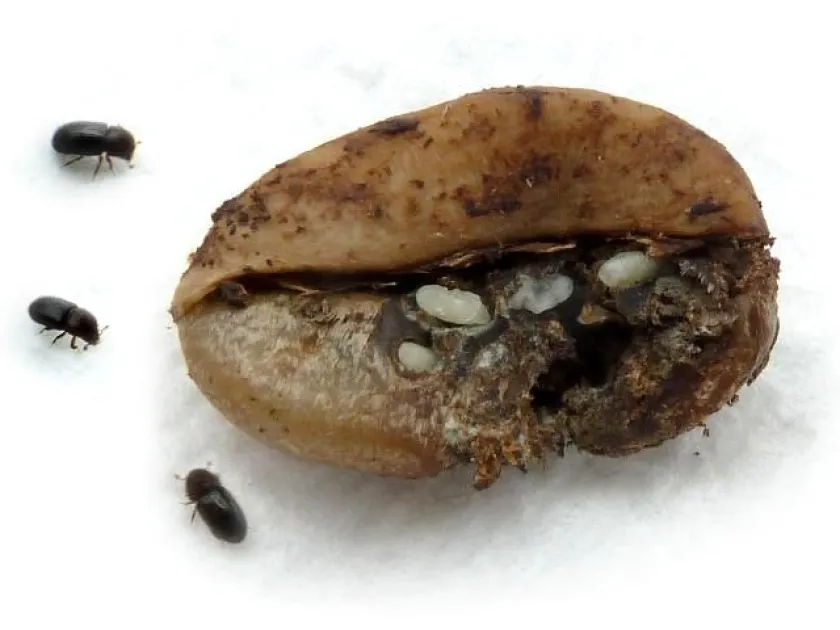
The coffee berry borer (Hypothenemus maculicollis) belongs to the Curculionidae family, subfamily Scolytinae. Adult beetles are minute, cylindrical, and range in color from dark brown to black.
The body of the adult is covered with dense, short hairs, a key morphological characteristic for identification under magnification. These insects are extremely small, typically measuring 1.5–2 millimeters in length.
Females are significantly larger than males and spend most of their life cycle inside the coffee fruit. Males possess vestigial wings and rarely leave the gallery, as they are adapted to fertilize females within the bean itself.
The larvae are white, legless, and develop directly inside the coffee bean endosperm. They feed on the seed tissue, growing rapidly and passing through several instars before pupation.
Due to the close resemblance to other Hypothenemus species, accurate identification requires professional microscopic examination of the pronotum and elytra structure.
What it damages
The primary target of this pest is the coffee berry (Coffea spp.). The beetles bore into both green and maturing berries, typically entering through the floral disc.
Damage is caused by both adults and larvae, which tunnel through the bean, destroying the commodity quality and reducing its market value significantly.
Infected beans become unsuitable for processing as they are prone to secondary fungal and bacterial infections. This damage often results in premature berry drop, which leads to substantial yield losses.
During heavy infestations, Hypothenemus maculicollis can destroy a significant percentage of the crop, posing a severe economic threat to coffee producers worldwide.
Beyond physical destruction, the tunneling activity facilitates the spread of pathogens that compromise the flavor profile of the final coffee beverage.
When it appears
The life cycle is closely linked to coffee phenology and regional climatic conditions. In tropical climates, reproduction can occur year-round if suitable berries are present.
Activity levels typically peak during the maturation phase of the berries, when environmental conditions are optimal for female colonization and oviposition.
A single female can lay dozens of eggs during her lifespan, with a full generation cycle taking approximately 20 to 30 days depending on ambient temperatures.
The pest population shows high resilience and can rebound quickly after chemical applications if untreated berries remain on the trees or the ground.
Adult dispersal to new berries occurs primarily during periods of moderate air temperature, a factor that must be considered when scheduling pest monitoring activities.
Signs of infestation
The first visual indication is the presence of tiny entry holes at the base of the berry, near the floral disc, often accompanied by traces of frass.
Premature yellowing and dropping of young berries often indicate that larvae are feeding inside the bean, disrupting the seed's physiological development.
- Entry holes approximately 1 mm in diameter.
- Bore dust on the surface of the fruit.
- Internal browning and decay of the coffee bean.
- Premature shedding of berries from the branches.
- Characteristic moldy odor emanating from fallen fruits.
Upon dissecting an infested berry, one can observe tunnels filled with frass, as well as larvae, pupae, or adults residing within the bean cavity.
In commercial operations, pheromone traps are utilized to monitor adult female activity and to determine the timing for necessary interventions.
Control measures
The most critical management practice is rigorous sanitation, including the collection and removal of all fallen berries from the ground, which serve as reservoirs for the pest.
Biological control strategies include the use of entomopathogenic fungi such as Beauveria bassiana, which effectively suppresses populations under conditions of adequate humidity.
Chemical control is challenging due to the beetle's protected life cycle inside the berry; therefore, insecticide applications must be timed precisely with female flight periods.
Good agricultural practices, such as proper canopy management to ensure air circulation, help reduce micro-humidity, making the environment less favorable for the pest.
Systematic monitoring of the plantation using trap arrays allows for the early detection of infestation spikes, enabling localized and cost-effective management of Hypothenemus maculicollis.
Taxonomy
- Latin name
- Hypothenemus maculicollis
- Order
- Coleoptera (beetles)
- Family
- Curculionidae
- EPPO code
- STEHMA
Discussion
No discussions yet — be the first.