
Coffee berry borer
Hypothenemus intricatus
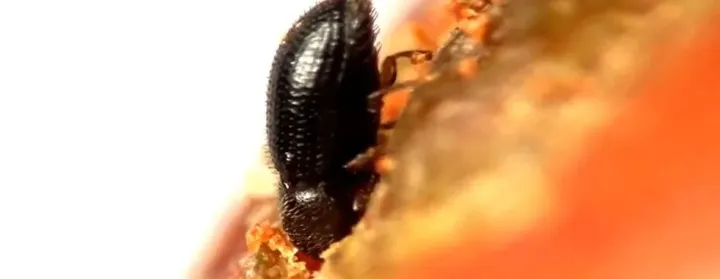
Description
How to identify
The coffee berry borer (Hypothenemus intricatus) is a small beetle belonging to the Scolytinae subfamily, famous for its destructive impact on coffee production worldwide.
Adult insects are extremely small, typically ranging from 1 to 2 millimeters in length. They are characterized by a dark brown, cylindrical body covered with fine, hair-like structures.
The life cycle is unique because most of the beetle's life is spent inside the coffee berry, protecting it from external predators and many conventional contact pesticides.
The population growth is highly dependent on environmental humidity and temperature, making tropical regions the primary habitat for this pest to complete multiple generations annually.
Females are the primary agents of infestation, boring into the coffee cherry to lay eggs, while males rarely leave the berry where they emerged, leading to a unique social structure inside the host fruit.
##damage##The coffee berry borer causes severe economic damage by directly destroying the coffee beans, which are the main marketable part of the crop.
Larval feeding activity inside the bean destroys the endosperm, significantly reducing the yield volume and causing total loss of quality for processing.
Beyond physical destruction, the tunneling of the borer creates entry points for various fungal and bacterial pathogens, which lead to further rotting and fermentation of the berries.
This pest is a major threat to coffee farmers, as even a small infestation can result in significant market value reduction, often rendering the crop unmarketable.
In addition to coffee, this species may exploit other hosts with similar seed characteristics, though its primary evolutionary focus remains the genus Coffea.
##signs##The most distinctive sign of infestation is the presence of tiny, circular holes on the surface of the coffee berries, usually found near the crown or the blossom end.
Premature ripening and dropping of cherries are common field symptoms indicating that the berries have been compromised by the beetle.
When an infested berry is cut open, one can observe internal galleries, larval stages, and powdery waste resulting from the insect's boring activities.
During the harvest phase, affected cherries often exhibit dark staining or mold growth around the entrance holes, as the beetles have introduced pathogens into the fruit.
Monitoring using ethanol-based traps is a standard procedure to detect the presence and activity levels of adult borers in the plantation before damage becomes widespread.
##control##Integrated Pest Management (IPM) is essential for controlling the coffee berry borer, starting with rigorous sanitation practices, such as removing all fallen cherries from the ground.
Biological control using entomopathogenic fungi, specifically Beauveria bassiana, has shown significant success in reducing borer populations in commercial coffee farms.
Trapping systems using specific chemical attractants help to monitor population density, allowing farmers to time their interventions more effectively.
Good agricultural practices, including systematic pruning to increase airflow and sunlight within the canopy, help create a less favorable environment for the beetles to thrive.
- Harvesting all berries completely to leave no food source for the next generation.
- Applying biological agents during peak humidity periods.
- Sorting and drying techniques to prevent further damage post-harvest.
- Maintaining healthy soil fertility to enhance the natural resilience of the trees.
Taxonomy
- Latin name
- Hypothenemus intricatus
- Order
- Coleoptera (beetles)
- Family
- Curculionidae
- EPPO code
- STEHIN
Discussion
No discussions yet — be the first.