
Coffee berry borer
Hypothenemus hampei
Description
How to identify
The coffee berry borer (Hypothenemus hampei) is a small beetle belonging to the order Coleoptera and the family Curculionidae, subfamily Scolytinae.
Measuring only 1 to 2 millimeters in length, these beetles have a robust, cylindrical body that is typically dark brown or black.
There is a distinct sexual dimorphism, where females are significantly larger and responsible for infesting the coffee berries, while males are small, flightless, and remain inside the berry.
The entire life cycle of this beetle, from egg to adult, usually occurs within the coffee bean, providing a protected environment from external threats.
Their capacity for rapid reproduction allows them to establish large colonies within a single coffee berry within a relatively short period.
What it damages
The female beetle bores a hole into the coffee berry, reaching the endosperm where it creates galleries for oviposition and larval development.
This damage directly destroys the bean, leading to significant yield loss and a decrease in the overall quality of the coffee produced.
Beyond physical destruction, the internal damage creates pathways for secondary fungal pathogens, such as Fusarium, which further degrade bean quality.
Infested berries often drop prematurely from the tree, resulting in additional labor costs for collection and significant harvest losses.
In severe infestations, almost every bean on a tree can be compromised, leading to a total loss of commercial value for the coffee harvest.
When it appears
Coffee berry borer activity is closely linked to the phenology of the coffee plant, specifically the maturation stage of the berries.
In tropical climates, the pest can persist throughout the year, especially when irrigation or irregular flowering results in multiple berry sets.
Adult females are most active during the start of the rainy season, when new berries develop and become susceptible to colonization.
High relative humidity and temperatures between 20°C and 30°C are ideal conditions that significantly shorten the beetle's development time.
During the off-season, the population survives in "mummy" berries that have fallen to the ground or remained on the tree branches.
Signs of infestation
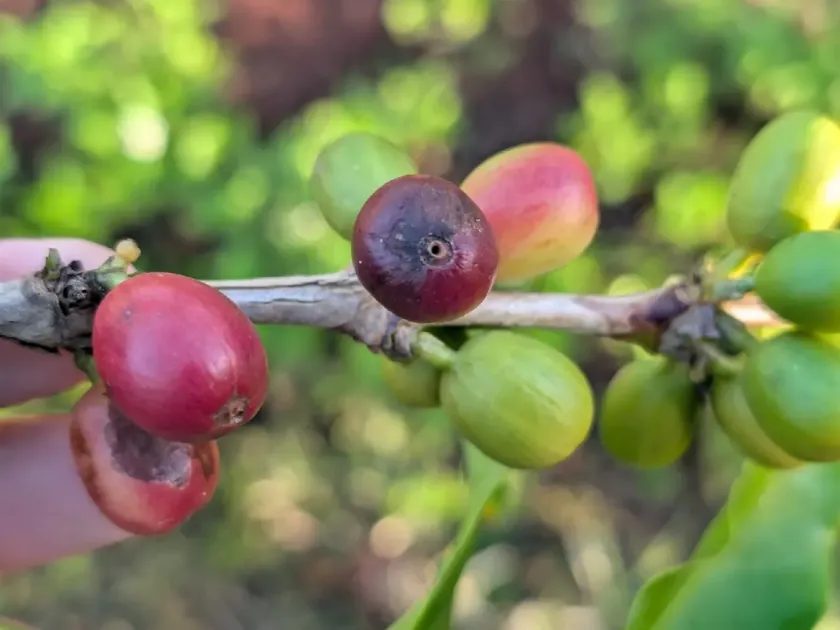
The most reliable sign of an infestation is a small, round entrance hole located at the blossom end (the "disk") of the coffee berry.
Careful inspection of the berries often reveals brownish boring dust around the entrance hole, indicating active construction of galleries.
Opening an infested berry will typically show internal damage to the endosperm, with the presence of larvae, pupae, and adult beetles inside.
Clusters of infested berries might show early ripening or blackening, contrasting with the healthy green or red berries on the same branch.
A noticeable increase in berry drop beneath the coffee trees is a strong indicator that the population has reached an economically damaging level.
Control measures
Cultural control, particularly "clean harvesting," is the most critical management step to remove reservoir berries that harbor the next generation of beetles.
Biological control using the entomopathogenic fungus Beauveria bassiana has proven to be highly effective when applied correctly under humid conditions.
Monitoring the population using alcohol-based pheromone traps allows farmers to time their interventions precisely when adults are seeking new berries.
- Strict sanitation by collecting all berries on and under the trees after harvest.
- Pruning to optimize light penetration and reduce humidity within the coffee canopy.
- Using resistant coffee cultivars if available for specific regions.
- Localized applications of systemic insecticides during peak migration periods.
Integrated Pest Management (IPM) is essential to keep the coffee berry borer under threshold levels, combining farm hygiene with biological and chemical tools.
Taxonomy
- Latin name
- Hypothenemus hampei
- Order
- Coleoptera (beetles)
- Family
- Curculionidae
- EPPO code
- STEHHA
Discussion
No discussions yet — be the first.