
Coffee berry borer
Hypothenemus erythrinae
Description
How to identify
The coffee berry borer (Hypothenemus erythrinae) is a small beetle belonging to the Curculionidae family. Measuring roughly 1.5 mm, this insect is a notorious pest that spends the majority of its lifecycle hidden inside coffee berries.
Adult females are dark, cylindrical beetles capable of flight, which allows them to infest new berries and plantations. Males are smaller, flightless, and spend their entire lives inside the berry where they were born, mating with females before they emerge.
The lifecycle encompasses egg, larva, pupa, and adult stages, all typically occurring within the seed or fruit of the coffee plant. The larvae are legless, white, and equipped with strong mandibles to bore through the hard tissue of the bean.
Due to its cryptic habit of living inside fruits, this insect is rarely seen on the surface of leaves or twigs, making conventional visual scouting difficult for plantation managers without experience.
Correct identification often requires cutting open infested berries to observe the characteristic tunneling patterns, as the damage itself is frequently the most reliable sign of the insect's presence.
What it damages
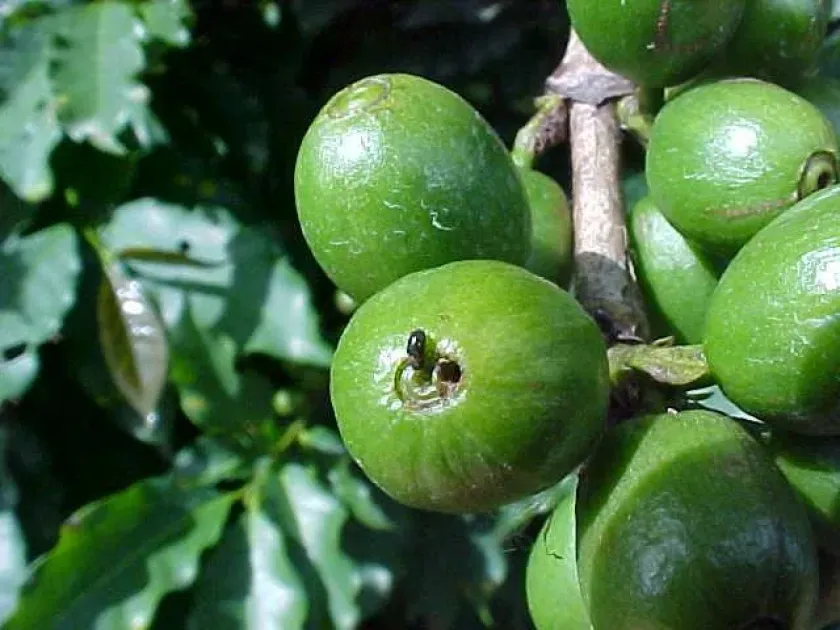
The primary damage occurs when females bore into coffee cherries to lay eggs. This action creates entry holes, compromising the integrity of the berry and allowing pathogens to enter the fruit tissue.
Once inside, larvae feed on the endosperm of the coffee bean. This feeding process destroys the seed's structure, causing significant weight loss and reducing the quality of the harvested coffee crop to unacceptable levels.
Infested beans often develop secondary fungal infections, such as those caused by Aspergillus or Fusarium. These molds introduce mycotoxins into the beans, which poses health risks and renders the coffee unmarketable.
The damage is not limited to coffee beans alone; the beetle is a polyphagous pest that can infest various legumes and other woody plants found in tropical agroecosystems, complicating local pest management.
In cases of severe infestation, yield losses can reach up to 50% or more, resulting in substantial financial losses for coffee farmers and a decrease in the overall productivity of the plantation.
Signs of infestation
The most distinctive sign of a coffee berry borer infestation is the presence of small, round entry holes on the surface of the coffee berries, usually found near the crown or the tip of the cherry.
Premature ripening and subsequent drop of berries are common indicators that an infestation is present. These fruits are often hollowed out or have significant internal damage that stunts their development.
Upon examination, the interior of the bean will show distinct tunnels filled with frass, which is the powdery waste produced by the larvae as they feed on the bean material.
Rotting or darkened patches on the surface of the fruit are secondary signs resulting from the entry holes. These spots signify that decay organisms have taken advantage of the damage caused by the beetle.
Field scouting should focus on the lower canopy and the base of the plants, where berries are often more shaded and humid, providing ideal conditions for the beetle population to thrive.
Control measures
Sanitary harvesting is the most important cultural control practice. Removing all infested and ground-fallen berries from the field effectively destroys the beetle's food source and breeding grounds.
Biological control using entomopathogenic fungi, specifically Beauveria bassiana, has shown significant promise in reducing adult beetle populations when applied during the peak of their flight activity.
Integrated Pest Management (IPM) programs frequently utilize baited traps containing chemical attractants to monitor population levels and determine the precise timing for intervention, thereby minimizing chemical use.
Chemical control, if necessary, involves the use of systemic insecticides. Applications must be carefully timed and follow strict pre-harvest intervals to ensure that no toxic residues remain in the coffee beans.
Maintaining proper tree spacing and light management is essential. A well-pruned and aerated plantation is less hospitable to the coffee berry borer, as the beetles prefer higher humidity and darker microclimates within the tree canopy.
Taxonomy
- Latin name
- Hypothenemus erythrinae
- Order
- Coleoptera (beetles)
- Family
- Curculionidae
- EPPO code
- HYOTEY
Discussion
No discussions yet — be the first.