
Colombian coffee borer
Hypothenemus columbi
Description
How to identify
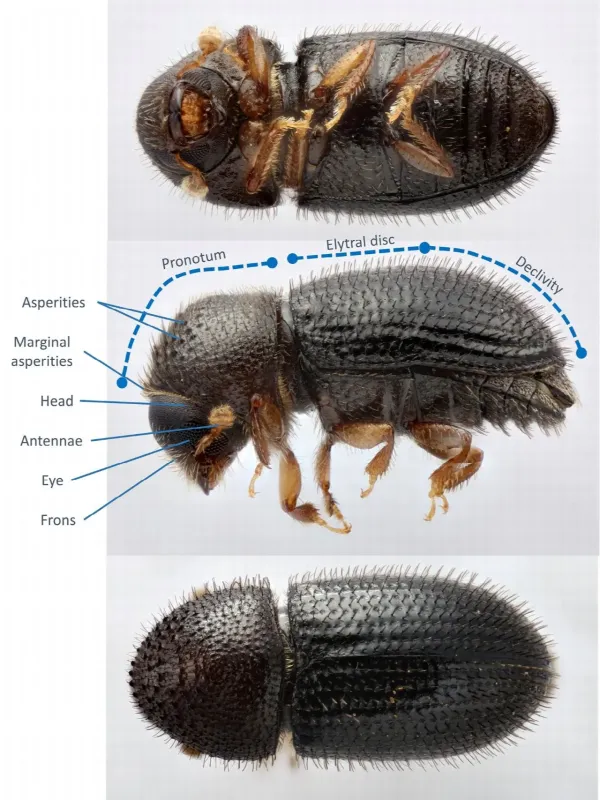
The Colombian coffee borer (Hypothenemus columbi) is a small insect belonging to the Curculionidae family, subfamily Scolytinae. These beetles are typically very small, ranging from 1.5 to 2 mm in length, which makes them difficult to detect without specialized monitoring.
The adult beetle has a cylindrical, robust body with a dark brown or black coloration. This morphology allows the insect to move efficiently through the dense tissues of coffee berries and hide within the internal structure of the seeds.
The species exhibits sexual dimorphism, where females are larger and possess wings for dispersal, while males are often wingless and remain within the host fruit. This mating behavior means that the reproduction cycle is largely hidden from external observation.
The larvae are small, legless, white grubs with a powerful set of mandibles designed for boring into hard plant matter. Their entire development takes place inside the berry, where they feed and complete their life cycle before emerging as adults.
The biology of Hypothenemus columbi is strictly dependent on the availability of suitable hosts. They require specific moisture levels and nutrient content in the fruits to successfully complete their metamorphosis, which influences their distribution patterns.
What it damages
The primary economic damage caused by the Colombian coffee borer is the destruction of the coffee bean itself. The larvae bore tunnels into the bean, consuming the endosperm and significantly reducing the weight and market value of the crop.
Beyond direct feeding, the borer creates entry points for various phytopathogenic fungi and bacteria. These secondary infections lead to fruit rot, which can spoil the entire cluster, even if the beetles have not consumed the majority of the seeds.
Heavy infestations often result in premature fruit drop. This loss of immature coffee berries directly translates to reduced yields, as the affected beans cannot develop the density or chemical composition required for high-quality production.
The presence of larvae and their frass (excrement) within the beans severely compromises the roasting quality of the coffee. Roasters often reject batches with high percentages of borer-damaged beans due to the off-flavors and aroma degradation.
In addition to quality degradation, the insect acts as a vector for various plant diseases. As adult females move between fruits to lay eggs, they spread spores of molds and other pathogens, leading to complex sanitary issues within the plantation.
When it appears
The seasonal activity of the Colombian coffee borer is closely linked to the fruit phenology of the coffee plant. The most susceptible phase for the crop is during the berry development stage, from the hardening of the endosperm to maturation.
In tropical regions, the borer can breed continuously throughout the year if host availability is constant. However, peak population growth often aligns with periods of high humidity and rainfall, which provide the micro-climate required for larval survival.
Temperature plays a crucial role in their life cycle. Warmer temperatures accelerate the metabolism of the larvae, leading to shorter generations. This can result in overlapping generations, making control efforts more challenging for plantation managers.
During the off-season, the borer can survive in residual berries left on the trees or on the ground. These «refugia» are critical for the survival of the population and serve as the source for the initial infestation of the new crop.
Monitoring the infestation cycle is essential. By using pheromone traps, agronomists can track the emergence of adults. Accurate timing of these observations is vital to prevent females from penetrating the young berries, which is the window of opportunity for control.
Signs of infestation
The most visible sign of infestation is the presence of small, perfectly circular entry holes on the surface of the coffee cherry. These holes are often located near the apex of the fruit and may have fine boring dust around them.
- Small circular entry holes on the fruit surface.
- Accumulation of fruit powder or frass at the entry point.
- Premature yellowing or shedding of the berries.
- Presence of larvae or adult beetles inside the coffee bean.
- Internal galleries filled with dark, powdery excrement.
If a suspicious cherry is dissected, internal galleries become evident. These tunnels are often filled with dark frass, which provides a stark contrast to the pale, healthy endosperm of an undamaged coffee bean.
Damaged cherries often appear shriveled or exhibit discoloration even before they are fully mature. This is due to the interruption of nutrient transport within the fruit caused by the damage to the internal structure of the seed.
Another sign of activity is the presence of fungal growth around the entry hole. This is a common secondary symptom where pathogens have entered the fruit through the borer's tunnel, causing the berry to develop a moldy or decayed appearance.
Control measures
Integrated Pest Management (IPM) is the most effective approach for controlling the Colombian coffee borer. A key component is strict sanitation: the complete removal and destruction of all infested berries after harvesting is essential to eliminate reservoirs.
Chemical control is generally limited by the fact that the pest spends most of its life inside the berry, where it is shielded from spray. Therefore, insecticide applications must be timed precisely with the adult flight peak to hit the females before entry.
Biological control methods are highly encouraged, particularly the use of entomopathogenic fungi like Beauveria bassiana. These fungi are effective because the beetles themselves carry the spores into their tunnels, spreading the pathogen to other individuals.
Cultural management, such as canopy management and proper pruning, helps improve airflow within the plantation. By reducing excessive humidity, these practices create a less favorable micro-climate for the rapid reproduction of the borer.
The use of pheromone-based traps is a standard practice for both monitoring and mass trapping. By deploying these traps strategically throughout the plantation, growers can significantly reduce the pressure of the borer population and protect the quality of the harvest.
Taxonomy
- Latin name
- Hypothenemus columbi
- Order
- Coleoptera (beetles)
- Family
- Curculionidae
- EPPO code
- HYOTCO
Discussion
No discussions yet — be the first.