
California coffee borer
Hypothenemus californicus
Description
How to identify
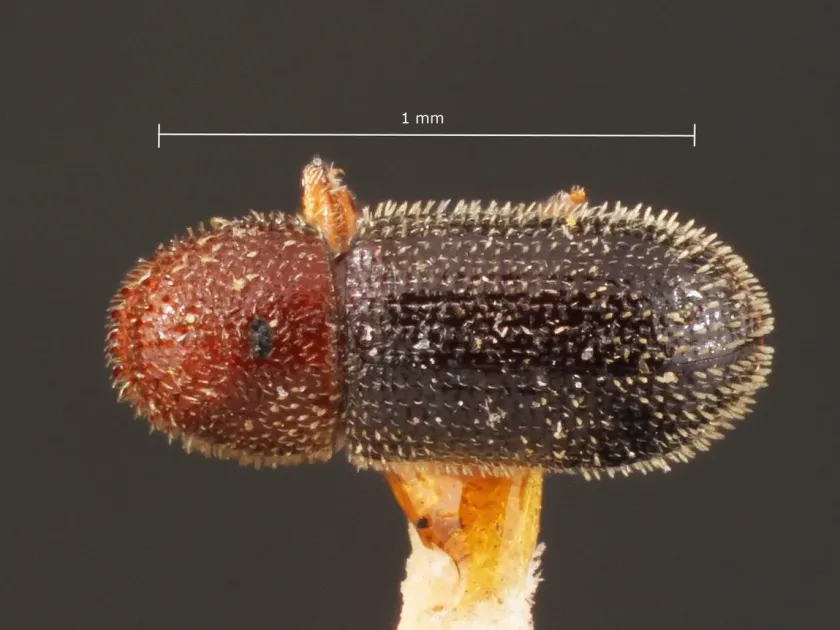
The California coffee borer (Hypothenemus californicus) is a minute beetle belonging to the Curculionidae family and Scolytinae subfamily. Adult beetles are tiny, typically measuring between 1 to 2 millimeters in length.
The body is cylindrical and ranges in color from dark brown to almost black. A distinguishing feature of the Hypothenemus genus is the presence of small scales or setae covering the elytra, which gives them a textured appearance.
The larvae are legless, C-shaped grubs with a creamy-white body and a sclerotized head capsule. They spend their entire developmental period hidden within the galleries excavated inside the host plant's tissues.
The life cycle involves egg, larval, pupal, and adult stages, all occurring within the host material. The duration of the life cycle is highly dependent on ambient temperature and host plant vigor.
These insects exhibit a cryptic lifestyle, spending most of their time sheltered inside host tissues, which makes early detection difficult for growers.
What it damages
This pest primarily infests woody plants and can occasionally cause damage to fruit crops by boring into the fruit tissue. The damage disrupts the structural integrity and nutrient transport system of the plant.
Both adults and larvae bore galleries through the bark, cambium, and sometimes into the fruit, which can significantly weaken the host plant and render it susceptible to secondary environmental stress.
Infested trees often show signs of reduced vigor, which can escalate into branch dieback or total plant collapse if the infestation is severe enough to girdle the stem or branches.
In fruit-bearing crops, the borer creates entry points that lead to fruit decay and premature drop, causing significant economic losses for farmers and orchard owners.
The wounds created by the beetle serve as pathways for opportunistic fungal and bacterial pathogens, which often exacerbate the initial damage caused by the insect activity.
Signs of infestation
The most common sign of an infestation is the appearance of tiny, circular entry holes on the bark of twigs, branches, or the surface of fruits, resembling holes made by a needle.
Small piles of boring dust, known as frass, are frequently observed near these entrance holes. This fine, sawdust-like material is expelled by the beetles as they excavate their galleries.
Yellowing, wilting, or premature drying of leaves on specific branches is often a physiological response to the blockage of sap flow caused by internal gallery damage.
When examining damaged fruit, one might notice dark necrotic lesions spreading around the entry hole, often accompanied by soft rot symptoms due to secondary infections.
A closer inspection by peeling back the bark or cutting open an infested fruit will reveal the complex network of tunnels containing larvae, pupae, and adult beetles.
Control measures
Effective management focuses on Integrated Pest Management (IPM) practices, emphasizing the maintenance of host plant health to prevent successful colonization by the borer.
Sanitation is a critical control measure; removing and destroying infested branches or entire trees reduces the local population density and prevents further spread.
Pheromone traps are highly effective for monitoring the flight activity of adult beetles, allowing for the precise timing of insecticide applications to maximize efficacy.
Biological control, including the use of entomopathogenic fungi or the conservation of natural predators, can provide sustainable suppression of borer populations in many agricultural settings.
- Sanitary pruning to remove infested plant parts.
- Balanced fertilization to maintain plant resistance.
- Proper irrigation to prevent drought-induced susceptibility.
- Timely application of systemic insecticides during flight periods.
Taxonomy
- Latin name
- Hypothenemus californicus
- Order
- Coleoptera (beetles)
- Family
- Curculionidae
- EPPO code
- HYOTCA
Discussion
No discussions yet — be the first.