
Coffee fruit borer
Hypothenemus brunneus
Description
How to identify
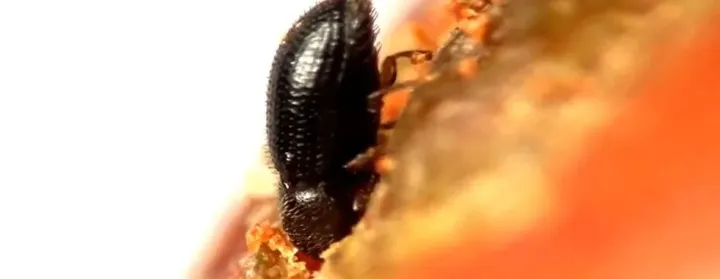
The coffee fruit borer (Hypothenemus brunneus) is a member of the Curculionidae family, specifically the Scolytinae subfamily. It is an extremely small beetle, with adults typically measuring between 1.5 and 2 millimeters in length.
These insects possess a compact, cylindrical body that is dark brown or black, which helps them blend into the coffee plant bark and the surface of the fruit.
The life cycle of this pest is completed largely within the fruit of the coffee plant, where the female bores into the berry to lay eggs.
The larval stage, which is responsible for most of the internal damage, is grub-like, legless, and white, well-adapted to life within the grain.
The species thrives in warm, humid conditions, which are typical of coffee-growing regions, allowing for rapid and overlapping generations.
What it damages
The primary damage is caused by the female beetle drilling a hole through the berry to reach the endosperm, where the seeds (coffee beans) are located.
The larvae feed on the seed, creating extensive galleries that destroy the internal integrity of the bean, rendering it useless for processing or consumption.
Secondary damage often occurs when the tunnels allow fungi and bacteria to enter the fruit, leading to premature berry rot and widespread crop loss.
Affected berries frequently drop from the tree before reaching full maturity, significantly reducing the total harvest weight.
In addition to quantitative loss, the physical destruction of the beans leads to a severe decline in the quality and market value of the harvested coffee.
Signs of infestation
The most visible sign of infestation is the presence of tiny, pin-prick-sized entry holes, usually found near the disk area of the coffee berry.
Inside the fruit, the presence of frass (excrement) and tunnel patterns confirms the activity of the borer larvae or adults.
Discoloration of the berry surface and the appearance of necrotic spots are often indicators of deeper infection caused by the insect's entry.
Premature ripening or shriveling of berries on the branches is a classic symptom of significant borer infestation within the developing seeds.
Presence of fine powdery material on the surface of the fruit or on the ground beneath the canopy indicates active boring by the beetles.
Control measures
Sanitation is the most critical control measure; all fallen berries must be collected and destroyed to break the reproductive cycle of the pest.
Trapping using alcohol-based attractants is a common practice to monitor population levels and capture flying adults during their migration phase.
Biological control using entomopathogenic fungi, particularly Beauveria bassiana, has shown significant success in reducing population density.
Chemical intervention is challenging because the pest lives inside the berry; therefore, treatments are only effective if timed correctly before the beetle enters the fruit.
Proper shade management and regular tree pruning improve air circulation, making the microenvironment less favorable for the survival and spread of the borer.
Taxonomy
- Latin name
- Hypothenemus brunneus
- Order
- Coleoptera (beetles)
- Family
- Curculionidae
- EPPO code
- HYOTBR
Discussion
No discussions yet — be the first.