
Bolivian coffee beetle
Hypothenemus bolivianus
Description
How to identify
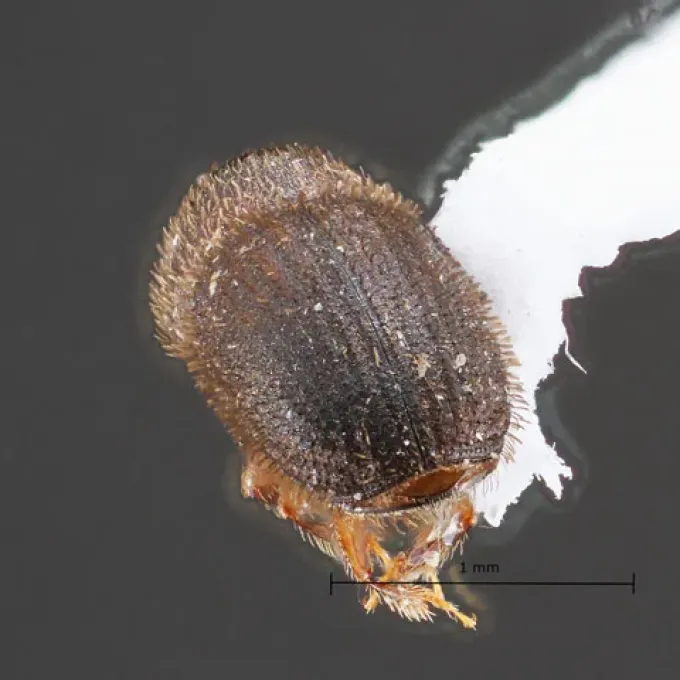
The Bolivian coffee beetle (Hypothenemus bolivianus) is a small pest belonging to the order Coleoptera and the family Curculionidae (subfamily Scolytinae). Adults are tiny, measuring only 1.5–2 mm in length.
These insects have a cylindrical, hard-shelled body that is typically dark brown or black in color. Their morphology is adapted for boring into plant tissues, particularly the hard endosperm of coffee seeds.
The larvae are small, legless grubs with a distinct, hardened head capsule. They develop entirely within the coffee bean, making them well-protected from environmental changes and predators during their growth phase.
There is a strong sexual dimorphism in this species: females are larger and capable of flight to colonize new coffee berries, while males are flightless and spend their entire life cycle inside the berry.
The life cycle is short, and under favorable tropical conditions, several generations can be produced within a single season, leading to rapid population growth on infested plantations.
What it damages
The primary damage is caused to the coffee berries, specifically the seeds (beans). Both the larvae and adults feed on the endosperm, causing direct loss of bean weight and structural integrity.
Infested beans lose their commercial value entirely. Processing such damaged coffee is difficult, and the final product is often characterized by significant defects, poor aroma, and unpleasant taste profiles.
The boring activity facilitates the entry of pathogenic fungi and bacteria, leading to secondary rot. This decay process ruins the beans and can result in the loss of entire harvest batches if left unmonitored.
Young berries attacked by the beetle often drop prematurely. This leads to substantial yield reductions, as the tree loses potential production before the harvest begins.
Seed vitality is also compromised, making infested coffee beans unsuitable for nursery propagation. This impact is critical for farms focused on maintaining or expanding their coffee tree varieties.
Signs of infestation
A key indicator of infestation is the presence of tiny, circular entry holes usually found on the top of the coffee berry near the disk area. These holes are the entry points for female beetles.
If you split an infested bean, you will see internal galleries or tunnels created by the larvae. The bean often looks crumbly, discolored, or shows signs of mold growth resulting from the beetle's activity.
Premature ripening and the drying of berries on the branches (often referred to as 'mummies') are classic symptoms of a high infestation level within the orchard.
A reduction in the total weight of harvested coffee is a subtle but consistent sign. Farmers often notice that the yield per bag is lower than expected, which can be correlated with the beetle population density.
Using pheromone or attractant-based traps in the field can confirm the presence of adult beetles, allowing for early detection before massive damage to the crop occurs.
Control measures
Sanitation is the most important control measure. Removing all leftover berries from the branches and clearing the ground of fallen fruit after the harvest is critical to disrupt the beetle's breeding cycle.
Biological control using entomopathogenic fungi, such as Beauveria bassiana, has proven effective in reducing population levels and is considered a sustainable tool for coffee plantation management.
Chemical control is challenging because the larvae are protected inside the berry. Applications must be timed precisely to target adult females during their short flight period when they migrate to new berries.
Proper agronomic practices, including regular pruning to keep the trees open and well-ventilated, can help create an environment less conducive to beetle outbreaks and secondary infections.
- Regular monitoring with attractant traps.
- Strict post-harvest orchard sanitation.
- Application of biological insecticides.
- Selection of resistant or less susceptible coffee varieties.
Taxonomy
- Latin name
- Hypothenemus bolivianus
- Order
- Coleoptera (beetles)
- Family
- Curculionidae
- EPPO code
- HYOTBO
Discussion
No discussions yet — be the first.