
Burmese coffee berry borer
Hypothenemus birmanus
Description
How to identify
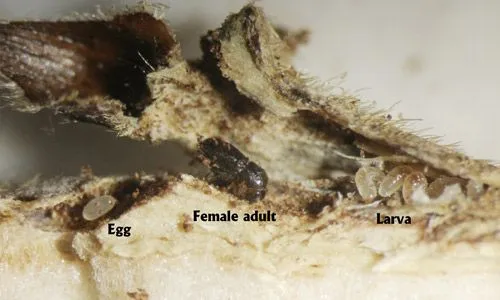
The Burmese coffee berry borer (Hypothenemus birmanus) is a small bark beetle belonging to the Curculionidae family, subfamily Scolytinae. Adult insects are very small, measuring about 1.5–2 mm in length, with a cylindrical, dark brown or black body.
The life cycle of this pest is intimately linked to the seeds of tropical crops. Females are the primary pests that penetrate the interior of the coffee bean to lay their eggs, while males often remain underdeveloped and stay within the galleries.
Due to their tiny size, identifying the species in the field often requires careful examination of coffee beans using magnification tools. Visual inspection of individual berries is the most reliable way to detect early stages of infestation.
Taxonomically, this species is classified as a significant seed pest, specializing in damaging the reproductive organs of host plants, which makes it a serious threat to the productivity of coffee and cacao farms worldwide.
It is crucial to distinguish this species from other members of the Hypothenemus genus, as H. birmanus exhibits high adaptability to tropical heat and a very aggressive reproductive strategy within the host fruits.
What it damages
This beetle primarily infests coffee (Coffea spp.) and cacao (Theobroma cacao). The pest is capable of attacking both ripening and fully developed fruits by boring through the outer husk to reach the endosperm.
Beyond coffee and cacao, the beetle may attack other tropical fruits with similar seed structures, provided the seeds offer sufficient nutritional value for larval development within the grain.
Larvae consume the endosperm, creating extensive galleries and tunnels. This results in the complete loss of commercial quality, making the beans unfit for processing, roasting, or consumption.
A secondary consequence of infestation is the introduction of pathogenic fungi through the entry holes. These infections accelerate fruit decay and significantly degrade the sensory quality of any remaining healthy parts of the crop.
Economic losses can be severe, with reports of damage exceeding 50% of the total yield in fields where sanitation practices are ignored or where the pest population is left unchecked.
When it appears
The activity of this pest is heavily dependent on the phenology of the host plant and local climatic conditions. In tropical regions, breeding can occur year-round if fruits at different stages of maturity are present on the trees.
Population peaks typically coincide with periods of high humidity and stable warm temperatures. These conditions favor the flight of adult females as they migrate from old remnants to fresh fruits to initiate a new reproductive cycle.
The infestation season usually aligns with the fruit formation stage. During this time, female beetles actively seek out young coffee berries to bore into, leading to a rapid increase in the number of generations.
Poor plantation management, particularly leaving infested berries on the branches or the ground, creates an ideal reservoir for the pest to persist throughout the year and prepare for the next harvest cycle.
Temperatures above 25°C significantly accelerate the metabolic rate of the larvae, reducing the full life cycle from egg to adult to as little as 20-30 days, which facilitates a rapid buildup of the population.
Signs of infestation
The most prominent sign of infestation is the appearance of tiny, circular entry holes on the surface of the coffee berry, usually located around the disc or the apex of the fruit.
Upon dissecting the affected fruit, one can find white larvae and fine, brown frass (waste material) that fills the space between the damaged bean and the fruit skin, indicating active feeding.
Premature fruit drop is also a major indicator of severe infestation. Infested berries often appear shriveled, discolored, and dehydrated compared to the healthy, vibrant berries on the same branch.
Using traps treated with specific chemical attractants is a highly effective method for early diagnosis. Detecting the first arrivals of the beetle allows growers to implement control measures before the infestation spreads across the plantation.
Plants with heavy infestations may show signs of stress, including leaf yellowing or stunted fruit growth, as the internal damage to the seeds redirects the tree's energy and disrupts the fruit's maturation process.
Control measures
The foundation of effective control is strict phytosanitary management. Regular collection and destruction of all fallen berries and infested fruit remaining on trees are essential to break the pest's reproductive cycle.
- Deployment of pheromone traps for population monitoring.
- Timely harvesting to reduce the window of exposure.
- Removal and burning of all infested crop residues.
- Maintaining adequate spacing to ensure good air circulation.
- Application of insecticides during peak female flight periods.
Chemical control is notoriously difficult because the larvae are protected inside the hard fruit shell. Therefore, systemic insecticides or specifically timed contact treatments are required for any significant effect.
Biological control, such as the use of entomopathogenic fungi like Beauveria bassiana, has shown great promise in suppressing beetle populations while being safer for the environment and the quality of the coffee harvest.
Integrated Pest Management (IPM) strategies should combine cultural practices with biological controls to minimize pesticide use, ensuring the long-term sustainability of the plantation and the quality of the final product.
Taxonomy
- Latin name
- Hypothenemus birmanus
- Order
- Coleoptera (beetles)
- Family
- Curculionidae
- EPPO code
- HYOTBI
Discussion
No discussions yet — be the first.