
Coffee berry borer
Hypothenemus
Description
How to identify
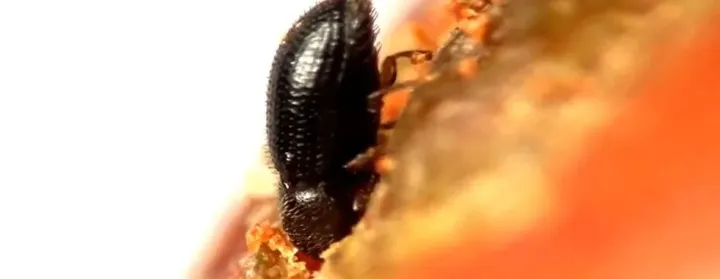
The coffee berry borer (Hypothenemus hampei) is a small beetle belonging to the order Coleoptera and the family Curculionidae. It is widely considered the most devastating pest of coffee plantations worldwide.
Adult beetles are extremely small, typically measuring between 1 and 2 millimeters in length. They have a cylindrical, dark brown to black body that is perfectly adapted to boring into the hard endosperm of coffee seeds.
The species displays extreme sexual dimorphism: females are the ones that fly and colonize new berries, while males are smaller, flightless, and spend their entire, short lives inside the berry where they were born.
The life cycle consists of egg, larva, pupa, and adult stages, with the entire development occurring within the coffee seed, which provides both food and protection from environmental stress and predators.
Due to its secluded lifestyle, the beetle is highly resilient and difficult to eradicate, making it a persistent challenge for coffee producers in tropical regions across the globe.
What it damages
The coffee berry borer causes significant damage by boring into the fruit and laying eggs inside the seed. The larvae then consume the endosperm, creating intricate tunnels throughout the bean.
This feeding activity destroys the commercial value of the bean. Damaged beans are lighter in weight, prone to breaking during processing, and produce a poor-quality brew due to the bitter taste caused by the beetle's presence.
Furthermore, the physical entry of the beetle facilitates the colonization of the berry by fungi, such as Aspergillus ochraceus, which can produce ochratoxin A, a harmful mycotoxin that compromises food safety.
Severe infestations lead to massive yield losses, as damaged fruits often fall prematurely. In many cases, if management is neglected, the infestation rate can exceed 50-80% of the harvest.
Even moderate infestations result in significant economic hardship, as affected beans must be sorted out, increasing labor costs and reducing the overall grade and market price of the coffee batch.
When it appears
The activity of the coffee berry borer is heavily dictated by the phonology of the coffee tree and local climatic conditions. In equatorial regions, breeding occurs year-round, while in other regions, it correlates with the rainy season.
The emergence of female beetles from old, dried berries is triggered by the availability of new green berries. Once the berries reach a certain level of hardness and moisture, the females begin to colonize them.
Dry periods often force the beetles to enter a state of dormancy within the infested berries. They remain protected inside the hard shell of the fruit until conditions become favorable again for reproduction.
Monitoring the onset of the wet season is crucial for growers, as this is when the beetle population typically sees a surge in activity and dispersal to new fruit sites.
Synchronizing cultural practices, such as pruning and cleaning, with the seasonal patterns of the beetle is essential to keep the population density below the economic damage threshold.
Signs of infestation
The most visible sign of infestation is the presence of small, perfectly circular entry holes at the blossom end (the disc) of the coffee berry. These holes are usually less than 1 mm in diameter.
Brown, powdery "frass" or dust often accumulates at the entry hole, providing a clear indication that a female beetle has successfully penetrated the berry and is actively tunneling.
Premature ripening or "blackening" of berries is another common symptom. Infected berries may turn colors prematurely and eventually drop from the tree, significantly reducing the potential yield.
Upon opening a suspicious berry, one can find the tunnels made by the larvae, and inside the bean, it is common to find adult females, larvae, and pupae at various stages of development.
A cluster of fallen berries under the tree canopy is a strong indicator of an ongoing infestation. These fallen berries act as primary reservoirs, allowing the pest to survive and re-infest the tree.
Control measures
The cornerstone of management is "field sanitation," which involves the diligent collection and destruction of all infested berries, both from the trees and the ground, to remove the beetle's habitat.
Biological control using the entomopathogenic fungus Beauveria bassiana has proven effective. When sprayed, the fungal spores infect and kill the beetles, helping to suppress population levels naturally.
Mass trapping using specialized traps baited with a mixture of methanol and ethanol is an effective strategy to capture host-seeking females, thereby reducing the number of fertile beetles colonizing new berries.
Chemical control is generally avoided or used as a last resort because the beetle is protected within the berry for most of its life, making insecticides less effective and increasing environmental risks.
An Integrated Pest Management (IPM) approach, combining sanitation, biological control, and regular monitoring, is the most sustainable way to manage the coffee berry borer and protect the crop's quality.
Taxonomy
- Latin name
- Hypothenemus
- Order
- Coleoptera (beetles)
- Family
- Curculionidae
- EPPO code
- HYOTSP
Discussion
No discussions yet — be the first.