
Hypolixus weevil
Hypolixus
Description
How to identify
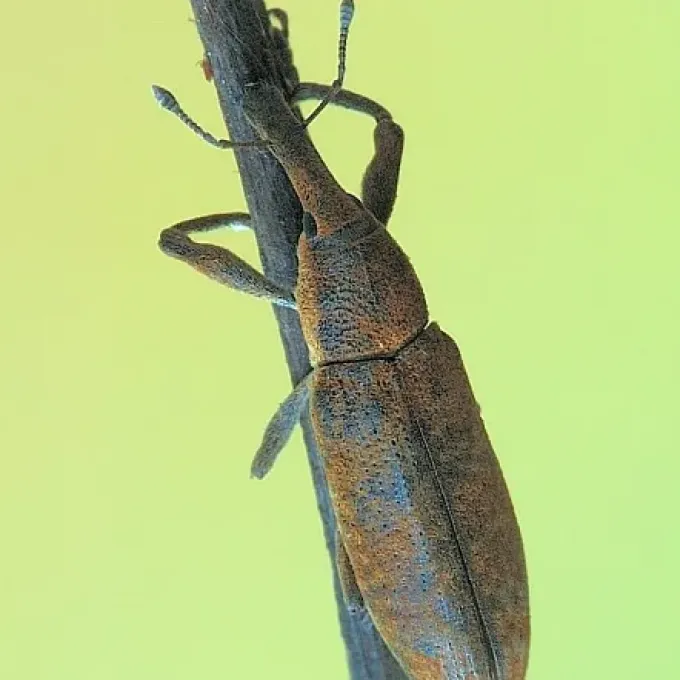
The Hypolixus weevil belongs to the Curculionidae family and is recognized by its characteristic elongated snout, which is typical for all members of this group.
Adult insects are generally cylindrical in shape, often covered with protective dust or scales that help them blend into the stems of host plants.
The larvae are apodous (legless) and possess a pale, fleshy body with a heavily sclerotized head, designed for mining plant tissues.
Their life cycle consists of a complete metamorphosis, including egg, larval, pupal, and adult stages, with each stage adapting to specific environmental conditions.
These weevils have evolved to be highly mobile, allowing them to disperse efficiently across fields and find suitable host plants for oviposition.
What it damages
The genus Hypolixus primarily affects plants in the Amaranthaceae family, with sugar beets and other root crops being the most susceptible.
Adult weevils cause damage by feeding on foliage, while larvae cause significant internal injury by boring into stalks and the crowns of roots.
This internal feeding disrupts the plant's vascular system, leading to stunted growth and a considerable decrease in the overall quality and sugar content of the crop.
In cases of heavy infestation, the structural integrity of the plant is compromised, making it prone to snapping under wind or harvesting equipment.
Furthermore, the tunnels created by larvae facilitate the entry of secondary pathogens, such as bacteria and fungi, causing rot throughout the field.
When it appears
Overwintered adults emerge from the soil in late spring, aligning their activity with the seedling emergence of their host plants.
Mating and egg-laying occur over a protracted period, often resulting in overlapping generations throughout the warmer months of the year.
The peak activity of adults usually coincides with sunny, dry weather, when they feed on stems and prepare to lay eggs in fresh plant tissue.
As the season progresses toward autumn, the new generation of adults reaches maturity and seeks overwintering sites in crop debris or deep in the soil.
Temperature fluctuations are a primary driver for the developmental speed of the larvae, with warmer climates favoring faster life cycles.
Signs of infestation
Early indicators of infestation include irregular holes in leaves and stalks caused by adult feeding patterns during the spring.
Stalk deformation, such as bending or twisting of the leaf petioles, serves as a clear diagnostic feature of larval activity inside the plant.
Upon splitting an infested stem, one can clearly see larval tunnels filled with dark frass, which effectively blocks the plant's nutrient transport.
Plants heavily infested by the weevil may show signs of premature wilting or yellowing, even when soil moisture conditions are optimal.
- Holes on the surface of leaf petioles.
- Internal tunneling within the main stem.
- Deformed growth of the plant canopy.
- Presence of larval frass in the pith.
Control measures
Crop rotation is considered the most effective long-term strategy for managing Hypolixus populations by disrupting their host availability.
Deep autumn tillage is highly recommended to expose overwintering stages to cold temperatures and predators, thereby reducing the spring pest pressure.
When infestation levels exceed the economic threshold, the application of systemic insecticides is necessary to reach the hidden larvae inside the stems.
Sanitation practices, including the removal of wild host plants like wild beets and pigweed, help minimize the infestation of commercial crops.
Regular field scouting is essential to identify the onset of adult activity, allowing for timely intervention before larvae begin mining the plant tissues.
Taxonomy
- Latin name
- Hypolixus
- Order
- Coleoptera (beetles)
- Family
- Curculionidae
- EPPO code
- HYPXSP
Discussion
No discussions yet — be the first.