
Clover leaf weevil
Hypera nigrirostris
Description
How to identify
The clover leaf weevil (Hypera nigrirostris) is a small beetle belonging to the Curculionidae family. It is a common pest of various leguminous crops, particularly clover.
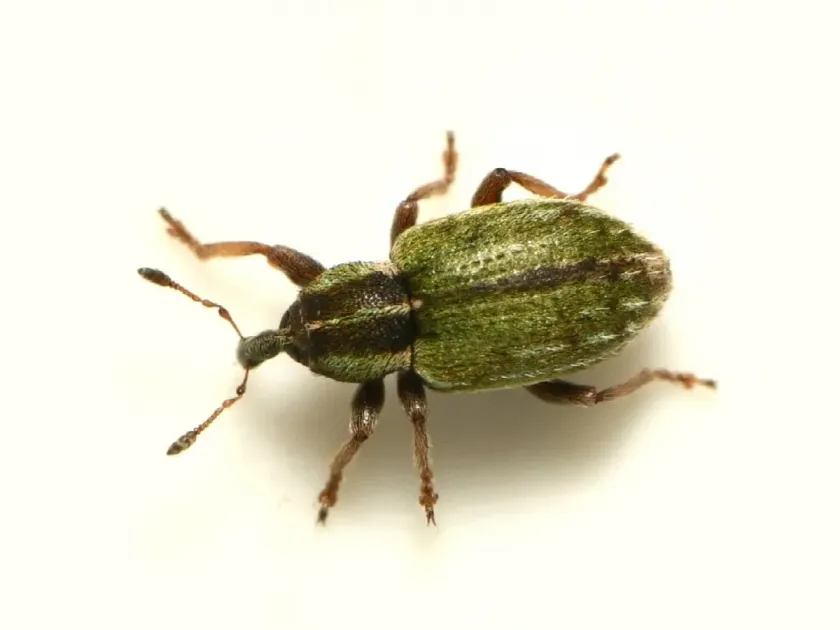
Adult weevils are typically 3 to 4 mm long. Their bodies are covered in dense scales that often appear bright green or emerald, helping them blend into the foliage.
The most distinctive feature of this species is its black rostrum (snout), which distinguishes it from other related weevil species commonly found in pastures and fields.
The larvae are approximately 5 mm in length, pale yellow in color, and feature a dark head. They are often found feeding on the undersides of leaves or within the leaf buds.
The species completes one generation per year. Adults typically overwinter in the soil or under dense plant debris, emerging in early spring as temperatures rise.
What it damages
Clover is the primary host for Hypera nigrirostris. However, it can also cause significant damage to other crops such as alfalfa, vetch, and occasionally peas.
Both adults and larvae cause economic damage. Adults feed on the leaf margins, creating irregular notches and holes, while larvae feed on tender new tissue and buds.
Severe infestations can lead to substantial reduction in leaf area, which decreases the plant's photosynthetic capacity and weakens its overall vigor.
In seed-production fields, the larvae are particularly destructive as they feed on the floral parts, causing aborted blossoms and significantly lower seed yields.
When populations are high, the impact on forage quality is significant, reducing the total biomass harvested for silage or hay.
Signs of infestation
The most recognizable sign of infestation is the presence of small, rounded holes or notches on the leaves, which are the result of adult feeding patterns.
Larval activity often results in the skeletonization of leaves, where only the veins remain. This gives the foliage a ragged, tattered appearance across the field.
If you inspect the terminal buds or newly unfurling leaves, you may find the larvae concealed inside. They are sensitive to disturbance and may drop to the ground when touched.
A decline in the overall growth rate of the clover stand after the spring emergence is a common field-level indicator of a potential infestation.
The presence of fine silk-like cocoons attached to the leaves is a clear sign that the larvae have pupated, indicating that the current generation has reached its final development stage.
Control measures
Cultural control is the first line of defense. Early harvesting of the clover crop is an effective technique to remove larvae and interrupt their life cycle before they reach the adult stage.
Maintaining crop rotation and ensuring new stands are not established immediately adjacent to old, heavily infested fields can limit the spread of the weevil population.
Chemical control should be utilized only when infestation levels exceed established economic thresholds. Insecticides must be applied in accordance with regional agricultural regulations.
When choosing a chemical solution, it is vital to check the safety labels regarding the pre-harvest interval, especially if the clover is intended for livestock feed.
Biological control, by encouraging natural predators such as parasitic wasps and predatory beetles, can play a significant role in long-term integrated pest management strategies.
Taxonomy
- Latin name
- Hypera nigrirostris
- Order
- Coleoptera (beetles)
- Family
- Curculionidae
- EPPO code
- HYPRNI
Discussion
No discussions yet — be the first.