
Alfalfa weevil
Hypera murina
Description
How to identify
The alfalfa weevil (Hypera murina) is a significant coleopteran pest belonging to the Curculionidae family, which frequently affects forage legume crops.
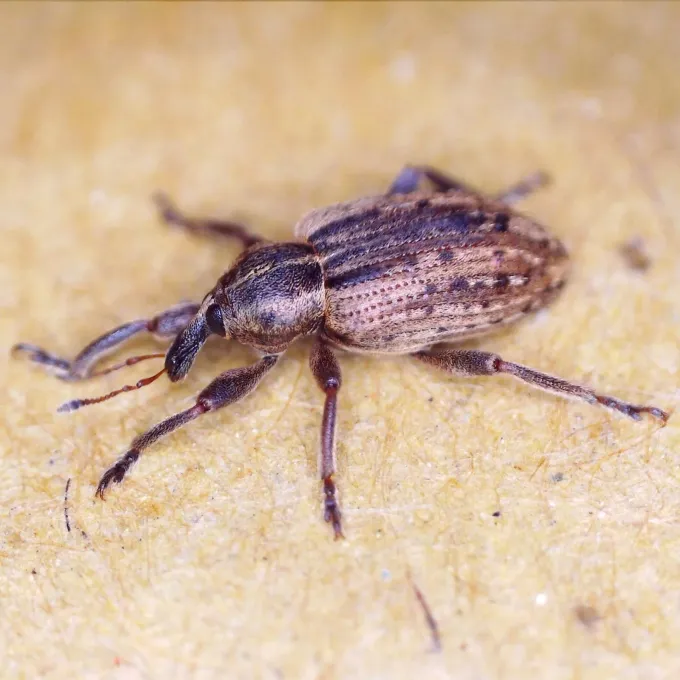
Adult beetles are relatively small, typically reaching 4–5 mm in length, with a distinct elongated snout and a mottled gray-brown body that camouflages them within plant debris.
Larvae are easily recognized by their legless, C-shaped body, which displays a vibrant green color highlighted by a clear white or yellowish stripe running down the back.
The life cycle involves complete metamorphosis: after the larval stages, the insect pupates within a protective, lacy, spherical cocoon often attached to the host leaves.
This species is highly adapted to temperate climates, successfully overwintering in various stages or as adults to emerge with the first warmth of spring.
What it damages
The primary host for Hypera murina is alfalfa (lucerne), but it is also capable of causing substantial damage to other related legumes such as sainfoin and clover.
Adults consume small portions of foliage and stems, but the primary economic impact is caused by larvae, which feed voraciously on the developing leaf tissues.
By skeletonizing the leaves, the larvae significantly impair the plant's ability to photosynthesize, directly reducing the total yield of dry matter and nutritional quality.
Severe infestations can lead to substantial losses in seed production, as the larvae frequently target the developing flower buds and reproductive parts of the plant.
In high-pressure years, the combined feeding of adults and larvae can result in stunted growth and premature plant senescence, requiring immediate intervention.
When it appears
The insect typically overwinters as an adult in the soil or protected under crop residues, emerging as temperatures rise during the early spring vegetative phase.
Egg-laying begins shortly after emergence, with females inserting eggs into the stems or petioles of the alfalfa, ensuring the larvae have immediate access to food.
Peak larval activity generally aligns with the rapid spring growth phase of the alfalfa, making the bud-to-early-flowering stage the most critical window for surveillance.
After the larvae complete their development and pupate, the newly emerged adults feed for a short period before entering a period of summer aestivation.
The timing of these life stages is tightly linked to thermal accumulation, meaning that in warmer springs, the pest development accelerates significantly.
Signs of infestation
Early symptoms include small pin-sized holes in the foliage, often appearing on the uppermost, younger leaves where the adult beetles are most active.
As larval density increases, the damage progresses to extensive leaf skeletonization, leaving behind only the tougher veins and midribs, which gives the field a frosted appearance.
- Frosted, grayish appearance of the field during heavy infestation.
- Presence of larvae on the growing tips and in the plant canopy.
- White or yellowish silk cocoons visible on leaves or flowers.
- Reduced plant vigor and uneven height throughout the field.
- Visible flower bud damage and potential loss of bloom.
The severity of infestation can be estimated by shaking plant terminals into a bucket to count the number of larvae per stem, a standard diagnostic procedure.
Control measures
Cultural control remains a cornerstone of management, specifically the timing of the first cutting, which can remove the larval population before they reach maturity.
Practicing crop rotation and maintaining spatial distance between new and established alfalfa fields can significantly reduce the risk of infestation.
Biological control options involve preserving natural enemies such as parasitic wasps, which can help keep the pest population below the economic threshold.
When chemical intervention is necessary, insecticides should be applied based on local economic threshold counts to minimize the impact on beneficial pollinators.
Promoting crop vigor through appropriate fertilization and soil management helps the plants tolerate minor levels of feeding and recover more rapidly after pest pressure.
Taxonomy
- Latin name
- Hypera murina
- Order
- Coleoptera (beetles)
- Family
- Curculionidae
- EPPO code
- HYPRMU
Discussion
No discussions yet — be the first.