
Clover leaf weevil
Hypera meles
Description
How to identify
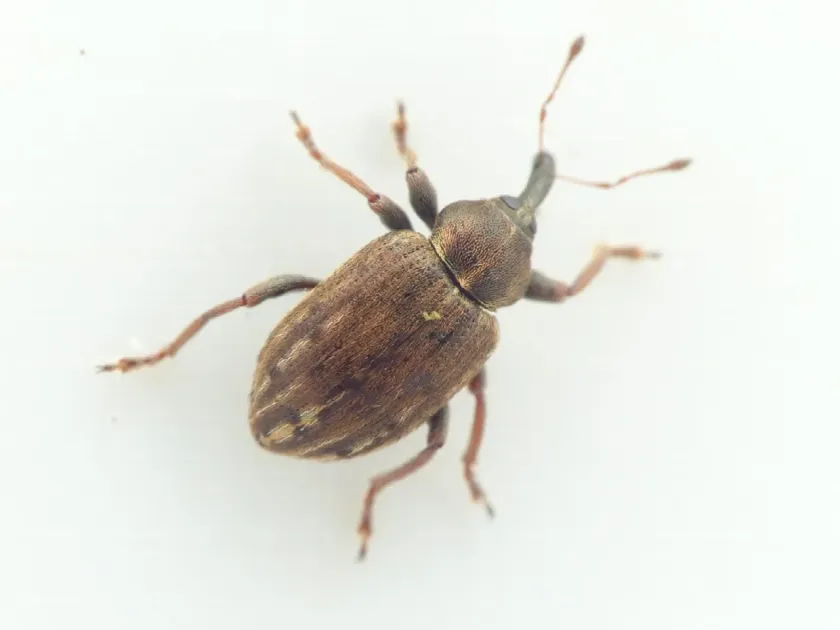
The clover leaf weevil, scientifically known as Hypera meles, is a member of the Curculionidae family. These beetles are relatively small, typically measuring between 4 to 5 mm in length, and exhibit a grey-brown color pattern.
Their bodies are densely covered in scales, which help them blend into the environment. A defining feature is their elongated snout, or rostrum, which is a common characteristic among members of the Hypera genus.
Larvae are arc-shaped and lack legs, featuring a distinct dark head that contrasts with their pale, often greenish or yellowish body. They reach a size of about 5–6 mm during their final development stage.
A unique identifier for this species is the lacy, web-like cocoon that the larvae construct to pupate. These structures are often found on the leaves or within the foliage of host plants.
The life cycle involves complete metamorphosis, consisting of eggs, larvae, pupae, and adults. In most climates, there is one generation per year, with adults serving as the overwintering stage.
What it damages
This pest primarily targets leguminous crops, with a strong preference for red clover (Trifolium pratense) and white clover (Trifolium repens). Other legumes, such as vetch and alfalfa, may also be affected.
Adult beetles feed on the foliage, leaving behind small holes or notched edges. While this feeding damage is usually not lethal to the plant, it can reduce its photosynthetic capacity if populations are high.
The most severe damage is caused by the larvae. They climb into the flower heads and consume the developing reproductive parts, which prevents successful seed formation and causes significant yield losses.
In seed production fields, the clover leaf weevil is considered a major threat. Because the larvae feed inside the buds, they are difficult to detect until substantial damage to the crop has already occurred.
Heavy infestations can lead to a drastic reduction in seed harvest, often resulting in economic losses that necessitate intervention in commercial farming operations.
When it appears
Adults overwinter in the soil, under plant debris, or in field margins. They emerge early in the spring as temperatures rise, beginning their activity by feeding on young clover foliage.
After a period of maturation and mating, females lay eggs by drilling into the stems or petioles of the host plants. The eggs hatch within a couple of weeks, depending on ambient temperatures.
Larvae appear in sync with the plant's budding phase. This is the period when they cause the most harm, as they move into the floral structures to feed on vital reproductive tissues.
Pupation typically occurs during the summer months, leading to the emergence of the new generation of adults. These beetles remain active during the warm months before seeking overwintering sites.
The timing of the larvae's emergence is critical for farmers, as it defines the window of opportunity for effective monitoring and pest control measures.
Signs of infestation
Early signs of infestation include minor, non-systemic leaf damage, such as small notches. While noticeable, these are often considered secondary compared to the reproductive damage.
The most alarming sign is the presence of distorted, drying, or damaged flower heads. If clover heads fail to bloom correctly or appear necrotic, an inspection is necessary to check for larval activity.
Carefully dissecting flower buds will reveal the larvae hiding inside. This is the most reliable way to confirm the presence of the pest and assess the intensity of the infestation.
The presence of fine, lacy, white cocoons on the leaves is a clear indicator that the larval stage has completed its development and pupation has occurred.
Reduced seed set and irregular maturity of clover heads are indirect signs that the pest has successfully fed on the developing seeds during the critical flowering period.
Control measures
Cultural control practices are essential. This includes crop rotation, isolating new seed fields from older clover stands, and deep plowing after harvest to destroy overwintering adults.
Managing the surrounding area by mowing weeds and field margins can significantly reduce the local population of the weevil and prevent them from migrating into the main crop.
Chemical control should be applied during the early budding stage before the larvae have effectively hidden within the flower heads. Systemic or contact insecticides are typically recommended.
Biological control options, including the use of entomopathogenic fungi, are being explored as part of integrated pest management (IPM) programs to reduce reliance on conventional pesticides.
- Regular field scouting during spring budding.
- Use of certified, high-quality seeds.
- Applying insecticides based on economic thresholds for seed fields.
Taxonomy
- Latin name
- Hypera meles
- Order
- Coleoptera (beetles)
- Family
- Curculionidae
- EPPO code
- HYPRME
Discussion
No discussions yet — be the first.