
Alfalfa leaf weevil
Hypera arator
Description
How to identify
The alfalfa leaf weevil (Hypera arator) is a beetle belonging to the Curculionidae family. It is a specialized pest that targets alfalfa and other related leguminous crops, often causing significant economic losses.
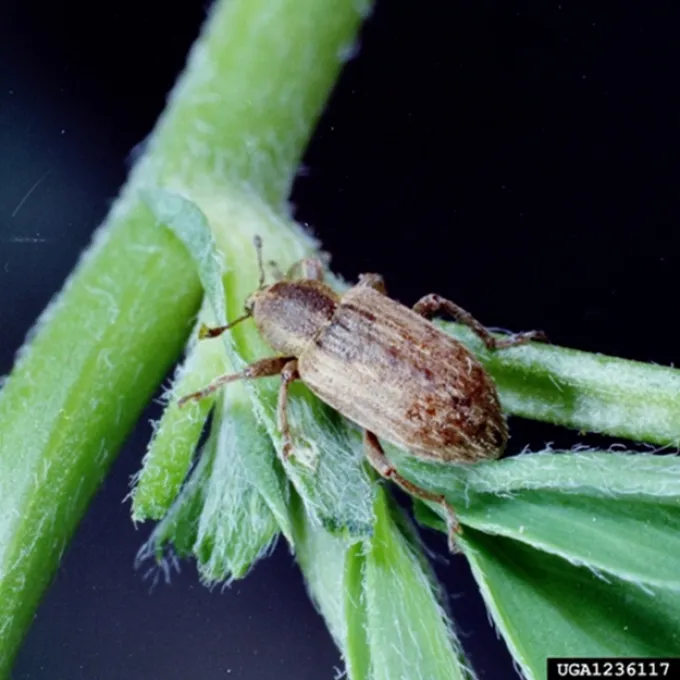
Adult weevils are small, typically measuring between 3 and 5 mm in length. They possess an elongated snout (rostrum) typical of the weevil family and are characterized by their muted, grey-brown coloration.
The body of the adult is covered in dense scales that often create specific patterns, helping the insect blend in with soil, dried leaves, and plant debris, making them difficult to spot during daytime.
Larvae are legless, with a C-shaped body that is creamy or greenish-white in color, and they feature a dark, sclerotized head capsule. They are often hidden within the plant's terminal buds.
As members of the order Coleoptera, these insects possess a rigid exoskeleton that offers protection against environmental stresses, complicating the timing and efficacy of contact insecticide applications.
What it damages
Both adult weevils and their larvae are responsible for plant damage. Adults feed on the leaf margins, creating small notches, which can reduce the photosynthetic capacity of the alfalfa foliage.
The most severe damage is caused by the larvae, which burrow into the terminal buds and young, developing leaves. This feeding pattern causes the leaves to skeletonize and eventually turn brown or shriveled.
Infested alfalfa fields often show a patchy, scorched appearance. If the infestation occurs early in the season, it can severely stunt plant growth and drastically reduce the tonnage of the first cutting.
Beyond quantity, the quality of the hay is compromised. Damaged plants tend to have a lower nutrient profile as the energy reserves are diverted towards surviving the herbivore pressure rather than biomass accumulation.
In seed production fields, the larvae may feed on flower buds and developing seed pods, leading to significant yield loss and economic damage for seed producers.
When it appears
The life cycle of the alfalfa leaf weevil is synchronized with the seasonal growth of the host crop. Overwintering adults emerge from soil crevices or plant litter in early spring as temperatures rise.
Feeding and mating begin shortly after emergence, coinciding with the rapid regrowth of alfalfa. Females deposit eggs into the stems or petioles, starting the cycle of the new generation.
Larval development typically lasts several weeks, during which they progress through several instars. The most intense feeding pressure usually occurs in mid-to-late spring, depending on the region's climate.
Pupation takes place within silk-like cocoons attached to the leaves or sheltered areas on the plant. A new generation of adults usually emerges by early summer, before entering a period of summer diapause.
The duration and intensity of the life cycle vary significantly based on temperature and moisture. Warmer springs can lead to earlier and more synchronized emergence, increasing the risk of widespread damage.
Signs of infestation
One of the earliest signs of an infestation is the presence of small, circular "shot holes" in the developing leaf tissue, followed by more extensive ragged feeding patterns along the leaf edges.
A telltale sign of larval activity is the presence of withered or yellowish terminal leaves. Upon close inspection, these leaves are often found to be partially consumed or webbed together by the larvae.
During spring field monitoring, the presence of these insects can be confirmed using a sweep net. Calculating the number of larvae per sweep is the standard method for determining the need for intervention.
The presence of fine, white, net-like cocoons found on the leaves or stems confirms that the larvae have completed their development and are transitioning into the pupal stage.
Overall field appearance, such as a "frosted" or stunted appearance of the crop, serves as a late-stage indicator that the infestation has reached levels exceeding the economic threshold.
Control measures
Integrated Pest Management (IPM) is essential for controlling the alfalfa leaf weevil. Early harvesting is one of the most effective mechanical methods to disrupt the larvae's developmental cycle.
Scouting is the cornerstone of control; growers should monitor their fields regularly in the spring to assess larval populations. Treatments should only be applied when the economic threshold is exceeded.
Chemical control involving systemic or contact insecticides may be necessary in high-pressure scenarios. It is crucial to choose products that minimize harm to pollinators and beneficial predatory insects.
Biological control, including the encouragement of naturally occurring predators and parasitoids, can help suppress weevil populations over time, reducing the need for synthetic inputs.
- Regular sweep net sampling to estimate population density.
- Early harvest to remove larvae before they pupate.
- Targeted insecticide use based on economic threshold values.
- Maintaining field health to ensure vigorous, resilient plant growth.
Taxonomy
- Latin name
- Hypera arator
- Order
- Coleoptera (beetles)
- Family
- Curculionidae
- EPPO code
- HYPRAR
Discussion
No discussions yet — be the first.