
Red-haired pine bark beetle
Hylurgus ligniperda
Description
How to identify
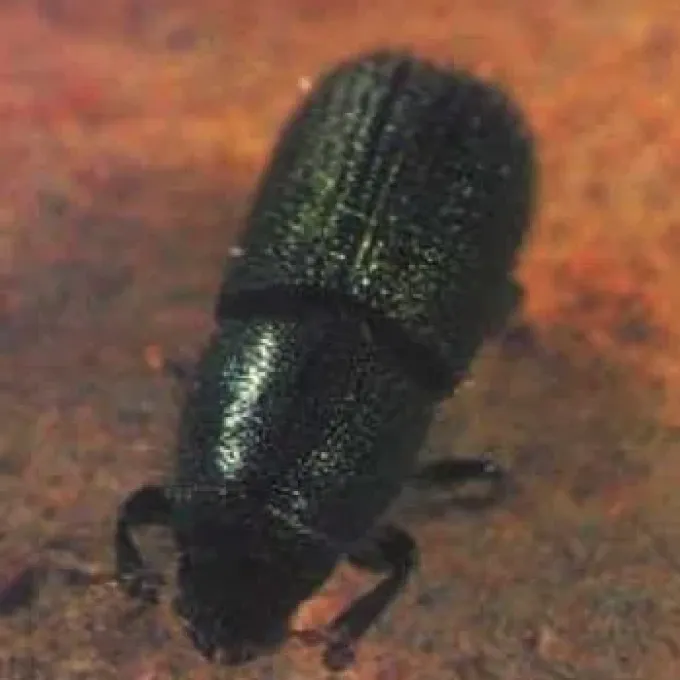
The Red-haired pine bark beetle (Hylurgus ligniperda) is a forest pest belonging to the Scolytinae subfamily. Adult beetles typically measure between 4 and 6 millimeters in length and feature a dark brown to black body covered with sparse, yellowish hairs.
The beetle has a distinct cylindrical body shape, which is typical for bark beetles. Its head is tucked into the pronotum, a structural feature that helps distinguish it from other wood-boring insects in the field.
The larvae are white, legless, and possess a heavily sclerotized, dark head capsule equipped with strong mandibles designed for boring into the inner bark and cambium of coniferous trees.
Pupation occurs within specialized pupal chambers constructed by the larvae. These chambers are located between the bark and the wood, providing a safe environment for the transformation into the adult stage.
This species is widely distributed in temperate forest regions and is particularly common in areas where pine trees are prevalent, adapting well to various environmental conditions.
What it damages
The primary hosts of the Red-haired pine bark beetle are pine species (Pinus spp.). While it often colonizes stressed or fallen timber, it can also act as a primary pest in young, healthy plantations.
The beetle causes damage primarily to the root collar and the base of the trunk. In seedlings and young trees, this feeding activity often leads to rapid decline and mortality due to the girdling of the stems.
Beyond physical destruction, the beetle is a known vector for various ophiostomatoid fungi. These pathogens are introduced into the tree's vascular system, causing blue-stain and accelerating the tree's collapse.
Infestations are frequently linked to poor sanitation in forest management, such as the accumulation of logging debris or logs left in the forest, which serve as breeding grounds for new generations.
Excessive beetle populations can lead to significant economic losses in nursery production, where even minor feeding on young stems can render the plants unsellable or lead to widespread seedling loss.
When it appears
The flight activity of the Red-haired pine bark beetle usually commences in early spring, as temperatures rise, typically peaking during April and May depending on the local climate.
The reproductive cycle is sustained throughout the summer months. Following mating, females lay eggs under the bark of host trees, initiating the development of the next generation of larvae.
As the season progresses, larvae feed, grow, and pupate, eventually emerging as new adults. These young beetles undergo a period of maturation feeding before they seek overwintering sites.
Overwintering occurs primarily in the adult stage. The beetles typically move into the leaf litter, soil, or the base of tree trunks to protect themselves from harsh winter temperatures.
In warmer, southern geographic zones, the species may complete two generations within a single year, which significantly heightens the pressure on forest stands and increases the likelihood of an outbreak.
Signs of infestation
A primary indicator of infestation is the presence of frass or boring dust, which resembles fine sawdust, accumulating around the base of the tree or within bark crevices near the ground.
Entry holes are often visible on the trunk near the root collar. In resilient trees, these holes may be accompanied by resinosis, where the tree attempts to push the beetle out with sap flow.
Foliage symptoms include the chlorosis or yellowing of pine needles, followed by a transition to brown. This indicates that the tree's nutrient transport has been critically compromised at the base.
Removing a section of the bark reveals a maze of larval galleries. These galleries are often filled with densely packed frass, signifying active feeding and reproduction by the beetle colony.
- Accumulation of fine sawdust (frass) at the tree base.
- Resin droplets forming around entry holes in the bark.
- Gradual yellowing and browning of the needles.
- Physical evidence of tunnels under the bark layer.
Control measures
Effective management begins with strict silvicultural practices, emphasizing the removal of weakened, diseased, or wind-thrown trees to reduce breeding availability for the beetle population.
Sanitation of forest sites by removing logging residues is critical to prevent the beetle from building up high population densities that could later migrate to healthy stands.
In nurseries and high-value plantations, insecticide applications during peak flight periods provide a necessary barrier to protect young seedlings from being colonized.
The use of pheromone-baited traps is a standard monitoring technique. These traps assist foresters in assessing population levels and can also serve as a tool to mass-trap adults during outbreaks.
Integrated Pest Management (IPM) strategies, which prioritize maintaining tree vigor and promoting biological control agents, offer the most sustainable approach to managing the Red-haired pine bark beetle.
Taxonomy
- Latin name
- Hylurgus ligniperda
- Order
- Coleoptera (beetles)
- Family
- Curculionidae
- EPPO code
- HYLGLI
Discussion
No discussions yet — be the first.