
Pine bark beetle
Hylurgus
Description
How to identify
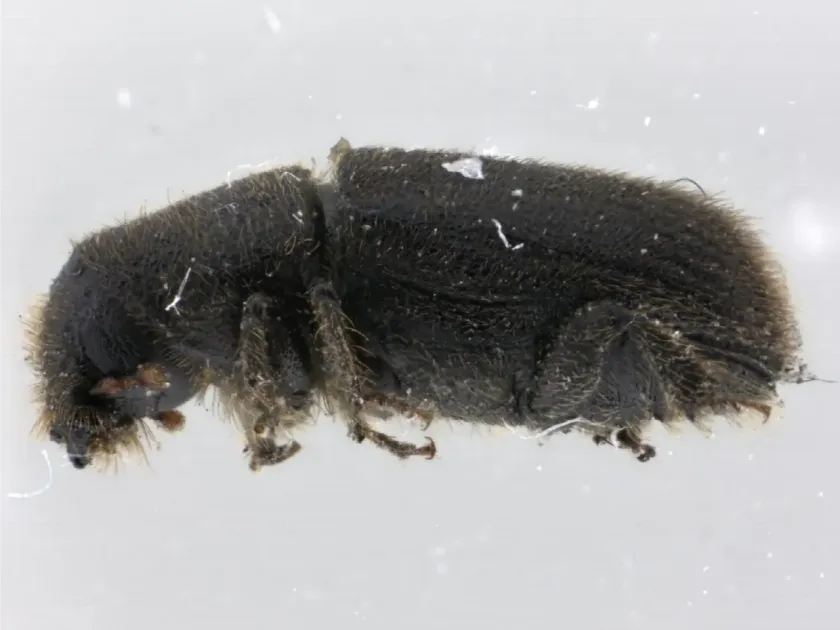
The pine bark beetle (Hylurgus ligniperda) is a member of the Curculionidae family, subfamily Scolytinae. Adult beetles are small, cylindrical insects, typically measuring between 4 and 6 mm in length.
The body is covered with coarse, short hairs, giving it a dull appearance. The color ranges from dark reddish-brown to almost black, which helps the insect blend into the bark of its host trees.
The larvae are white, legless, and have a distinct curved C-shaped body with a brown head capsule. They spend their entire developmental cycle beneath the bark, feeding on the inner tissues.
Pupae develop inside small chambers constructed under the bark. The pupal stage is free, showing clear anatomical structures that will eventually become the adult beetle's appendages.
Eggs are small, white, and oval-shaped. They are laid in maternal galleries created by females in the root collar area or in the thicker bark of lower trunk sections.
What it damages
The pine bark beetle primarily attacks various species of pine, though it can also infest spruce and fir. It is especially attracted to stressed, dying, or freshly cut timber.
Adult beetles pose the biggest threat as they feed on the inner bark and cambium layer near the root collar. This activity disrupts the transport of nutrients, leading to the rapid decline of the tree.
Seedlings and young trees are particularly vulnerable. A mass attack can kill a young tree within a single growing season due to the girdling effect caused by larval and adult feeding galleries.
In addition to physical damage, these beetles act as vectors for fungal pathogens. Their galleries create openings for fungi to enter the tree, often causing root rot and accelerating the tree's death.
In forest plantations, they often colonize stumps left behind after logging. These stumps serve as a reservoir for the beetle population, which then spreads to nearby healthy young trees.
When it appears
The flight period for adults generally occurs in early spring, typically between April and May, when temperatures rise significantly. This coincides with the start of the host tree's active growth period.
During the summer months, beetles are highly active, and multiple generations can occur in warmer climates. They continue to colonize new hosts throughout the growing season.
As autumn approaches, adult activity begins to decline. Beetles search for suitable overwintering sites, often moving into the soil litter or burrowing deeper into the bark of host trees.
The length of the feeding and breeding season is largely dependent on regional climate. Warmer regions see extended activity, while cooler regions may only see one or two generations per year.
Spring is the most critical time for monitoring. The emergence of the overwintered population represents the highest risk to young forest stands and nursery seedlings.
Signs of infestation
The most visible sign of an infestation is the presence of frass (boring dust) at the base of the tree. This powdery material is ejected by beetles through entrance holes in the bark.
Discoloration of the needles is a diagnostic sign of severe damage. Needles usually turn from green to yellow and eventually to brown as the tree's internal water transport system fails.
Inspecting the root collar often reveals small, circular entrance holes. In healthy or reactive trees, these spots may be marked by resin exudation, which is a defensive response against the beetle.
- Entrance holes found at the root collar.
- Presence of galleries beneath the bark layer.
- Progressive wilting and thinning of the tree crown.
If the bark is carefully removed from the base of an infested tree, one can observe the mother galleries, which are usually vertical, and the larvae feeding within the cambium.
Control measures
Sanitation is the most effective management strategy. Removing and destroying infested material, such as logging slash and stumps, reduces the available habitat for the beetles.
Using trap logs during the spring flight period helps to monitor and reduce the local population. Once colonized, these logs must be removed or treated before the next generation emerges.
Chemical control can be used in nurseries and high-value plantations. Targeted insecticide applications to the lower trunk and root collar can prevent successful beetle attacks.
Maintaining tree vigor is essential. Proper planting spacing, irrigation, and soil management help trees build resistance to bark beetle colonization.
Biological control through the preservation of natural predators, such as clerid beetles and parasitic wasps, plays a vital role in regulating populations in natural forest ecosystems.
Taxonomy
- Latin name
- Hylurgus
- Order
- Coleoptera (beetles)
- Family
- Curculionidae
- EPPO code
- HYLGSP
Discussion
No discussions yet — be the first.