
Pine bark beetle
Hylurgops pinifex
Description
How to identify
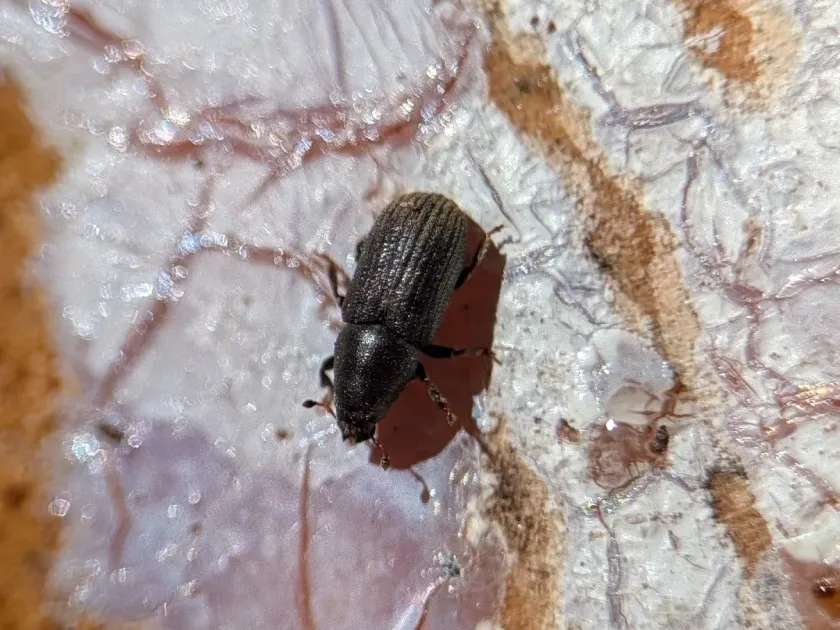
The Pine bark beetle (Hylurgops palliatus) is a small beetle belonging to the family Curculionidae, subfamily Scolytinae. It measures approximately 2.5 to 3.5 mm in length and is recognized by its dark brown, matte-textured body.
The beetle's body is covered in fine yellowish hairs, giving it a somewhat dull appearance. The head is partially concealed by the pronotum, a structural adaptation common to bark beetles that aids in tunneling through bark layers.
Larvae are legless, white, and curved, with a distinct brownish head. They reside strictly under the bark, feeding on the phloem and cambium layer, which is crucial for the tree's transport of nutrients.
Adults emerge during the warmer months to disperse and colonize new hosts. They are particularly attracted to the scent of stressed or freshly cut coniferous wood, which signals a suitable environment for breeding.
The life cycle is typically univoltine, meaning one generation per year, though in cooler climates, it may extend over two years. The beetle is a common inhabitant of Eurasian boreal and temperate forests.
What it damages
Damage is primarily caused by both larvae and adults consuming the inner bark. This feeding disrupts the tree's vascular system, preventing the flow of water and nutrients from the roots to the canopy.
Stressed trees, such as those weakened by drought, disease, or mechanical damage, are the primary targets for colonization. The beetle also thrives in logging debris and stumps left in the forest after harvesting operations.
While often considered a secondary pest, large populations can attack and kill relatively healthy trees if environmental stress is high. This can lead to significant economic loss in commercial forestry.
In nurseries, this species can cause severe damage to seedlings, often resulting in total plant mortality if not managed correctly. Protection of young trees is vital for successful reforestation.
The overall impact includes degradation of wood quality, rendering logs unsuitable for lumber. Infestations often create focal points that expand rapidly if not suppressed by immediate sanitary measures.
Signs of infestation
The most reliable sign of an infestation is the presence of boring dust (frass) around the bark surface. This dust is kicked out by beetles as they create entrance holes, accumulating on the bark or at the base of the tree.
Small, circular entrance holes appear on the trunk, indicating where beetles have bored into the wood. In some cases, resin flow may be observed if the tree is attempting to repel the infestation.
When the bark is carefully removed, a system of galleries becomes visible. These consist of a longitudinal maternal gallery with numerous lateral larval tunnels, which cause the bark to separate from the wood.
Crown symptoms include a gradual fading, yellowing, and eventual browning of the needles. This indicates that the tree's health is rapidly declining due to girdling caused by the larvae.
Large-scale peeling of the bark is a final sign of decline, often associated with the presence of mature larvae or pupae. By this stage, the tree is usually beyond recovery and serves as a nursery for the next generation.
Control measures
Sanitary forest management is the most effective control strategy. Removing infested or fallen trees promptly ensures that beetle populations do not reach outbreak levels during the breeding season.
Trap trees are widely used to lure beetles away from healthy timber. Once the traps are colonized, they are removed or debarked to destroy the developing brood before the adults emerge.
Chemical control, involving systemic or contact insecticides, is reserved for high-value stands or nursery environments. Application timing is critical, usually targeting the period of peak adult flight.
Encouraging biodiversity by protecting natural predators, such as predatory beetles and woodpeckers, contributes to biological regulation. A healthy ecosystem is less susceptible to massive bark beetle outbreaks.
- Rapid removal of logs and logging residues from the forest.
- Debarking wood before the summer emergence of adults.
- Monitoring population levels using pheromone-baited traps.
- Promoting forest vigor through appropriate silvicultural practices.
Taxonomy
- Latin name
- Hylurgops pinifex
- Order
- Coleoptera (beetles)
- Family
- Curculionidae
- EPPO code
- HYLUPI
Discussion
No discussions yet — be the first.