
Lesser spruce bark beetle
Hylurgops palliatus
Description
How to identify
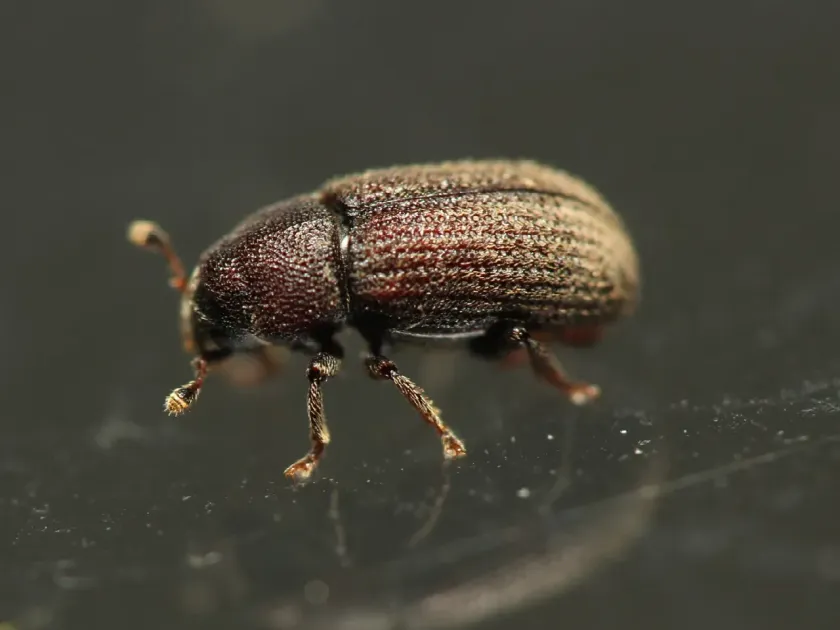
The Lesser spruce bark beetle (Hylurgops palliatus) is a small beetle belonging to the Curculionidae family and the Scolytinae subfamily. Adults typically measure 2.5 to 3.5 mm in length.
The beetle has a reddish-brown to dark brown body covered with dense yellowish hairs, giving it a dull, matte appearance under close inspection.
Its larvae are legless, C-shaped grubs with creamy-white bodies and light brown head capsules, commonly found feeding in the inner bark.
The wing covers (elytra) are marked with distinct rows of punctures, and the posterior margin is rounded, lacking the prominent teeth found in some other bark beetle species.
They predominantly occupy the lower sections of coniferous tree trunks, often near the root collar or in thick-barked areas close to the ground.
What it damages
This pest primarily targets Norway spruce, but it is also frequently found on Scots pine and silver fir in various European forest ecosystems.
Damage is caused by both adults and larvae, which tunnel through the inner bark (phloem) and cambium layer, disrupting the tree's nutrient transport system.
The beetle usually infests weakened, stressed, or storm-damaged trees, as well as fresh logging debris and stumps left in the forest after harvesting.
While often considered secondary, in high populations, they can contribute to the death of trees already suffering from environmental stress or drought.
The resulting galleries cause phloem necrosis, which accelerates the decline of the host tree and serves as an entry point for wood-staining fungi.
When it appears
Adult emergence typically begins in mid-spring, usually April or May, depending on regional temperature increases reaching the required thermal thresholds.
Females bore into the bark to construct longitudinal maternal galleries, where they lay their eggs along the sides of the tunnel walls.
Larval development takes place throughout the summer months, with pupation occurring in small chambers located between the bark and the sapwood.
New adults emerge by late summer or autumn and often overwinter beneath the bark or in the forest litter, emerging again the following spring.
In warmer climates, the species may show potential for two overlapping generations, though one annual generation is the standard lifecycle in most regions.
Signs of infestation
The presence of fine, sawdust-like bore dust (frass) collecting at the base of the tree trunk or in bark crevices is a primary diagnostic indicator.
Small, circular entrance holes on the lower trunk surface confirm that bark beetles have successfully breached the protective outer bark layer.
Upon removing a section of the bark, one can observe the characteristic longitudinal maternal galleries coupled with fan-shaped or irregular larval feeding tracks.
Foliar discoloration, starting with yellowing needles and progressing to total crown browning, occurs as the tree's water and nutrient flow is severely restricted.
Pitch tubes or resin flow on the trunk surface may be visible if the tree is attempting to repel the beetles through natural chemical defense mechanisms.
Control measures
Strict forest hygiene is the most effective management strategy, requiring the rapid removal of windthrows and infested logs from the forest site.
Logging residues should be removed or debarked promptly to prevent the development of large-scale breeding populations within harvested areas.
The use of trap trees, specifically placed logs left for a short period to attract pests, allows for the controlled collection and destruction of the beetles.
Maintaining a diverse forest stand with high numbers of natural predators, such as parasitoid wasps and clerid beetles, promotes natural population control.
In nurseries or high-value urban tree settings, preventative insecticide sprays on the lower stem can be applied during the spring flight period if necessary.
Taxonomy
- Latin name
- Hylurgops palliatus
- Order
- Coleoptera (beetles)
- Family
- Curculionidae
- EPPO code
- HYLUPA
Discussion
No discussions yet — be the first.