
Hylurgops glabratus
Hylurgops glabratus
Description
How to identify
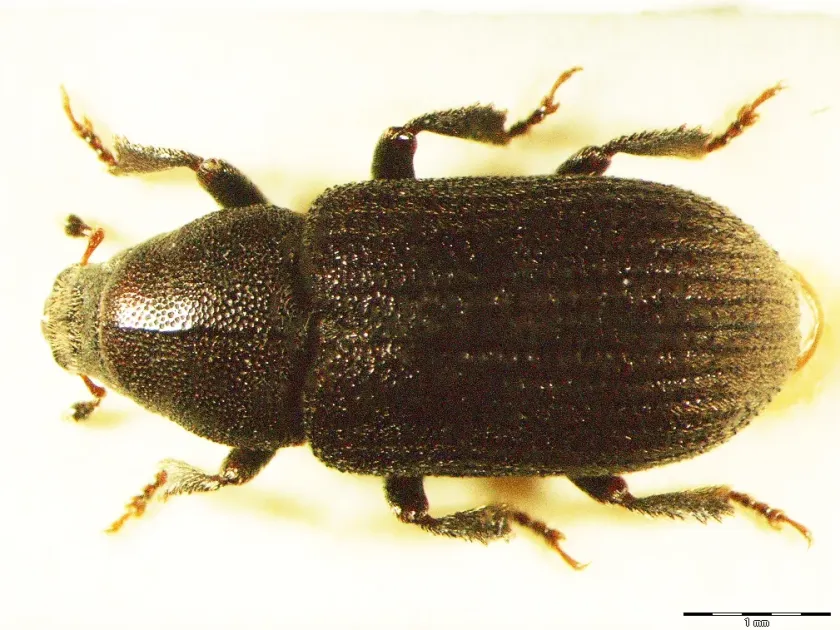
Hylurgops glabratus is a species of bark beetle belonging to the Curculionidae family. Adult beetles are typically 4 to 5.5 mm long with a dark brown or black appearance.
The name reflects its appearance, as the elytra (wing covers) are relatively smooth and shiny, with fine punctures and sparse short hairs compared to related species.
Larvae are legless, white, and C-shaped with a dark head capsule. They develop within the inner bark, specifically targeting the phloem layer of the host tree.
These beetles are primarily associated with the lower parts of tree trunks and roots, often choosing shaded or moist sections of the bark for their activities.
Identification is often confirmed by examining the characteristic gallery patterns found beneath the bark after removing a section of the infested wood.
What it damages
This beetle primarily infests coniferous species, with a strong preference for Pinus sylvestris (Scots pine), though it can also be found in spruce.
Damage is caused by both adults, which construct galleries for egg-laying, and larvae, which tunnel through the nutrient-rich phloem tissues.
By girdling the tree through extensive gallery formation, the pest disrupts the flow of nutrients and water, eventually leading to tree mortality.
In addition to direct feeding, the beetle may introduce pathogenic fungi, which further weaken the host and accelerate the decline of the tree health.
Extensive infestations create forest gaps and economic losses, particularly when large areas of weakened timber remain in the stand for too long.
When it appears
Adult flight typically begins in early spring, once temperatures are consistently warm enough for activity, often starting in April depending on the region.
The reproductive season lasts throughout the spring and summer months, during which the beetles actively colonize new host trees or fallen logs.
Generation time is often synchronized with the vegetation period, with new adults emerging from the bark in late summer to seek overwintering sites.
Winter is spent in the adult stage, where they often retreat into the soil or deeper layers of the bark near the base of the tree to survive the cold.
Environmental conditions, especially warm winters and dry summers, can significantly increase the population pressure of this beetle in local forests.
Signs of infestation
The most reliable sign of an infestation is the presence of fine wood dust, known as frass, appearing near the base of the tree or on the ground.
Entrance holes through the outer bark are visible upon close inspection, sometimes accompanied by small resin droplets if the tree is still producing sap.
Needle discoloration, turning from green to yellow or reddish-brown, indicates that the tree's vascular system has been compromised by the beetle feeding.
Peeling back the bark reveals a distinct system of longitudinal maternal galleries and radiating larval tunnels that consume the phloem layer.
Surveillance should focus on the lower trunk and root flare, as these areas are the most common sites for initial attack and colonization.
Control measures
Sanitation harvesting of infested trees is the primary method of control, aimed at removing the breeding material before new adults emerge.
Management practices must include the rapid removal of fresh slash and logging debris from the forest to prevent them from becoming breeding sites.
Trap trees, which are intentionally left or prepared to attract beetles, can be used to gather and subsequently destroy the pest population.
Maintaining high stand vigor through thinning and proper silvicultural techniques helps trees defend themselves against successful colonization.
Chemical control is generally impractical for large-scale forest management but may be considered for high-value urban or ornamental coniferous trees.
Taxonomy
- Latin name
- Hylurgops glabratus
- Order
- Coleoptera (beetles)
- Family
- Curculionidae
- EPPO code
- HYLUGL
Discussion
No discussions yet — be the first.