
Hylurgops
Hylurgops
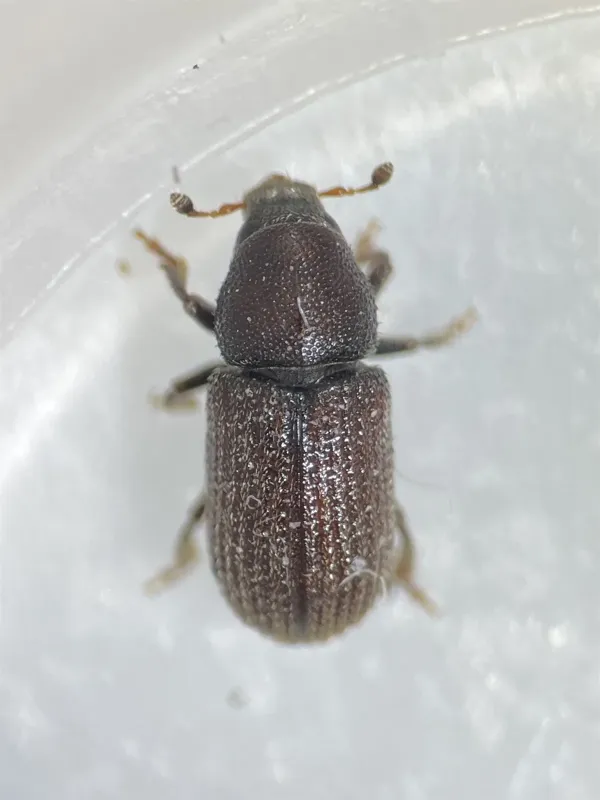
Description
How to identify
Hylurgops is a genus of bark beetles belonging to the Curculionidae family. These insects are typically small, ranging from 3 to 5 mm in length, and possess a stocky, cylindrical body.
Their head is usually retracted under the pronotum, a common trait among many bark beetle species. The elytra are covered with fine scales and setae, and they lack prominent teeth on the posterior slope, which helps in distinguishing them.
The larvae are legless, white grubs with a yellowish head capsule that feed and develop underneath the bark of host trees.
Adult beetles prefer the base of the trunk and the root collar area, where they find suitable conditions for burrowing into the bark to breed.
These beetles are well-adapted to life beneath the bark, often choosing stressed or weakened coniferous trees to establish their galleries.
What it damages
Hylurgops beetles primarily attack coniferous trees, with a strong preference for pines and spruces in forest ecosystems.
They damage the tree by constructing feeding and breeding galleries in the inner bark (phloem), which disrupts the flow of nutrients from the needles to the roots.
Young plantations and saplings are particularly vulnerable; a successful attack by these beetles often leads to the rapid death of the host plant.
In addition to physical destruction of the tissue, these beetles are known vectors for various fungal pathogens that cause wood stain and decay.
Outbreaks can lead to significant forest degradation, especially after environmental stressors such as drought, windthrow, or pollution make the trees susceptible.
When it appears
Adult activity typically begins in early spring, as temperatures rise and the beetles emerge from their overwintering sites in the soil or bark.
The primary flight and colonization period usually occurs in April and May, when adults seek out host trees for mating and egg-laying.
The life cycle duration depends on regional climate conditions, with warmer seasons potentially accelerating the development of the brood.
Pupation takes place beneath the bark, after which new adults emerge to feed briefly before seeking shelter for the winter.
Overwintering occurs primarily in the adult stage, often in the leaf litter, soil at the base of trees, or within existing galleries under the bark.
Signs of infestation
One of the most indicative signs of a Hylurgops infestation is the presence of fine wood dust or "frass" at the base of the trunk.
Careful inspection of the bark at the root collar reveals vertical or slightly winding galleries created by the parent beetles.
A change in crown color, transitioning from green to yellow or reddish-brown, is a classic sign of advanced colonization and tree decline.
Resin flow or "pitch tubes" may appear on the bark as the tree attempts to defend itself against the beetle attack, though these are often insufficient to stop a large population.
The separation of dead bark from the sapwood in the lower trunk area is a common indicator that the tree has been successfully colonized.
Control measures
The most effective management practice is the timely removal and disposal of infested trees, known as sanitary logging, to reduce the beetle population.
Using trap trees during the spring flight period is a reliable way to attract and subsequently destroy a large portion of the local beetle population.
Regular forest pathology surveys are essential for detecting early signs of infestation and preventing the formation of large outbreak centers.
In nurseries and young plantations, insecticide applications targeting the root collar area during peak flight times can provide effective protection.
- Sanitary removal of infested wood
- Deployment of trap trees
- Prompt disposal of logging residues
- Maintenance of forest stand vigor
Taxonomy
- Latin name
- Hylurgops
- Order
- Coleoptera (beetles)
- Family
- Curculionidae
- EPPO code
- HYLUSP
Discussion
No discussions yet — be the first.