
Native elm bark beetle
Hylurgopinus rufipes
Description
How to identify
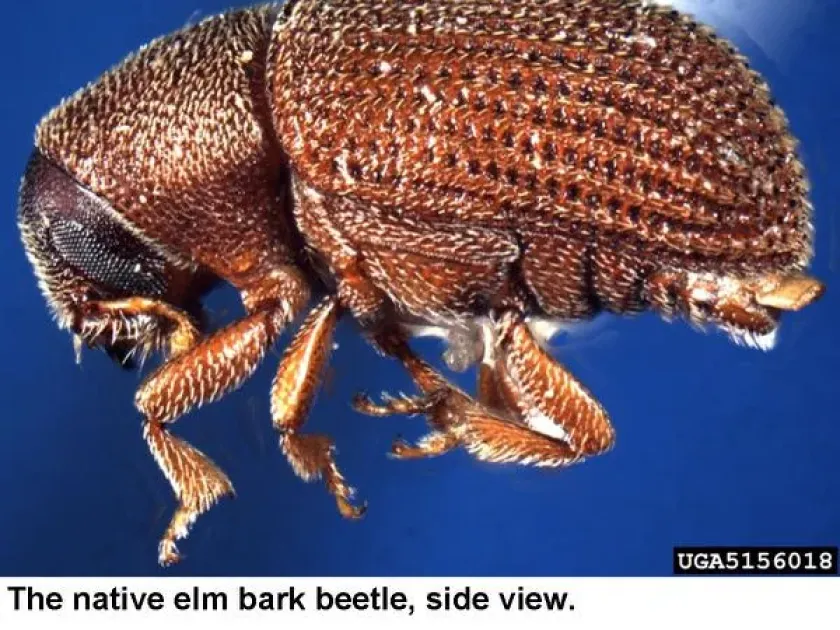
The native elm bark beetle (Hylurgopinus rufipes) is a small wood-boring insect, typically ranging from 2.5 to 3.5 mm in length, known for its cryptic behavior.
The beetle has a dark brown or blackish color and is covered in fine, dense hairs, which helps it blend in with the rough bark of host trees.
Taxonomically, it belongs to the Curculionidae family and the Scolytinae subfamily, identifying it as a specialist that relies on the cambium layer for development.
The larvae are white, legless grubs that dwell underneath the bark, feeding on the inner tissues and disrupting the tree's vascular transport system.
Adult beetles are often elusive and are primarily identified by the characteristic boring patterns they leave under the bark surface.
What it damages
This species primarily targets elm trees (Ulmus species), making it a significant threat to American elm populations across its range.
While it prefers stressed or weakened trees, it is capable of colonizing relatively healthy specimens, especially when beetle populations are high.
The most devastating impact of this beetle is its role as a primary vector for the fungi that cause Dutch elm disease (Ophiostoma ulmi and O. novo-ulmi).
As the beetles feed on the bark of healthy twigs, they introduce fungal spores into the tree's vascular system, leading to systemic infection and tree death.
Beyond disease transmission, the larval feeding galleries can physically girdle smaller branches, causing localized dieback and structural decline.
When it appears
The life cycle of the native elm bark beetle is highly dependent on seasonal temperature fluctuations in temperate climates.
Adults overwinter in thick bark on the trunks of living trees, which provides a thermal buffer against harsh winter temperatures.
Spring emergence typically occurs when ambient temperatures consistently rise, with peak flight activity often noted between May and June.
Depending on the latitude and local climate, the beetle can complete one to two generations per growing season before entering hibernation.
Fall activity involves beetles migrating to their overwintering sites, where they prepare to survive until the next cycle begins in the spring.
Signs of infestation
The presence of the beetle is marked by small entry and exit holes in the bark, often accompanied by fine wood shavings known as frass.
Upon removing a section of the bark, one can observe the diagnostic egg galleries, which often branch in a specific pattern unique to this species.
Crown dieback, wilting of leaves, and yellowing foliage are the most prominent indicators of systemic infection related to the beetle's activity.
Cutting into the sapwood often reveals brown or black streaks, which are a hallmark sign of the fungal pathogen transferred by the insect.
- Presence of small boring holes in the tree bark.
- Frass accumulation near the base of the trunk.
- Sudden yellowing or wilting of the crown (flagging).
Control measures
Sanitation is the most effective management strategy; removing and properly disposing of infested trees prevents the spread of the population.
Prohibiting the storage of elm firewood near healthy trees is essential, as these logs serve as major breeding grounds for the beetle.
Chemical control using insecticides on high-value trees can protect them from adult beetle feeding, though this is not feasible for large-scale forest stands.
Monitoring populations with pheromone-baited traps allows arborists to time preventative treatments and assess the risk level in specific areas.
Promoting tree health through proper irrigation and soil management helps increase the resistance of elms to both beetle colonization and disease.
Taxonomy
- Latin name
- Hylurgopinus rufipes
- Order
- Coleoptera (beetles)
- Family
- Curculionidae
- EPPO code
- HYLRRU
Discussion
No discussions yet — be the first.