
Native elm bark beetle
Hylurgopinus
Description
How to identify
The Native elm bark beetle (Hylurgopinus rufipes) is a small beetle belonging to the Curculionidae family. Adults typically measure about 2.5 to 3.5 millimeters in length.
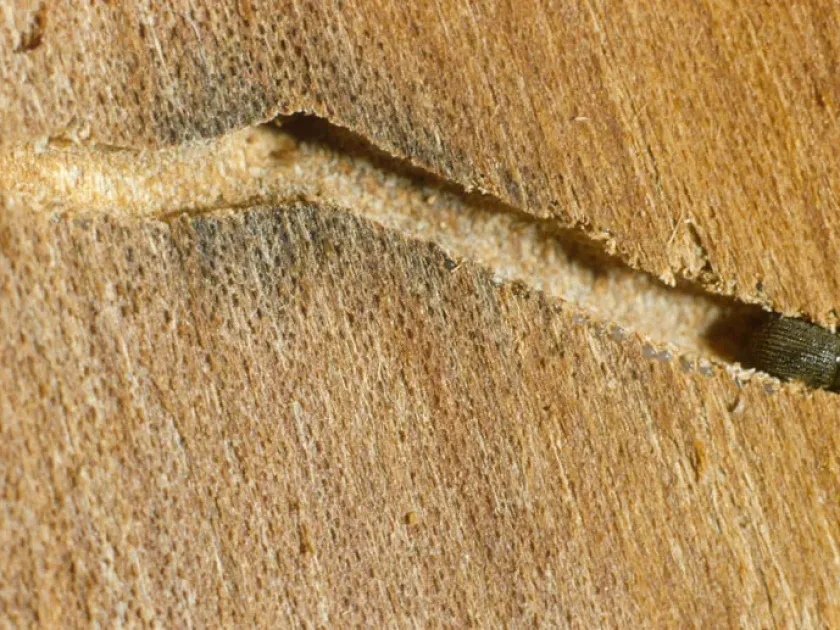
They possess a dark brown to black cylindrical body covered with fine hairs, which allows them to navigate within the bark crevices of their host trees.
The life cycle of the beetle progresses through the egg, larva, pupa, and adult stages, with most development occurring under the bark of elm trees.
Larvae are legless, white grubs that feed on the inner bark, creating tunnels that disrupt the nutrient flow of the tree as they grow.
Beetles are active throughout the growing season, with adults often overwintering in the bark of healthy or declining elm trees.
What it damages
The primary hosts for this beetle are various species of elm, including the American elm and the slippery elm. The beetles are highly attracted to these species.
Beyond the direct physical damage caused by tunneling, these beetles are notorious vectors for the fungus Ophiostoma novo-ulmi, the cause of Dutch elm disease.
The fungus blocks the tree's vascular system, preventing water and nutrients from reaching the branches, which leads to rapid wilting and tree death.
Infestations often result in the destruction of entire elm populations, as the beetles can easily spread the pathogen from tree to tree in a stand.
Healthy trees can also be targeted, particularly when beetle populations are high, leading to significant landscape and ecological losses.
Signs of infestation
Look for small, circular entrance holes on the bark of the trunk or larger branches, often accompanied by fine brown wood dust or frass.
When the bark is carefully peeled back, one can observe the characteristic gallery patterns created by adults and their larvae in the phloem layer.
Foliage symptoms include flagging (wilting of branches), yellowing, and premature leaf drop during the spring and summer months.
Crown dieback is a common observation as the infection progresses, eventually leading to the death of the entire tree within one to two seasons.
In winter, adults may be found huddled in bark grooves, and their presence can be confirmed by looking for specialized overwintering chambers.
Control measures
Sanitation is the most effective management strategy, requiring the prompt removal and destruction of infested wood to prevent the emergence of new adults.
Felling and burning or burying infested elm wood is crucial to interrupt the beetle's life cycle and reduce the local population pressure.
Pheromone traps are useful monitoring tools to track beetle activity and determine the timing for necessary insecticide applications on the bark.
Systemic fungicide injections are recommended for high-value individual trees to protect them from the associated Dutch elm disease pathogen.
Proper tree care, including regular watering and avoiding mechanical damage to the trunk, helps trees maintain natural defenses against beetle colonization.
Taxonomy
- Latin name
- Hylurgopinus
- Order
- Coleoptera (beetles)
- Family
- Curculionidae
- EPPO code
- HYLRSP
Discussion
No discussions yet — be the first.