
Pine bast beetle
Hylurdrectonus piniarius
Description
How to identify
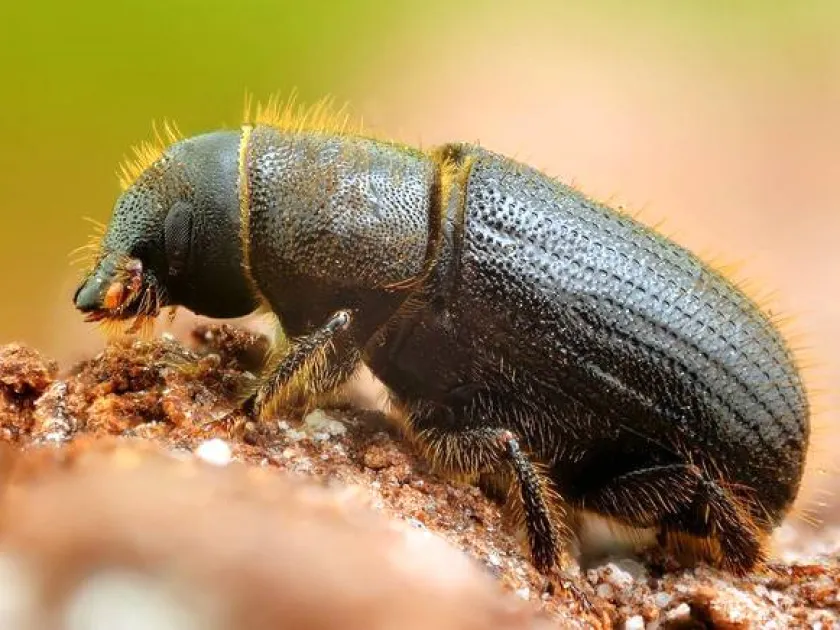
The pine bast beetle (Hylurdrectonus piniarius) belongs to the Curculionidae family, subfamily Scolytinae. It is a small wood-boring insect that specializes in infesting various species of pine trees within its natural range.
The adult beetle typically exhibits a cylindrical body shape, adapted for life beneath the bark. Its color ranges from dark brown to black, providing camouflage against the inner bark and cambium layers of the host tree.
Its biological cycle is intricately linked to the host tree's cambium layer. Adults create gallery systems where they deposit eggs, and the resulting larvae tunnel outward, feeding on the nutrient-rich bast layer, which is essential for the tree's health.
The life cycle encompasses four stages: egg, larva, pupa, and adult. Development is highly dependent on ambient temperature and host vigor, with activity peaking during the spring and summer months when the beetles emerge to colonize new hosts.
These insects are known for their ability to thrive in stressed or weakened trees. However, during outbreaks, their population density can rise significantly, allowing them to attack even apparently healthy individuals in a forest stand.
What it damages
The primary hosts of this pest are species of the genus Pinus. The beetle is particularly attracted to trees stressed by environmental factors such as drought, fire, or soil nutrient deficiency, which often occurs in monoculture plantations.
The damage caused by feeding larvae and adults disrupts the tree's phloem, which carries essential nutrients from the needles to the roots. This obstruction leads to a gradual decline in the tree's vigor and potential death if the infestation is severe.
A major consequence of the infestation is the tree's weakened resistance to secondary pathogens. Beetles often introduce fungi that cause blue stain or wood decay, significantly reducing the commercial quality of the timber.
Repeated infestation over several seasons causes crown dieback, starting from the top and progressing downwards. This visible decline is often the first indicator of a long-term pest pressure on the forest stand.
In cases of mass outbreaks, the beetle can cause significant economic losses in commercial forests by increasing the volume of salvage timber and requiring costly intervention programs to contain the spread.
Signs of infestation
The most reliable sign of an infestation is the presence of "frass" or boring dust, which accumulates at the base of the tree trunk or in the bark fissures. This dust is the byproduct of the beetles excavating their galleries.
Small circular entrance holes are usually visible on the bark surface. In healthy trees, resin flow might be observed around these holes as a defensive mechanism, though this response diminishes as the tree loses strength.
Fading foliage is a critical late-stage symptom. The needles gradually turn from their natural green to chlorotic yellow and eventually reddish-brown, indicating that the tree can no longer transport water and nutrients effectively.
Peeling back a piece of bark on an infested tree reveals the characteristic gallery pattern. The central mother gallery and the radiating larval tunnels form a distinct, often species-specific, structure under the bark.
An increased presence of woodpeckers on specific trees is a biological indicator of larval infestation. Birds are highly effective at detecting and excavating the hidden larvae, often stripping away large patches of bark in the process.
Control measures
Sanitation felling remains the most effective management strategy. By removing infested trees before the new generation of adults emerges, the overall population pressure in the forest area can be significantly reduced.
Trap trees, or trap logs, are used to lure beetles away from healthy stands. These trees are felled at specific times and later removed and destroyed, preventing the larvae from completing their development cycle.
Chemical control, involving the application of insecticides to tree trunks, is typically reserved for high-value stands or nurseries. This method must be timed precisely with the beetle's peak flight period to be successful.
Promoting forest resilience through proper silvicultural practices, such as thinning and diversity enhancement, helps maintain tree health and limits the impact of potential beetle outbreaks over time.
- Selective sanitation harvesting of infested trees.
- Deployment of trap logs during spring.
- Application of systemic insecticides for high-value trees.
- Timely removal of fresh slash to eliminate breeding sites.
- Encouraging natural predators and woodpecker populations.
Taxonomy
- Latin name
- Hylurdrectonus piniarius
- Order
- Coleoptera (beetles)
- Family
- Curculionidae
- EPPO code
- HYLDPI
Discussion
No discussions yet — be the first.