
Warren root collar weevil
Hylobius warreni
Description
How to identify
The Warren root collar weevil (Hylobius warreni) is a member of the Curculionidae family. It is a snout beetle specialized in attacking the root systems of various coniferous trees in North American forests.
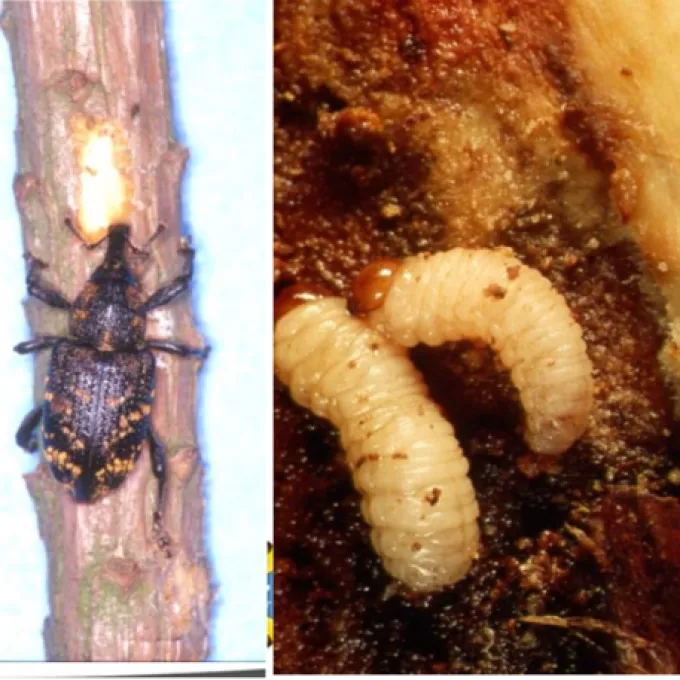
Adult weevils are dark-colored, often black, with an elongated rostrum typical of their family. They are primarily nocturnal, spending daylight hours hiding within the bark crevices or under forest litter.
The larvae are white, legless, and have a brown head capsule. They reside entirely within the root collar and primary root tissues, making their identification difficult without excavating the soil.
The life cycle of Hylobius warreni is notably long, often spanning several years. This extended development period makes the species particularly resilient and difficult to eradicate from a site once established.
Optimal habitats include cool, moist forested areas where conifer seedlings are abundant. The presence of stumps or coarse woody debris provides essential breeding grounds for the population to thrive.
What it damages
This pest is a significant threat to young coniferous plantations, particularly pine and spruce species. Trees aged between 5 and 15 years are most susceptible to lethal damage.
Larval feeding destroys the cambium layer in the root collar area. This disruption of nutrient and water flow leads to the gradual decline, chlorosis, and eventual mortality of the young host trees.
Adult weevils supplement the damage by feeding on the tender bark of twigs and branches. While usually less destructive than larval feeding, it contributes to the overall stress of the tree.
In high-density infestations, the mortality rate of young plantations can be severe, leading to significant economic losses and structural changes in forest regeneration efforts.
The weevils often colonize areas where previous logging has left behind stumps, which act as primary reservoirs for the larvae to develop before they emerge to attack neighboring healthy saplings.
Signs of infestation
The most visible sign of an infestation is the yellowing of needles and a noticeable reduction in annual leader growth. Affected saplings often look stunted compared to their healthy counterparts.
Resinosis, or excessive resin flow around the base of the trunk, is a classic indication of the tree attempting to seal off larval feeding sites beneath the bark.
Upon careful excavation of the soil around the root collar, one can find galleries filled with frass, which are tunnels created by the larvae as they consume the cambium.
The presence of adult weevils can be confirmed by nocturnal inspection or by placing fresh conifer stem sections as baits to attract active beetles during their feeding period.
Dead or dying trees should be inspected for the presence of larval tunnels, which are usually located just below the soil surface at the root collar junction.
Control measures
Silvicultural practices are the cornerstone of management. Removing stumps and large root fragments immediately after logging significantly reduces the availability of breeding sites.
Proper site preparation before replanting helps minimize the local weevil population, giving young saplings a better chance to establish themselves without immediate pressure from the pest.
Maintaining a temporal or spatial gap between harvest activities and the planting of new conifer stocks is effective in preventing the spread of the weevil into new plantations.
In extreme cases where seedlings are at high risk, localized application of authorized insecticides can protect the root collar area during the most vulnerable stages of sapling development.
Biological control research, focusing on natural predators and entomopathogenic fungi, offers a sustainable long-term approach to managing Hylobius warreni populations in managed forests.
Taxonomy
- Latin name
- Hylobius warreni
- Order
- Coleoptera (beetles)
- Family
- Curculionidae
- EPPO code
- HYLOWA
Discussion
No discussions yet — be the first.