
Pine weevil
Hylobius pinicola
Description
How to identify
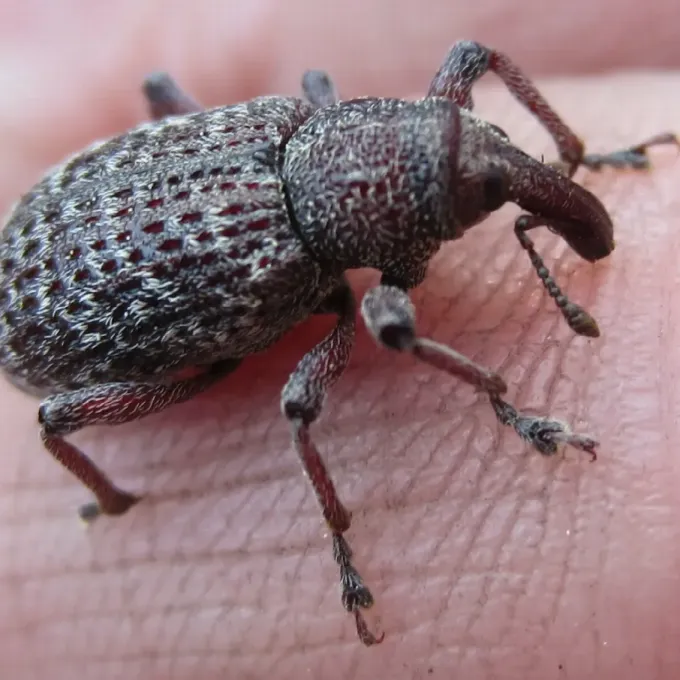
The pine weevil (Hylobius pinicola) is a beetle belonging to the Curculionidae family, specifically recognized for its impact on coniferous trees. Adult weevils are roughly 10–14 mm long, displaying a dark brown to black coloration, often marked with light-colored hair patterns on their wing covers (elytra).
A distinctive feature of this species is the long rostrum (snout) at the front of the head, which the beetle uses to bore into tree bark for feeding purposes. The body is robust and sturdy, well-adapted for movement across the rugged bark of pine trees.
Larvae are legless, white-colored, and C-shaped, with a prominent brown head capsule. They develop beneath the bark of host trees, carving galleries through the cambium layer, which significantly impacts the tree's vascular system.
The lifecycle of this pest is highly dependent on environmental conditions, typically spanning one to two years. It thrives in dense forest stands where environmental stress makes trees more susceptible to infestation.
It is important to distinguish this species from other related weevils by its host preference and the specific ecological niches it occupies within the forest landscape.
What it damages
The primary hosts for this weevil are species within the Pinus genus. While they show a strong preference for pines, they can occasionally be found on other conifers, including spruce, if the population density is high.
Damage is caused by both adults, who feed on the bark of young twigs, and larvae, who disrupt sap flow by creating galleries under the bark of the trunk. This dual-threat approach can weaken even healthy-looking trees.
Infestations are most severe in weakened trees, such as those suffering from drought, previous physical damage, or stress caused by other environmental factors, making them unable to mount a sufficient defensive response.
The tree's reaction to feeding is typically intense resin production. While this is a defense mechanism, high levels of resin flow indicate that the tree is under heavy pressure and may be nearing exhaustion.
Over time, significant infestations lead to a decline in tree vigor, branch dieback, and in extreme cases, the death of the entire tree. This creates secondary risks, including fire hazards and increased susceptibility to other pathogens.
When it appears
Adult weevil activity typically commences in the spring as temperatures rise, usually around April or May. This period marks the beginning of their flight activity and search for suitable host trees.
Feeding continues through the spring and into early summer, which is the critical period for mating and egg-laying. Females are particularly active during this time, seeking out bark cracks for oviposition.
Larval development begins shortly after eggs are laid and continues throughout the summer months. The larvae remain active under the bark, feeding and growing until the onset of lower autumn temperatures.
Wintering strategies vary, with both adults and larvae overwintering in various stages of maturity. They typically seek refuge in the forest litter, soil, or within the wood of their host trees to survive the winter frost.
The seasonal progression is well-synchronized with the phenology of the host pines, ensuring that the next generation of weevils emerges when food resources are most abundant.
Signs of infestation
The most visible sign of infestation is the appearance of resinous patches or bleeding on the trunk, caused by the weevils' boring activity. These patches often serve as the first indication of a potential problem.
An accumulation of frass, or fine wood dust, at the base of the tree is a classic diagnostic sign. This material is pushed out from the larval galleries, confirming that larvae are currently active under the bark.
Needle discoloration, ranging from yellowing to premature browning and shedding, is a late-stage sign of systemic infestation. It suggests that the tree's internal transport system has been severely compromised.
Woodpecker activity on the stems is another useful, albeit indirect, sign. Birds often forage for larvae under the bark, leaving behind characteristic patterns of damage that are easy to spot from a distance.
Inspecting the bark more closely often reveals entrance holes, and removing a section of damaged bark will expose the winding galleries and the larvae themselves, providing definitive proof of the pest's presence.
Control measures
The most effective management strategy is sanitation. Prompt removal and destruction of infested trees prevent the population from reaching levels that could threaten the surrounding healthy forest.
Trapping techniques, such as using pheromone lures or log traps, can be used to monitor population dynamics and reduce adult numbers during their active flight season.
Silvicultural practices, including proper thinning and maintaining forest health, help trees remain vigorous. Healthy trees are significantly better at repelling weevil attacks through their own natural defenses.
- Regular forest pathology surveys to detect early infestations.
- Promotion of natural predators such as parasitic wasps and insectivorous birds.
- Strict adherence to logging schedules to avoid leaving fresh material that attracts weevils.
While chemical control is possible in nurseries or young plantations, it should be used cautiously as a last resort, prioritizing environmentally friendly biological methods to maintain ecological balance.
Taxonomy
- Latin name
- Hylobius pinicola
- Order
- Coleoptera (beetles)
- Family
- Curculionidae
- EPPO code
- HYLOPI
Discussion
No discussions yet — be the first.