
Large pine weevil
Hylobius pinastri
Description
How to identify
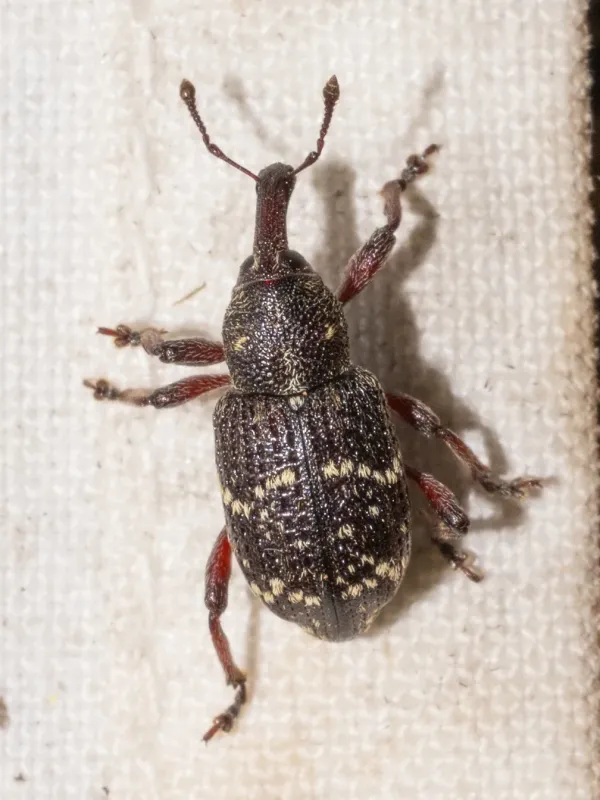
The Large pine weevil (Hylobius pinastri) is a beetle belonging to the order Coleoptera and the family Curculionidae. The adult beetle is typically 7 to 12 mm long, featuring a mottled appearance created by light and dark scales on its dark body.
It possesses a robust, long rostrum (snout) which is perfectly adapted for piercing the bark of young trees. The antennae are elbowed and clubbed, providing the beetle with keen sensory capabilities for navigating its environment.
The larvae are white, legless, and C-shaped with a distinct brown head. They live and develop exclusively within the bark and root systems of host trees or decaying wood, which protects them from environmental stressors.
The insect’s life cycle usually spans one to two years depending on the regional climate. Adults are primarily nocturnal, spending daylight hours hiding in litter or under loose bark, which makes detection difficult for forest managers.
This species is highly mobile and possesses a strong flight ability, allowing it to move across vast forest areas to find fresh food sources, particularly in clear-felled zones where host material is abundant.
What it damages
This weevil primarily infests conifers, including pine, spruce, larch, and occasionally fir. It poses the most severe threat to young seedlings and saplings in nurseries and newly reforested areas.
Adult beetles cause significant damage by feeding on the thin bark of young trees. They create irregular, deep ulcers on the stems and branches, which can eventually lead to girdling and the subsequent death of the young plant.
Larvae contribute to the damage by boring into the roots and root collars of weakened or recently felled trees. This activity interferes with the nutrient transport system, significantly weakening the tree's health.
Economic impact is measured by the high mortality rates in young plantations, which necessitates expensive replanting operations. Furthermore, growth suppression in partially damaged trees leads to long-term timber value loss.
Outbreaks are frequently associated with sites following recent timber harvests. Stumps and remaining roots create an ideal environment for the weevil to build up its population, posing a high risk to subsequent planting efforts.
When it appears
Overwintered adults emerge in early spring once temperatures consistently reach 10-12 degrees Celsius. The peak feeding period for adults occurs during May and June as they emerge from their winter refuges.
Activity dips in mid-summer, but a secondary peak of feeding activity often occurs in late summer before adults retreat to overwinter. Pupation occurs in specialized chambers created within the woody tissue.
Both adults and larvae have evolved to survive harsh winter conditions. They hibernate deep in the forest litter, soil, or within the bark of stumps, allowing the population to persist from one year to the next.
Environmental factors like soil moisture and humidity levels directly influence the developmental rate of larvae. A mild and damp season can accelerate the development of the brood and increase survival rates.
Phenology is a key factor in the beetle's life cycle; the timing of adult emergence is closely synchronized with the growth phases of coniferous hosts, ensuring that high-quality nutrition is available when needed.
Signs of infestation
The most prominent sign of infestation is the presence of irregular, raw ulcers on the bark of young saplings. These feeding sites are often accompanied by resin exudation as the tree attempts to seal the wounds.
Wilted or discolored foliage on individual young trees is a red flag, indicating that the stem has been girdled by adult feeding. Such trees often fail to survive their first few years of growth.
Direct sightings of beetles in the forest floor litter around the base of trees, especially during evening hours, provide confirmation of a current infestation within the area.
The presence of winding larval galleries under the bark of stumps or the roots of dead saplings indicates that the insect is breeding nearby, posing an immediate threat to the remaining stand.
Early warning signs often include the yellowing of needles on specific young trees within a plantation, which should prompt immediate field inspection to determine the extent of the damage.
Control measures
Effective management begins with strict site hygiene. Removing stumps and clearing logging debris significantly reduces the habitat available for the weevil to breed and increases the success rate of young plantations.
Using trap logs made of fresh conifer wood is a reliable manual control method. These logs attract adult beetles, which can then be collected and destroyed in a systematic way to lower the population density.
Chemical control is an option for high-risk areas, involving the application of insecticides to seedlings at planting or during the peak feeding season to prevent adult damage.
- Delaying replanting until stump colonization risk has decreased.
- Promoting natural predators like insectivorous birds and parasitic wasps.
- Monitoring population levels using synthetic pheromone-based traps.
- Enhancing seedling vigor through proper silvicultural practices.
Integrated Pest Management (IPM) strategies, which combine cultural practices, trap usage, and targeted chemical applications, offer the best protection against this pest in professional forest management.
Taxonomy
- Latin name
- Hylobius pinastri
- Order
- Coleoptera (beetles)
- Family
- Curculionidae
- EPPO code
- HYLOPN
Discussion
No discussions yet — be the first.