
Large pine weevil
Hylobius piceus
Description
How to identify
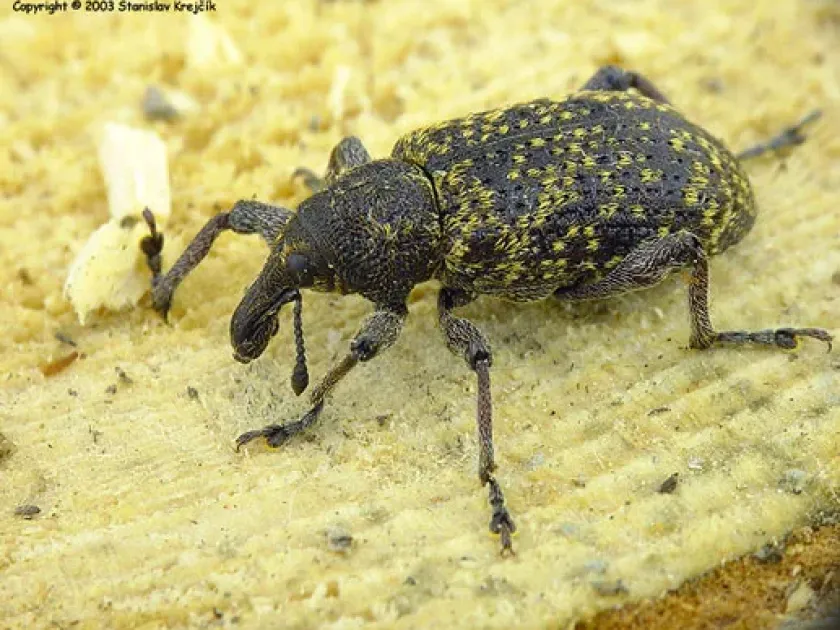
The large pine weevil is a significant forest pest belonging to the Curculionidae family. The adult beetle is relatively large, measuring between 12 and 16 millimeters, with a dark brown to black coloration.
The elytra of the beetle are covered with fine punctures and yellowish scales, which often form irregular cross-bands. A distinct feature is its elongated snout, or rostrum, which is characteristic of the weevil family.
The larvae are legless, C-shaped grubs with a pale white body and a brownish head. They live concealed beneath the bark or within the woody tissues of the host tree, making them hard to spot.
Adults are nocturnal and primarily active during the night. During the day, they hide in the leaf litter, soil crevices, or under the bark of stumps, emerging only when conditions are suitable for feeding.
The life cycle typically spans 2 to 3 years. This extended development period is a critical factor in understanding the persistence of local populations and the timing of necessary control measures.
##damage##The primary hosts of this pest include young conifer saplings, particularly spruce, pine, fir, and larch. It is especially damaging in forest plantations established on recent clear-cut areas where stumps remain.
Adult weevils feed on the bark of young stems and shoots, causing deep, crater-like lesions. These injuries often result in heavy resin flow, which weakens the tree and can lead to its eventual death.
Larval feeding occurs under the bark of root collars and stumps. By consuming the cambium layer, the larvae disrupt the tree's vascular system, preventing the transport of nutrients and water.
Severe infestations in young plantations can lead to high mortality rates, necessitating costly replanting efforts. The damage is most critical during the first few years after the saplings are planted.
Injured trees are also highly susceptible to secondary attacks by other bark beetles and fungal pathogens, such as root rot, which further exacerbates the decline of the stand.
When it appears
Adult emergence from hibernation occurs in early spring, as soon as temperatures rise above 10 degrees Celsius. This marks the beginning of the initial spring feeding phase.
The mating and egg-laying period typically takes place between late spring and early summer. Females seek out fresh stumps or stressed trees to lay their eggs under the bark.
Throughout the summer months, the larvae develop within the bark tissues, growing through several instars. Feeding activity remains intense until the larvae reach maturity.
Pupation usually occurs in the late summer or autumn within specialized chambers created under the bark or in the superficial soil layer near the host.
Winter survival is achieved by both adults and larvae. They hibernate in the soil, leaf litter, or deep within the bark of stumps, remaining dormant until the return of warmer spring weather.
Signs of infestation
Visible signs of an infestation include small, irregular feeding craters on the stems of young saplings, often accompanied by crystallized resin droplets leaking from the wounds.
The presence of fine wood dust or frass around the base of the tree is a clear indicator of larval boring activity occurring just beneath the outer bark layer.
Wilting of the terminal shoot or lateral branches is a common symptom of severe vascular damage, which often precedes the total death of the affected young tree.
Searching at the base of young conifers during the night with a flashlight can reveal the presence of adult weevils, allowing for an accurate assessment of population density.
Fresh stumps on a plantation site are the most reliable indicator of potential infestation risk, as they serve as the primary breeding grounds for the insect population.
Control measures
The most effective strategy is the removal or chemical treatment of stumps immediately after harvest to eliminate the primary breeding sites of the pest.
Using pheromone-based traps and log traps helps monitor adult populations and provides an opportunity to reduce the number of beetles before they migrate to new plantings.
Treating seedlings with authorized systemic insecticides before planting creates a protective barrier that shields the young trees during their most vulnerable growth stages.
Biological control agents, including entomopathogenic fungi and nematodes, can be applied to the soil to target larvae, offering a more environmentally friendly approach to management.
- Timely site sanitation and debris removal;
- Planting of robust, high-vigor seedlings;
- Regular monitoring of plantation health during the spring months.
Taxonomy
- Latin name
- Hylobius piceus
- Order
- Coleoptera (beetles)
- Family
- Curculionidae
- EPPO code
- HYLOPC
Discussion
No discussions yet — be the first.