
Pales weevil
Hylobius pales
Description
How to identify
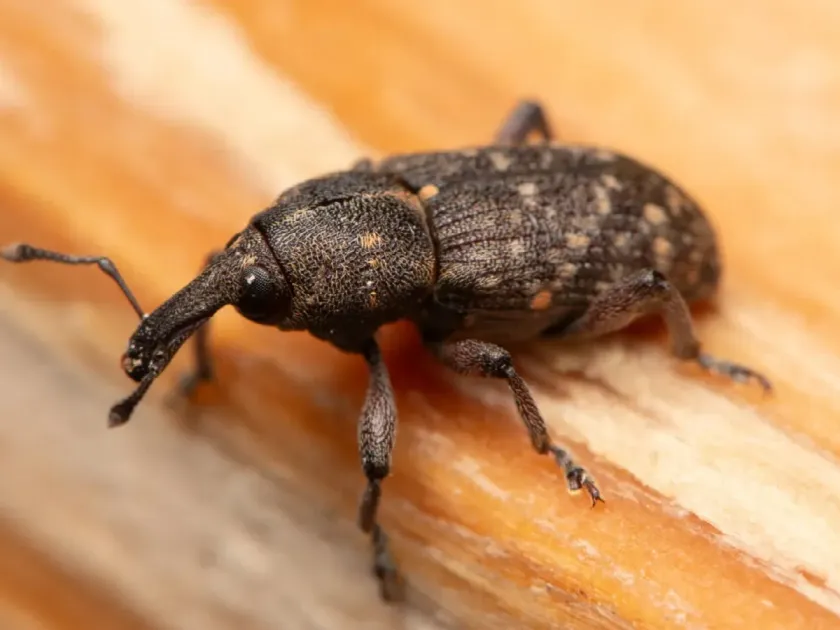
The Pales weevil (Hylobius pales) is a member of the Curculionidae family, which is one of the most destructive pests affecting coniferous forests and nurseries. The adult beetle is dark brown to black, measuring 7-10 mm in length, with small yellow or white scales scattered on its elytra.
The adult is characterized by a prominent snout (rostrum), which is a key identification feature for this species. The larvae are creamy-white, legless, and possess a distinct brown head capsule, typically reaching about 12-15 mm in length during their development.
These insects are highly adaptable to coniferous environments, preferring areas with abundant woody debris. They are strong fliers, which enables them to colonize new clear-cut areas and nursery sites quickly after the initial plantation has been established.
The life cycle of the Pales weevil is intricately linked to the availability of fresh stumps, where they primarily breed. However, in the absence of stumps, they pose a significant threat to young, healthy seedlings that have been recently planted.
Identifying the presence of adults can be challenging due to their nocturnal habits and tendency to remain hidden in the soil or leaf litter during the daylight hours, making them difficult to detect during routine visual field inspections.
What it damages
Pales weevil larvae and adults attack various coniferous species, including pine, spruce, fir, and larch. Young seedlings under five years of age are particularly susceptible to their feeding activities, which often prove fatal.
Adult beetles feed on the tender bark of young seedlings, creating irregular pits and wounds. This feeding causes the girdling of the stems, preventing nutrient transport from the foliage to the roots, leading to the rapid wilting and death of the plant.
Larvae develop beneath the bark of roots and root collars of stumps or stressed trees. When populations are high, they may move to the roots of healthy seedlings, consuming the cambium and phloem layers, which destroys the root system's integrity.
The economic impact of Pales weevil infestation is substantial in forestry operations, as it frequently causes widespread mortality in new plantations, necessitating expensive replanting efforts and significant logistical challenges.
Trees that survive the feeding damage are often severely weakened, exhibiting reduced growth rates and increased susceptibility to secondary infections by pathogens, such as root rot fungi.
When it appears
The seasonal activity of the Pales weevil commences in early spring as temperatures rise, signaling the emergence of overwintering adults from the soil and litter layers. This period marks the start of the feeding and mating phase.
Peak feeding activity usually occurs during the spring and early summer months. During this time, the weevils are most active in their migration toward suitable host trees, where they feed intensively to build energy reserves for reproduction.
Egg-laying typically takes place from spring through mid-summer, with females depositing eggs into the crevices of the bark in the root collar area of fresh stumps or dying trees.
The larval development stage spans throughout the summer, with some larvae remaining in the wood until the following spring. Overwintering occurs primarily in the adult stage within the soil, though some larvae may also overwinter in stumps.
Depending on the climatic zone, the generation time for the Pales weevil is typically one year, although unfavorable weather conditions can lead to a two-year cycle, complicating the implementation of long-term control measures.
Signs of infestation
The most diagnostic sign of a Pales weevil infestation is the presence of small, irregular feeding pits on the stems of young seedlings. These wounds often exude sticky resin as the tree attempts to seal the damage.
Discoloration of needles, progressing from a pale green to yellow and finally brown, indicates that the tree's vascular system has been compromised. Stunted growth and general flagging of the crown are also common indicators.
Inspecting the base of dead or dying seedlings often reveals characteristic feeding galleries under the bark, filled with wood shavings or "frass," which is a clear indication of past or present larval activity.
Sudden seedling mortality in new forest plantations located near recent clear-cut sites is a strong circumstantial indicator that Pales weevils are the primary cause of the decline.
In addition to visual signs on trees, using pitfall traps or bait logs placed in the plantation area can provide quantitative evidence of the adult population density in the immediate vicinity.
Control measures
Integrated pest management strategies are crucial for mitigating Pales weevil damage. Control programs should combine silvicultural adjustments with well-timed chemical interventions to achieve maximum efficacy.
The most effective silvicultural control is to delay planting for at least one to two years after a harvest, allowing the stumps to become unsuitable for larval development, thereby reducing the local population pressure.
Chemical control involves the application of insecticides to the stem and base of young seedlings. This is often done as a preventative treatment before or immediately after planting in high-risk areas.
Effective monitoring using pheromone or host-attractant traps is essential to determine the timing of peak adult emergence, which allows for the precise application of protective sprays.
- Removal of stumps during site preparation.
- Use of systemic insecticides as a pre-planting dip for seedlings.
- Promoting the growth of natural predators in the forest ecosystem.
- Monitoring clear-cut boundaries for initial signs of weevil migration.
Taxonomy
- Latin name
- Hylobius pales
- Order
- Coleoptera (beetles)
- Family
- Curculionidae
- EPPO code
- HYLOPA
Discussion
No discussions yet — be the first.