
Large pine weevil
Hylobius assimilis
Description
How to identify
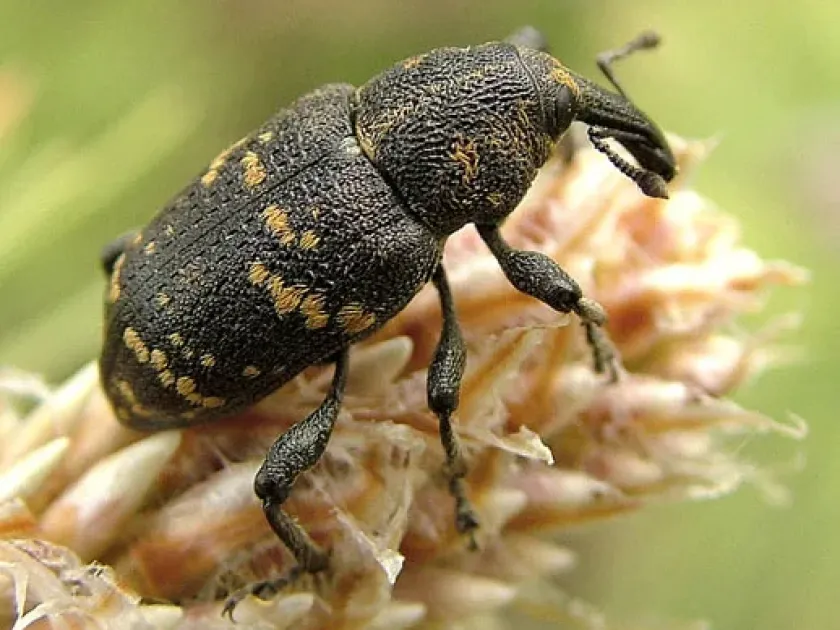
The Large pine weevil (Hylobius assimilis) is a destructive insect belonging to the Curculionidae family. Adult beetles typically measure between 10 and 15 mm in length and possess a dark brown to black coloration.
A distinctive morphological feature is the presence of small, light-colored scales on the elytra, which form clear transverse bands. Their robust rostrum allows them to penetrate the bark of young coniferous trees effectively.
The larvae, which develop within the subcortical layers, are white, legless, and curved, with a prominent brown head capsule. They feed exclusively on the inner bark and cambium layer of their host plants.
Adult beetles are primarily nocturnal, spending daylight hours hiding within forest litter or deep inside cracks in tree stumps, which makes direct observation during the day difficult.
The lifecycle of this species is complex and highly dependent on environmental conditions, often requiring one to two years to complete a full generation, depending on the latitude and climate.
What it damages
The most significant damage is caused to young conifer seedlings, particularly pine and spruce. Adult weevils feed on the bark of stems, often causing girdling at the root collar.
This girdling effect cuts off the tree's nutrient supply, leading to rapid yellowing, wilting, and eventually the death of the sapling. In nurseries, this can result in total plantation failure.
In addition to physical destruction, the feeding wounds provide entry points for secondary pathogens and fungal spores, which can lead to tree diseases or rot, further compromising the plant.
The economic impact is particularly severe in newly reforested areas located near older harvesting sites, where weevil populations tend to thrive in the residual logging debris.
While mature trees can usually withstand minor feeding, young saplings up to five years of age are extremely vulnerable and require constant monitoring to prevent mass infestation.
When it appears
Adult weevils emerge from hibernation in early spring as soon as ground temperatures reach approximately 10-12 degrees Celsius. The spring flight period is a critical time for monitoring.
During the summer months, beetles remain active and engage in feeding and mating. Females seek out suitable substrates such as dying trees, logs, or stumps for oviposition.
Larval development occurs throughout the summer and autumn. The larvae remain active under the bark, consuming the soft tissues and effectively completing their growth cycle.
The emergence of the new generation of adults typically occurs in late summer or early autumn. These beetles then feed heavily to build up energy reserves before entering their overwintering stage.
Temperature fluctuations directly influence the activity levels of the pest, with warmer and more humid conditions promoting higher survival rates and faster population growth.
Control measures
The primary control strategy involves intensive silvicultural management, specifically the prompt removal of stumps and logging residues that serve as breeding grounds for the weevil.
In forest nurseries, preventive chemical treatments using insecticides are often necessary to protect young seedlings during the high-risk period of adult weevil emergence.
Monitoring programs using pheromone-baited traps or log-trap systems are essential for assessing population densities and determining the exact timing for control interventions.
Strategic planning of reforestation efforts, such as waiting for several years after harvesting before replanting, can significantly reduce the risk of localized weevil outbreaks.
- Removal of logging debris and tree stumps.
- Application of approved insecticides in nurseries.
- Use of trap logs to collect and destroy adult beetles.
- Monitoring pest density through pheromone traps.
Taxonomy
- Latin name
- Hylobius assimilis
- Order
- Coleoptera (beetles)
- Family
- Curculionidae
- EPPO code
- HYLORH
Discussion
No discussions yet — be the first.